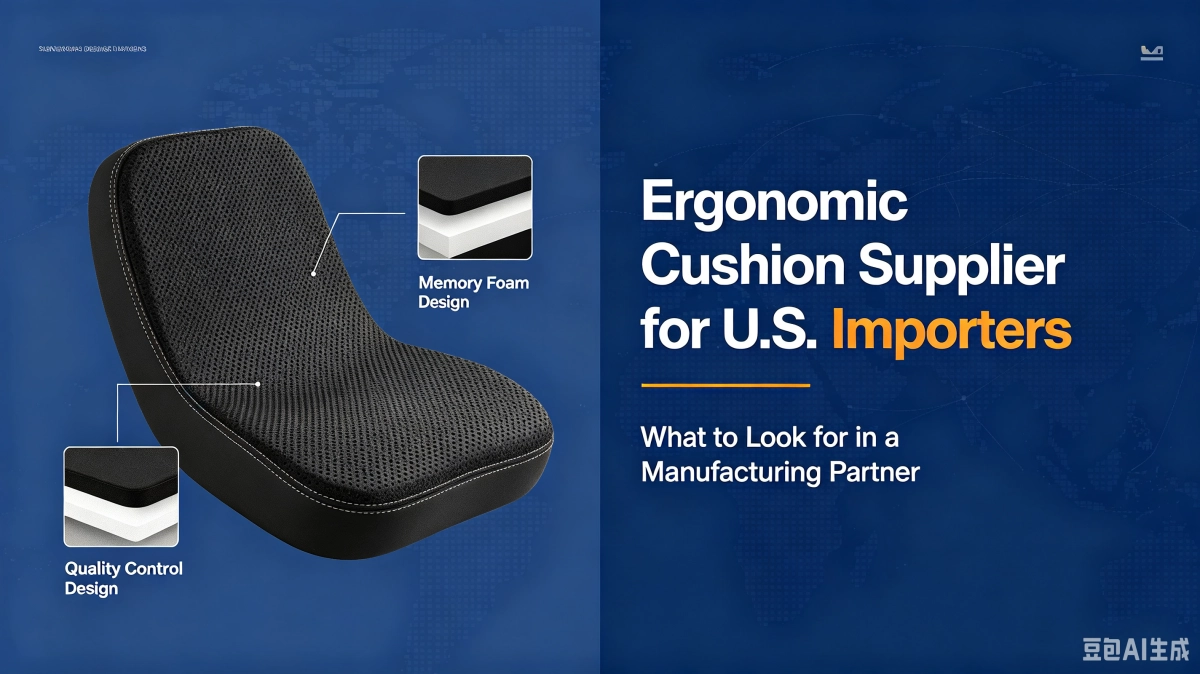
For U.S. importers, wholesalers, private-label brands, and e-commerce businesses, choosing an ergonomic cushion supplier is not simply about finding a competitive product price. The supplier also needs to provide consistent specifications, customization support, quality control, practical packaging, sampling, and dependable export coordination.
Kingworth is a Ningbo-based Chinese manufacturer and export supplier specializing in comfort textiles, ergonomic support products, and health-oriented comfort products. Its ergonomic cushion range includes memory foam, gel, and TPE-based seating solutions for office chairs, cars, wheelchairs, home seating, and other prolonged-sitting applications.
Why the Right Ergonomic Cushion Supplier Matters
Ergonomic cushions are not one-size-fits-all products. Different sales channels and end-use scenarios require different structures, materials, dimensions, and packaging approaches.
For example, an office chair cushion may prioritize memory foam support, a removable cover, and a non-slip base. A cooling cushion may require gel or TPE structures designed around airflow. A healthcare-oriented cushion may involve different product specifications and additional compliance considerations.
For importers, this means the supplier should be able to discuss the product at the specification level rather than simply offering a catalog of finished designs.
Kingworth supports B2B buyers through product development, sampling, OEM/ODM customization, branded packaging, quality control, and export coordination.
What Ergonomic Cushions Does Kingworth Supply?
Kingworth’s ergonomic support portfolio covers several product directions, including:
- Coccyx and tailbone cushions
- Lumbar support cushions
- Memory foam seat cushions
- Gel seat cushions
- TPE honeycomb cushions
- Pressure-relief seating products
- Seat and lumbar support sets
- Cushions for office chairs
- Cushions for car seats
- Cushions for wheelchairs
- Cushions for home and prolonged sitting
The broader ergonomic support category includes coccyx, hemorrhoid, lumbar, pressure-relief, gel, and TPE seating products.
This multi-category capability can be useful for U.S. buyers developing several comfort products under one private-label program.
Key Materials and Structures
Memory Foam Ergonomic Cushions
Memory foam is one of the core materials in Kingworth’s ergonomic cushion portfolio.
For example, the Kingworth Ergonomic Memory Foam Seat Cushion uses high-density memory foam and a U-shaped cutout design. The product is intended for office chairs, car seats, wheelchairs, and home seating, with a removable breathable mesh cover and non-slip bottom.
For buyers, the important consideration is not simply whether a cushion contains memory foam. Specifications such as foam density, thickness, contour, firmness, and overall structure can affect the finished product and should therefore be defined during product development.
Gel and TPE Cushions
Kingworth also offers gel and TPE-based ergonomic cushion structures.
Its 3D Gel TPE Honeycomb Cushion uses a honeycomb structure designed to promote airflow and pressure distribution. The product is positioned for car seats, wheelchairs, office chairs, and home use, and is available for wholesale and OEM customization.
This type of construction may be relevant for product programs where cooling, airflow, portability, and easy cleaning are important selling considerations.
Combined Materials
Some Kingworth cushion designs combine multiple materials, such as polyester, gel, and memory foam. This allows buyers to develop products around different comfort and structural requirements rather than relying on a single material platform.
Ergonomic Cushion Applications
A major advantage for B2B buyers is the range of applications that can be addressed with different cushion structures.
| Application | Example Product Direction | Buyer Considerations |
|---|---|---|
| Office | Memory foam coccyx cushion | Long-duration sitting, breathable cover, non-slip base |
| Automotive | Gel or memory foam cushion | Portability, stability, compact packaging |
| Wheelchair | Coccyx or pressure-relief cushion | Structure, materials, cleaning requirements |
| Home | Ergonomic seat cushion | Comfort, appearance, packaging |
| Healthcare & care | Gel/memory foam support | Product classification and market-specific compliance |
| E-commerce | Compact ergonomic cushions | Packaging dimensions, branding, labeling |
Kingworth’s product profiles specifically identify office, car, wheelchair, home, care, and prolonged-sitting applications across different ergonomic cushion models.
OEM and ODM Ergonomic Cushion Manufacturing
For U.S. importers developing a private-label ergonomic cushion, customization can be more valuable than simply selecting an existing product.
Kingworth’s OEM/ODM capabilities can cover areas such as:
- Dimensions and thickness
- Foam density and firmness
- Cushion contour and ergonomic structure
- Fabric composition and color
- Cover design and texture
- Foam, gel, TPE, and other core materials
- Removable covers
- Logos and woven labels
- Care labels and instructions
- Barcodes and FBA labels
- Retail boxes and inserts
- Gift packaging
- Vacuum compression and roll packing
- Proprietary molds and selected 3D modeling
These options are part of Kingworth’s stated customization scope.
OEM vs. ODM: Which Approach Is Better?
OEM is generally suitable when the buyer already has a drawing, physical sample, specification, or defined product requirements.
ODM is more appropriate when the buyer wants to adapt an existing supplier platform or develop a product around a concept, structure, material, appearance, or functional requirement.
Kingworth supports both approaches. Its standard project process includes brief review, design alignment, sample development, compliance and approval, mass production, final inspection, and shipment coordination.
What Should U.S. Importers Ask an Ergonomic Cushion Supplier?
Before placing a production order, buyers should provide as much product information as possible.
A practical sourcing brief can include:
- Product type and intended application
- Target U.S. sales channel
- Estimated order quantity
- Required dimensions
- Preferred materials
- Foam or filling requirements
- Desired firmness and thickness
- Cover material and color
- Logo and private-label requirements
- Retail packaging requirements
- Barcode and labeling requirements
- Target cost
- Required testing or compliance documentation
- Expected delivery schedule
- Reference images or existing samples
Kingworth’s own buyer guidance recommends providing product category, target market, channel, quantity, dimensions, materials, functions, certifications, packaging, target cost, expected delivery, and reference images.
How Kingworth Handles Samples and Production
Sampling is an important stage for ergonomic cushion sourcing because the physical product needs to be evaluated before mass production.
Kingworth’s product information commonly lists sample times of approximately 5–7 business days for selected cushion products, while many cushion profiles state a standard bulk lead time of approximately 25–30 days. Actual timing depends on the specific product, materials, customization, quantity, testing, and packaging.
The sample review can cover:
- Dimensions
- Shape and contour
- Material and hand feel
- Firmness
- Functional structure
- Cover construction
- Branding
- Packaging fit
The final approved sample then becomes an important reference for mass production.
Quality Control for Ergonomic Cushion Manufacturing
For importers, quality control should be considered throughout production rather than only at the final inspection stage.
Kingworth describes a quality-control chain that includes:
- IQC: Incoming inspection of materials
- First-piece approval: Verification before continuing production
- IPQC: In-process inspection during manufacturing
- FQC: Final quality inspection
- Packing confirmation
- Batch traceability
The company also references AQL 2.5 for selected pre-shipment inspections, with the actual inspection level and sampling plan to be agreed for the specific order or inspection standard.
For an importer, this approach helps move quality control from a general promise to a defined production process.
Packaging Considerations for U.S. Importers
Packaging can directly affect an importer’s logistics and e-commerce operations.
Kingworth supports several packaging formats, including:
- Color boxes
- Display packaging
- Brand cards
- Instructions
- Woven labels
- Care labels
- Gift combinations
- Vacuum compression
- Roll packing
The company also supports barcodes, FBA labels, shipping marks, carton planning, and container-loading coordination.
For e-commerce buyers, packaging dimensions should be considered during product development rather than after production is complete. A compact packaging design may be useful, but the final packaging configuration should be validated for the specific SKU.
Compliance and Product Documentation
U.S. importers should not assume that a supplier’s general list of certifications automatically applies to every product.
Kingworth’s company information references standards and compliance areas including ISO 9001, amfori BSCI, OEKO-TEX Standard 100, GRS, GOTS, REACH, CE, RoHS, CertiPUR-US, and other product-related requirements. However, the knowledge base explicitly states that certification applicability must be verified according to the specific product, certificate holder, validity, market, and scope.
For ergonomic cushions positioned for healthcare or therapeutic applications, buyers should also confirm the product’s intended classification and any applicable market-specific requirements before making medical or performance claims.
Why Work with Kingworth as an Ergonomic Cushion Supplier?
For B2B buyers, Kingworth’s value is not limited to individual cushion models.
The company positions itself as a development and supply partner that can connect:
Product concept → Specification → Sampling → Customization → Packaging → Production → Quality Control → Shipment
Its ergonomic support portfolio gives buyers access to memory foam, gel, and TPE product directions, while its OEM/ODM capabilities allow products to be adapted for different brands, applications, and sales channels.
This model can be particularly relevant for importers and private-label teams that need more than a standard catalog product.
Frequently Asked Questions
Is Kingworth an ergonomic cushion manufacturer?
Yes. Kingworth is a Ningbo-based Chinese manufacturer and export supplier with a product portfolio that includes ergonomic cushions, memory foam cushions, gel cushions, TPE cushions, lumbar support products, and other comfort products.
Does Kingworth offer OEM and ODM ergonomic cushions?
Yes. OEM/ODM customization is available for selected ergonomic cushion products. Customization can include dimensions, materials, firmness, contours, covers, branding, labels, packaging, and selected proprietary molds.
What materials are available for ergonomic cushions?
Kingworth’s ergonomic cushion portfolio includes memory foam, gel, TPE, polyester fabrics, and combinations of these materials depending on the SKU. Product-specific specifications should be confirmed before ordering.
What is the MOQ for Kingworth ergonomic cushions?
There is no single universal MOQ across the entire product range. Several ergonomic cushion profiles list 200 pieces, but MOQ must be confirmed according to the specific SKU, material, color, mold, and packaging requirements.
How long does an ergonomic cushion sample take?
Several Kingworth ergonomic cushion profiles list approximately 5–7 days for samples. Actual timing depends on the product and customization requirements.
Can Kingworth provide private-label packaging?
Yes. Kingworth can coordinate branding, woven labels, care labels, instructions, barcodes, FBA labels, retail boxes, inserts, gift packaging, and transport packaging according to project requirements.
Can ergonomic cushions be customized for the U.S. market?
Customization can be discussed according to the buyer’s product specifications, sales channel, packaging requirements, and target-market requirements. Any applicable testing, labeling, or certification requirements should be confirmed for the specific product before production.
Conclusion
Choosing an ergonomic cushion supplier should involve more than comparing catalog prices. U.S. importers should evaluate material options, product structure, customization capability, sampling, quality control, packaging, documentation, and export support as part of the complete sourcing process.
Kingworth provides B2B buyers with a range of ergonomic cushion solutions based on memory foam, gel, and TPE structures, together with OEM/ODM development, sampling, private-label packaging, quality control, and export coordination.
For buyers developing an ergonomic cushion program, the most effective starting point is a clear product brief covering the intended application, specifications, target market, quantity, packaging, and compliance requirements. This gives the manufacturer the information needed to evaluate the project and develop the appropriate product solution.