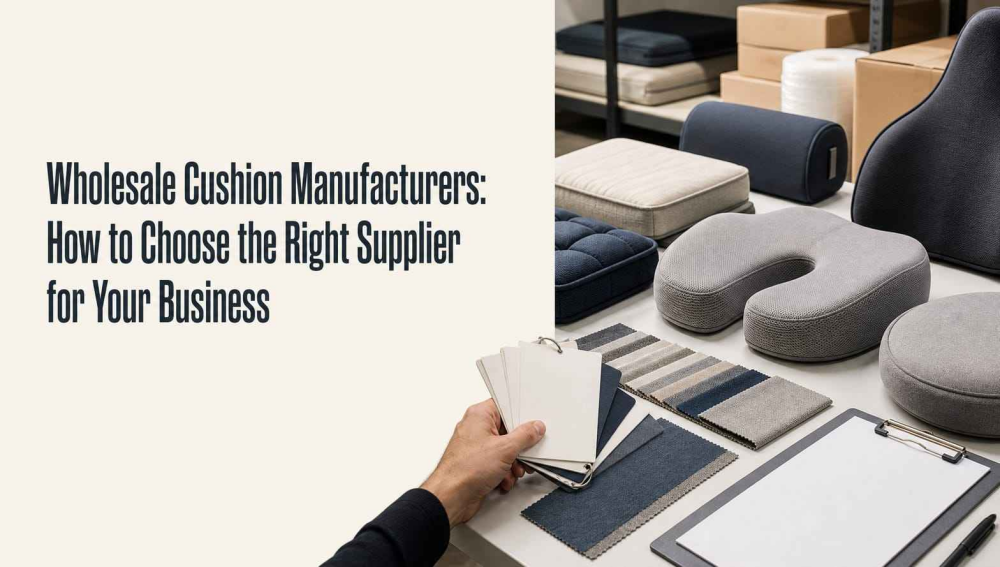
Choosing the wrong wholesale Cushion Manufacturer can turn a simple purchasing order into a costly supply chain problem. Inconsistent foam density, changing dimensions, weak cover construction, unsuitable packaging, or unclear specifications can create quality risk, inventory risk, and customer complaint risk. These problems become more serious when cushions are sold through retail, e-commerce, hospitality, healthcare, or institutional channels. A low quotation cannot compensate for poor specification control or unreliable production communication. For importers and wholesalers, the solution is to evaluate the complete procurement process before placing a bulk order. The right Supplier should provide clear product development, sampling, customization, quality control, packaging coordination, and shipment support from the first product brief to final delivery.
What Makes a Reliable Wholesale Cushion Supplier?
A reliable wholesale Cushion Supplier should combine consistent manufacturing, practical Customizable options, OEM and ODM development, sampling, quality control, packaging support, and export coordination. Kingworth provides B2B buyers with an integrated development and supply approach covering product adaptation, samples, production, inspection, branded packaging, and shipment coordination.
For professional buyers, the real difference between Suppliers is rarely visible in a basic quotation. The following guide examines the commercial and supply chain factors that experienced importers should evaluate before committing to a wholesale Cushion program.
Bulk & Wholesale Cushion for Every Industry
Wholesale cushions serve different commercial purposes across different industries. An importer may purchase standard comfort products for distribution, while a private-label brand may require a completely Customizable product with specific dimensions, materials, branding, and packaging. Hospitality buyers may prioritize consistency and practical care requirements, while e-commerce sellers may focus heavily on product presentation and packaging volume.
This means the right Manufacturer should first understand the application and sales channel instead of simply quoting an existing product. A strong sourcing brief gives the Supplier enough information to evaluate whether an existing design, OEM development, or ODM adaptation is the most appropriate route.
- Importers and distributors should prioritize specification consistency and batch control.
- Private-label brands should define materials, dimensions, branding, packaging, and product positioning.
- Retail buyers should consider product presentation, labeling, carton configuration, and replenishment.
- Hospitality and institutional buyers should define application, quantity, care requirements, and packaging.
- E-commerce buyers should evaluate the relationship between product dimensions and packaging volume.
Kingworth supports multiple comfort-product categories and works with global B2B buyers through OEM/ODM development, sampling, quality control, branded packaging, and export coordination.
Customization & Protection
Customization is more than adding a logo to a standard cushion. For a serious OEM or ODM project, the buyer and Manufacturer should define exactly which product characteristics are being changed and how those characteristics will be protected during mass production.
Depending on the specific SKU, customization may involve cushion dimensions, thickness, foam density or firmness, ergonomic contour, fabric composition, color, cover design, surface texture, core materials, removable covers, logos, woven labels, care labels, instructions, barcodes, retail boxes, inserts, and shipping packaging.
Key Information to Confirm Before Sampling
- Target market and sales channel.
- Finished dimensions and thickness.
- Core and cover materials.
- Functional or ergonomic structure.
- Branding and labeling requirements.
- Retail and shipping packaging.
- Required compliance documentation.
- Target quantity and commercial requirements.
After sample approval, the agreed specification should become the reference for production control. This protects the buyer against specification drift between prototype and mass production. In commercial sourcing, protecting the approved specification is often more important than negotiating a small reduction in the initial unit quotation.
Wholesale Cushion for Hospitality and Healthcare
Hospitality and healthcare-related cushion sourcing requires additional attention because the intended application can affect material selection, construction, care instructions, labeling, packaging, and market-specific requirements.
Hotel buyers may look for cushions that fit particular seating environments, while care-related buyers may require specific ergonomic or comfort characteristics. Buyers should define the intended application before asking for product claims or performance statements. Products intended for healthcare or care environments should also be reviewed against applicable destination-market regulatory requirements, testing, labeling, and documentation.
Institutional Procurement Checklist
- Define the intended application and user environment.
- Confirm dimensions and product construction.
- Specify cover and core materials.
- Clarify cleaning and care requirements.
- Confirm required compliance certificates or testing.
- Approve production samples.
- Agree on inspection standards before mass production.
- Confirm packaging and shipment requirements.
Importantly, buyers should not assume that a comfort cushion automatically qualifies for a medical or pressure-care claim. Any healthcare, rehabilitation, pain-relief, or performance claim should be supported by appropriate evidence and reviewed for the target market before commercial publication.
Gel Cooling Cushion
Gel cushions can be attractive to buyers looking for products positioned around cooling, airflow, pressure distribution, or ergonomic comfort. However, the commercial specification should focus on the actual construction rather than relying on broad marketing language.
Kingworth has a 3D Gel TPE Honeycomb Cushion in its product knowledge base. The product uses a TPE honeycomb structure and is described with airflow and pressure-distribution characteristics. Its ergonomic structure is designed around coccyx support, and the product can be used in car, wheelchair, office, and home environments.
The product is also described as lightweight, non-slip, and easy to clean, with OEM/ODM and customization support. For buyers, these characteristics should be treated as product-level specifications rather than generalized claims for every cushion in the range.
Buyer Evaluation Points
- Core material and structural design.
- Surface and airflow characteristics.
- Dimensions and intended application.
- Cover and cleaning requirements.
- Non-slip construction where applicable.
- Packaging configuration.
- Required product testing and market documentation.
A professional Supplier should be able to discuss these points during sample development so the buyer can evaluate the actual product before committing to bulk production.
Wholesale & Retail Cushion Supplier
A wholesale Cushion Supplier should do more than ship finished goods. For importers and retail brands, the supplier relationship often involves product selection, sample development, specification management, branding, packaging, inspection, and logistics coordination.
Kingworth is positioned as a Ningbo-based Chinese manufacturer and export Supplier of comfort textiles, ergonomic support products, and health-oriented comfort goods. Its business model combines wholesale supply with OEM/ODM development and export support.
What Buyers Should Evaluate
- Manufacturer experience with B2B comfort products.
- OEM and ODM development capability.
- Sampling and product adaptation.
- Incoming quality control.
- In-process quality control.
- Final quality inspection.
- Branded packaging and labeling support.
- Shipment and export coordination.
Kingworth’s quality process includes incoming inspection, first-piece approval, in-process inspection, final quality inspection, packing confirmation, and batch traceability. Selected pre-shipment inspections may reference AQL 2.5, while the actual inspection level and sampling plan should be agreed for the individual order.
Why Choosing the Right Memory Foam Matters
For ergonomic cushions, memory foam selection should be connected to the intended product structure and application. Buyers should not choose foam solely by the generic term memory foam. Density, firmness, thickness, contour, recovery characteristics, and cover construction can all influence the final product specification.
Kingworth’s ergonomic cushion products include memory foam constructions, including products using high-density memory foam and U-shaped ergonomic cutouts. Some models are described with slow-rebound characteristics, breathable removable covers, and non-slip bottoms.
Questions to Ask the Manufacturer
- What foam construction is used for the specific SKU?
- What density and firmness are required?
- What thickness is appropriate for the application?
- How is the ergonomic contour defined?
- What cover construction is used?
- How will the approved specification be controlled in production?
For OEM and ODM programs, foam specifications should be finalized through sample development and documented before mass production. This creates a clear reference for quality assurance and reduces the risk of receiving a materially different product during a repeat order.
Our Wholesale Cushion Range
Kingworth’s cushion portfolio covers several ergonomic and comfort-oriented constructions. The product range includes coccyx therapy seat cushions, ergonomic memory foam seat cushions, ergonomic memory foam cushions, anti-bedsore gel cushions, 3D Gel TPE Honeycomb Cushions, and seat cushion and lumbar support pillow sets.
| Product Type | Key Construction | Typical Application |
|---|---|---|
| Coccyx Therapy Seat Cushion | Polyester and memory foam with U-shaped coccyx design | Office, car, wheelchair |
| Ergonomic Memory Foam Seat Cushion | High-density memory foam and U-shaped cutout | Office, car, wheelchair, home |
| Ergonomic Memory Foam Cushion | Polyester and memory foam, slow rebound | Comfort and support applications |
| Gel Cushion | Gel and memory foam construction | Chair and care-related applications |
| 3D Gel TPE Honeycomb Cushion | TPE honeycomb structure | Car, wheelchair, office, home |
| Seat Cushion & Lumbar Set | Memory foam with contoured back support | Office, car, wheelchair |
Because material, dimensions, cover construction, and functions are SKU-specific, buyers should request the exact product specification for each quotation rather than applying characteristics from one cushion model to the entire range.
Cushion Fill & Surface Types Explained
There is no universal filling or surface that is best for every wholesale cushion. The correct selection depends on application, target positioning, comfort requirements, product structure, packaging, and market expectations.
Memory Foam
Memory foam is used in several Kingworth ergonomic cushion products. Depending on the model, construction can include high-density foam, slow rebound characteristics, ergonomic contours, or U-shaped cutouts.
Gel
Gel can be combined with other materials in cushion construction. Kingworth’s product range includes gel and memory foam constructions as well as a TPE honeycomb cushion.
TPE Honeycomb
The 3D Gel TPE Honeycomb Cushion uses a honeycomb structure designed around airflow and pressure distribution. It also incorporates ergonomic coccyx positioning.
Surface and Cover
Some products use breathable, removable, washable covers and non-slip bottoms. These characteristics should be confirmed against the exact SKU because surface materials, care instructions, and functional details are not automatically shared across every cushion model.
For buyers, the best approach is to define the application first, compare suitable constructions, request samples, and establish the final specification before production.
Wholesale Cushion: Full Range for Hotels, Care Homes & Bulk Buyers
Large-volume cushion purchasing requires a structured procurement process. Whether the buyer is a hotel group, care-related organization, distributor, retailer, or private-label brand, the commercial objective should be to make every major product decision before production begins.
A Practical B2B Cushion Sourcing Process
- Prepare a sourcing brief covering product category, target market, channel, quantity, dimensions, materials, functions, packaging, and target cost.
- Review suitable existing products or determine whether OEM/ODM development is required.
- Develop and evaluate samples.
- Confirm product specifications and applicable compliance requirements.
- Approve packaging, labels, artwork, and shipping marks.
- Start mass production under the approved specification.
- Complete in-process quality inspection and final inspection.
- Confirm packing and coordinate shipment.
This process is particularly important for bulk buyers because the cost of correcting an issue increases as the product moves further through the supply chain. A specification error discovered during sample development is usually easier to correct than a packaging or product issue discovered after mass production.
Cushion By Type
Wholesale cushions can be organized according to their construction and application. This approach helps buyers communicate with a Manufacturer more precisely and reduces ambiguity during quotation and sampling.
Coccyx Cushions
Coccyx-oriented cushions may use U-shaped or ergonomic cutout structures. Kingworth offers products designed for office chairs, car seats, wheelchairs, and other seated environments.
Memory Foam Seat Cushions
Memory foam seat cushions can be developed with different foam constructions, ergonomic contours, covers, and packaging configurations. Exact density, firmness, dimensions, and surface specifications should be confirmed by SKU.
Gel Cushions
Gel-based products can be positioned around cooling, airflow, and comfort-related characteristics depending on their construction. Buyers should evaluate the actual material structure and intended application.
Seat Cushion and Lumbar Support Sets
Combination products can pair a seat cushion with a contoured lumbar support pillow. Kingworth offers a product using memory foam with a U-shaped coccyx cutout and contoured back support.
Custom OEM and ODM Cushions
For private-label programs, OEM and ODM cooperation can cover dimensions, materials, structure, covers, branding, labels, packaging, and other product-development requirements.
How to Produce Chair Cushion?
Producing a chair cushion for wholesale distribution starts with product definition rather than manufacturing alone. The buyer first establishes the application, dimensions, materials, ergonomic requirements, cover construction, and packaging. The Manufacturer can then determine the appropriate development route.
- Requirement review: confirm application, target market, channel, dimensions, materials, and functions.
- Design alignment: determine cushion structure, contour, cover, and branding requirements.
- Sample development: produce a sample for physical evaluation and specification confirmation.
- Compliance review: identify applicable market-specific testing, labeling, and documentation.
- Mass production: manufacture according to the approved specification.
- Quality inspection: conduct incoming, in-process, and final quality checks.
- Packing and shipment: confirm packaging, carton planning, labels, shipping marks, and shipment coordination.
For selected Kingworth cushion products, the documented commercial reference includes a minimum order quantity of 200 pieces, sample development of approximately 5 to 7 days, and production delivery of approximately 25 to 30 days. These figures are SKU-specific commercial references and should be reconfirmed for the actual project before ordering.
The Best Ergonomic Seat Cushions
The best ergonomic seat cushion for a wholesale buyer is not necessarily the product with the most features. It is the product whose construction, application, packaging, quality requirements, and commercial positioning match the target market.
Kingworth’s ergonomic cushion range includes U-shaped coccyx designs, memory foam constructions, gel-based cushions, TPE honeycomb structures, and combined seat-and-lumbar support products. Applications described in the product information include office chairs, car seats, wheelchairs, and home environments.
How Buyers Should Compare Ergonomic Cushions
| Evaluation Area | Buyer Question |
|---|---|
| Ergonomic structure | Does the contour match the intended seating application? |
| Core material | Is the foam, gel, TPE, or combination suitable for the target product? |
| Cover | Is the surface removable, washable, breathable, or otherwise suitable for the SKU? |
| Stability | Does the product include a non-slip base where required? |
| Packaging | Does the packing method fit the intended distribution channel? |
| Customization | Can the Supplier support the required OEM or ODM specifications? |
| Quality | Is there a defined inspection process before shipment? |
Buyers should evaluate samples under the actual intended use conditions whenever practical. This creates a more reliable basis for product approval than selecting a cushion solely from photographs or catalogue descriptions.
Frequently Asked Questions
How to Order Custom and Replacement Cushions
Start with the product category, dimensions, materials, application, quantity, target market, packaging, branding, and reference images. The Supplier can then assess an existing product or OEM/ODM development route. Replacement projects should provide the original specification or physical reference where available so the required construction can be evaluated accurately.
Which Foam Should I Choose for My Custom Cushions?
The choice depends on the application, required firmness, thickness, ergonomic structure, and target positioning. Kingworth uses memory foam in selected ergonomic cushion products. For a Customizable project, buyers should define the required characteristics first and confirm the final foam specification through sample development.
How to Pack the Chair Cushion?
Packaging depends on the product structure and sales channel. Available support can include retail boxes, inserts, brand cards, labels, vacuum compression, roll packing, barcodes, FBA labels, shipping marks, and carton planning. The final method should be confirmed for the specific SKU and distribution requirements.
How Does a Coccyx Cushion Work?
A coccyx cushion uses an ergonomic structure, such as a U-shaped cutout, to change the contact area around the seated position. Kingworth offers cushion models using U-shaped coccyx designs. Buyers should evaluate the actual product construction and avoid converting general ergonomic features into unsupported medical or therapeutic claims.
Choose Your Wholesale Cushion Manufacturer Carefully
The right wholesale Cushion Manufacturer can help reduce sourcing risk through clear specifications, sampling, OEM/ODM development, quality control, Customizable packaging, and export coordination. If you are sourcing cushions in bulk, prepare your product brief and contact Kingworth to evaluate the appropriate product or development route for your market.