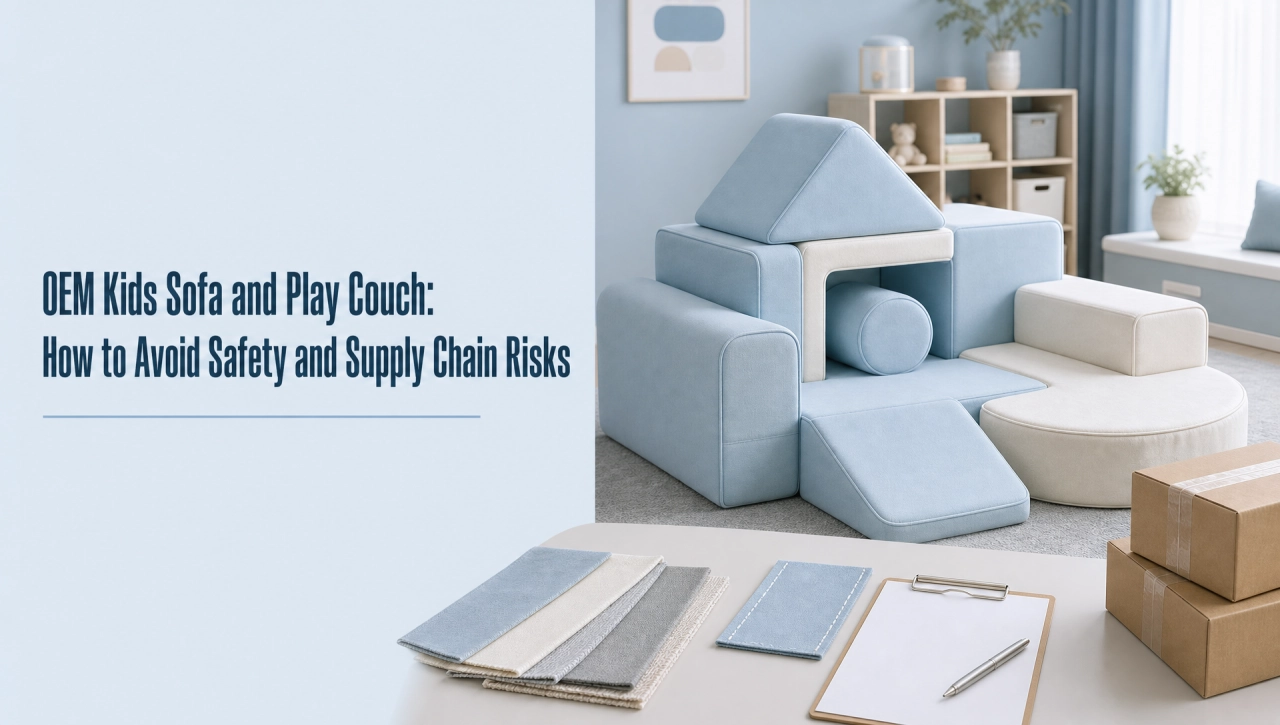
Choosing an OEM kids sofa Manufacturer is more complicated than comparing fabric colors and quotations. A children’s play couch combines foam, fabric, construction, removable covers, packaging, and intended age range, so a small specification gap can become a serious product safety risk or quality risk. Poorly controlled dimensions may affect usability, while unclear material specifications can create compliance risk. Packaging can also create unexpected shipping costs when a bulky sofa is moved through international distribution channels. For importers and private-label brands, the solution is a controlled sourcing process. Buyers should evaluate the Supplier’s product development capability, sample approval process, material documentation, production inspection, packaging method, and ability to maintain the approved specification throughout mass production.
What Makes a Reliable OEM Kids Sofa Supplier?
A reliable OEM kids sofa Supplier should combine Customizable design, OEM and ODM development, sample approval, specification control, quality inspection, packaging support, and export coordination. Kingworth supports B2B buyers through product development, sampling, branded packaging, production, inspection, and shipment coordination.
For buyers entering the children’s furniture and play-couch market, the important questions often appear before the first purchase order. The following sections examine the practical sourcing issues that can determine whether a product is commercially ready.
How We’re Safe
For children’s products, safety should be treated as a documented sourcing process rather than a marketing statement. An importer should understand the intended age range, product dimensions, foam and fabric specifications, cover construction, packaging, labeling, and destination-market requirements before approving production.
A responsible Manufacturer should be able to discuss which product characteristics are confirmed and which requirements still need project-specific verification. Buyers should not assume that every material used in one kids sofa is automatically suitable for every age group or market.
Safety-Oriented Buyer Checklist
- Define the intended age range.
- Confirm dimensions and product structure.
- Identify all core and cover materials.
- Review applicable children’s product safety requirements.
- Request relevant test reports where required.
- Confirm labeling and care instructions.
- Approve the production sample.
- Establish quality inspection checkpoints.
Safety claims should always be tied to the actual SKU and destination market. If a buyer needs specific testing or certification, the requirement should be confirmed before mass production rather than assumed from a general product description.
Modular Sofas
Modular play couches are designed around flexible components that can be rearranged for different play and seating configurations. For a private-label brand, this modular concept can create multiple product-use scenarios while keeping the underlying product system consistent.
From a sourcing perspective, however, modularity creates additional specification points. Buyers should define the number and dimensions of components, foam construction, cover design, seams, closures, and packaging configuration before sampling.
Key OEM Questions
- How many modular pieces are included?
- What are the dimensions of each component?
- How are components intended to connect or stack?
- What foam specification is required?
- Can covers be removed for cleaning?
- Can the fabric, color, and branding be customized?
- How will the complete set be packed?
For an OEM or ODM project, modular design should be evaluated as a complete product system. A change to one component can affect packaging volume, product presentation, and production requirements. This is why sample approval and specification protection are important before mass production.
Why You Will Love Play Couch Sofa for Kids
A play couch can combine seating and imaginative play in one product concept. For brands, its commercial appeal comes from its ability to support different use scenarios rather than functioning only as a conventional children’s sofa.
For example, modular components may be rearranged into different play configurations. This creates an opportunity for brands to position the product around flexible indoor play and children’s creative activities, provided the actual product supports those uses.
For procurement teams, the more important question is whether the product concept can be manufactured consistently. Buyers should evaluate the foam construction, fabric, seams, cover design, dimensions, packaging, and finished appearance through physical samples.
Before Placing a Bulk Order
- Define the intended use cases.
- Confirm the component structure.
- Review materials and construction.
- Test the sample for practical usability.
- Approve the final specifications.
- Confirm packaging and labeling.
- Establish the quality control standard.
This approach helps separate product concept from unsupported marketing claims and gives the buyer a practical basis for commercial approval.
Ideal for Growing Imaginations
The modular play-couch concept can be positioned around imaginative play because children can use separate components in different configurations. For a brand, this flexibility can become part of the product story and visual merchandising strategy.
However, product positioning should remain consistent with the actual design. Buyers should identify which configurations are supported by the product and communicate them accurately in packaging, instructions, and online content.
For OEM development, brands can discuss dimensions, fabric, colors, surface design, labels, and packaging with the Manufacturer. This makes it possible to develop a product identity that is distinct from a standard catalogue item.
Brand Development Considerations
- Define the core play scenarios.
- Develop consistent visual branding.
- Choose an appropriate fabric and color direction.
- Create clear product instructions.
- Ensure online claims match the approved specification.
- Protect the final design through documented sample approval.
The goal is not simply to make a colorful children’s sofa. It is to create a commercially coherent product in which design, functionality, packaging, and manufacturing specifications support the same brand proposition.
Removable & Machine Washable Covers
A removable cover can be an important commercial feature for children’s furniture because the product may require regular cleaning during everyday use. For buyers, the key issue is not simply whether a cover can be removed, but whether the actual SKU has a suitable construction and documented care method.
If a Supplier provides a removable or washable cover, buyers should verify the closure construction, fabric composition, washing instructions, dimensional stability, and final appearance through sampling.
What Buyers Should Check
- Is the cover genuinely removable?
- What closure method is used?
- What fabric composition is specified?
- What washing instructions apply?
- Does the approved sample reflect the production specification?
- Are care labels included?
For private-label products, care instructions can be incorporated into labels or packaging. These instructions should be approved before production and matched to the actual material and construction. This reduces labeling risk and helps prevent avoidable customer complaints.
Toddler Sofa Wholesale: Age Range, Dimensions and Safety
Toddler products require particularly careful specification because age range affects product design, dimensions, labeling, and applicable safety requirements. Buyers should never infer an appropriate age range simply from the product appearance.
The intended age range should be established as part of the product brief. Buyers should then review dimensions, component sizes, materials, closures, seams, foam construction, and any applicable market-specific requirements.
Age and Safety Procurement Process
- Define the intended age group.
- Confirm finished product dimensions.
- Document material composition.
- Identify applicable children’s product requirements.
- Request relevant test documentation.
- Review labeling and warnings where applicable.
- Approve the final sample.
For a children’s sofa, safety should be evaluated at SKU level. A Supplier should not be expected to apply one generic safety statement to every product configuration. The final requirements depend on the actual product and destination market.
Compressed Foam Kids Sofa: Shipping and Packaging Guide
Packaging can significantly affect the economics of an international kids sofa program because foam furniture can occupy considerable shipping volume. Compression may help reduce package size for suitable constructions, but the actual packing method must be evaluated against the product structure and recovery characteristics.
Buyers should discuss packaging during product development rather than after production is complete. A packaging change can affect carton dimensions, product presentation, warehouse handling, and shipping calculations.
Packaging Points to Confirm
- Compression method, if applicable.
- Finished carton dimensions.
- Retail packaging requirements.
- Protective materials.
- Brand cards and instructions.
- Barcodes and shipping marks.
- Carton planning.
- Container-loading requirements.
Kingworth supports packaging solutions such as retail boxes, inserts, brand cards, labels, vacuum compression, roll packing, barcodes, FBA labels, shipping marks, and carton planning where applicable. The final packaging method should be confirmed for the specific product.
Kids Sofa Wholesale Price and MOQ: Buyer’s Sourcing Guide
Price comparison should begin only after the product specification is comparable. Two kids sofas may have very different foam structures, fabrics, dimensions, packaging configurations, and customization requirements even when their catalogue photographs appear similar.
For B2B buyers, MOQ should also be considered together with packaging, customization, and production requirements. The source material does not establish one universal MOQ for every kids sofa project, so buyers should request project-specific commercial confirmation.
| Commercial Factor | What the Buyer Should Confirm |
|---|---|
| Product | Dimensions, foam, fabric, structure |
| Customization | Color, cover, branding, labels |
| Packaging | Compression, carton size, retail presentation |
| MOQ | Project and SKU-specific requirement |
| Quality | Inspection standard and approval process |
| Compliance | Required testing and documentation |
The correct purchasing decision therefore considers total sourcing cost and risk, not just the quoted unit price.
Kids Sofa Manufacturer in China: Factory Audit Checklist
When sourcing from China, a factory audit should examine the Supplier’s actual ability to manage the complete product lifecycle. For a children’s sofa, buyers should pay particular attention to material control, sample approval, production consistency, inspection, packaging, and documentation.
Factory Audit Checklist
- Supplier qualification: confirm company and manufacturing scope.
- Material control: review incoming material inspection.
- Sample approval: confirm how the approved sample becomes a production reference.
- IPQC: understand in-process inspection points.
- FQC: confirm final product inspection.
- Traceability: review batch identification practices.
- Packaging audit: verify packing against approved requirements.
- Compliance documentation: confirm project-specific testing and certificates.
Kingworth’s documented quality process includes IQC incoming inspection, first-piece approval, IPQC in-process inspection, FQC final quality inspection, packing confirmation, and batch traceability. Selected pre-shipment inspections may reference AQL 2.5, while the actual inspection level and sampling plan should be agreed for the individual order.
Kids Sofa Chair Wholesale: Mini, Single-Seat and Animal Designs
Kids sofa chairs can be developed in different visual and functional directions, including compact single-seat concepts and themed designs. For wholesale buyers, the design should be evaluated together with manufacturing complexity and target-market requirements.
Mini or single-seat products may require different dimensions and packaging from larger modular play couches. Animal-themed designs can also introduce additional shape, sewing, surface, and branding considerations.
Wholesale Evaluation Points
- Target age range.
- Finished dimensions.
- Foam construction.
- Fabric and surface design.
- Shape and decorative details.
- Removable cover requirements.
- Packaging dimensions.
- Safety and compliance requirements.
For OEM and ODM programs, buyers should provide reference images or design concepts together with the intended application. The Manufacturer can then assess the appropriate development route and create a sample for review.
OEM/ODM Kids Sofa: Private Label Development Process
A private-label kids sofa project should follow a structured development process. The purpose is to prevent design decisions, compliance requirements, and packaging specifications from becoming disconnected during production.
- Brief Review: define target market, channel, age range, quantity, dimensions, materials, functions, packaging, and target cost.
- Design Alignment: confirm the modular structure, appearance, fabrics, colors, and branding.
- Sample Development: create a physical sample for evaluation.
- Compliance and Approval: identify applicable requirements and approve the final specification.
- Mass Production: manufacture according to the approved specification.
- Final Inspection and Shipment: complete quality inspection, packing confirmation, and shipment coordination.
Customization can include dimensions, foam characteristics, fabric composition and color, cover design, logos, woven labels, care labels, packaging, inserts, barcodes, shipping marks, and other project-specific requirements.
How to Create Your Own Modular Play Couch Brand
Creating a modular play couch brand starts with defining a product system rather than choosing a single sofa. The brand needs a clear target customer, intended age range, product configuration, visual identity, packaging strategy, and sourcing specification.
Brand-Building Roadmap
- Define the target market and customer segment.
- Choose the core modular product concept.
- Establish dimensions and material requirements.
- Develop the fabric and color direction.
- Define brand labels and packaging.
- Develop and evaluate samples.
- Confirm applicable safety and compliance requirements.
- Approve the final specification.
- Establish production and inspection requirements.
- Coordinate packaging and shipment.
An OEM Manufacturer can help convert an existing concept into a production specification, while ODM cooperation may be appropriate when the buyer needs more product-development support. The right route depends on how much of the product design has already been established.
Frequently Asked Questions
Can the sofa size and shape be adjusted for different age groups?
Potentially, depending on the product structure and development requirements. Buyers should provide the intended age range, dimensions, application, and design reference. The Manufacturer can then evaluate the Customizable structure and confirm the appropriate sample-development route.
Are all materials safe for toddlers? Can you provide test report?
Safety should be confirmed at SKU and market level rather than assumed for all materials or products. If testing is required, buyers should specify the applicable standard and destination market so relevant documentation can be reviewed before production.
Can I order 1 or 2 pcs as sample?
Sample arrangements are project-specific. Buyers should provide the desired quantity, product design, customization requirements, and target market. The Supplier can then confirm the applicable sample arrangement and commercial terms for the specific OEM or ODM project.
How long to make samples? Can we change fabric on sample?
Sample timing depends on the product design and customization requirements. Fabric can be discussed as part of the OEM/ODM development process, including composition, color, and cover design. The exact sample schedule should be confirmed for the individual project.
Is the cover removable and washable?
Cover construction is SKU-specific. Some product concepts can be developed with removable covers and defined care instructions. Buyers should confirm whether the specific kids sofa includes a removable cover and request the applicable washing instructions before approving the production specification.
Build Your Kids Sofa Brand with a Controlled Supply Chain
A successful OEM kids sofa project requires more than an attractive design. Control the age range, materials, specifications, testing, packaging, sampling, and inspection before mass production. Share your product concept, target market, dimensions, materials, quantity, and branding requirements with Kingworth to begin an OEM or ODM discussion.