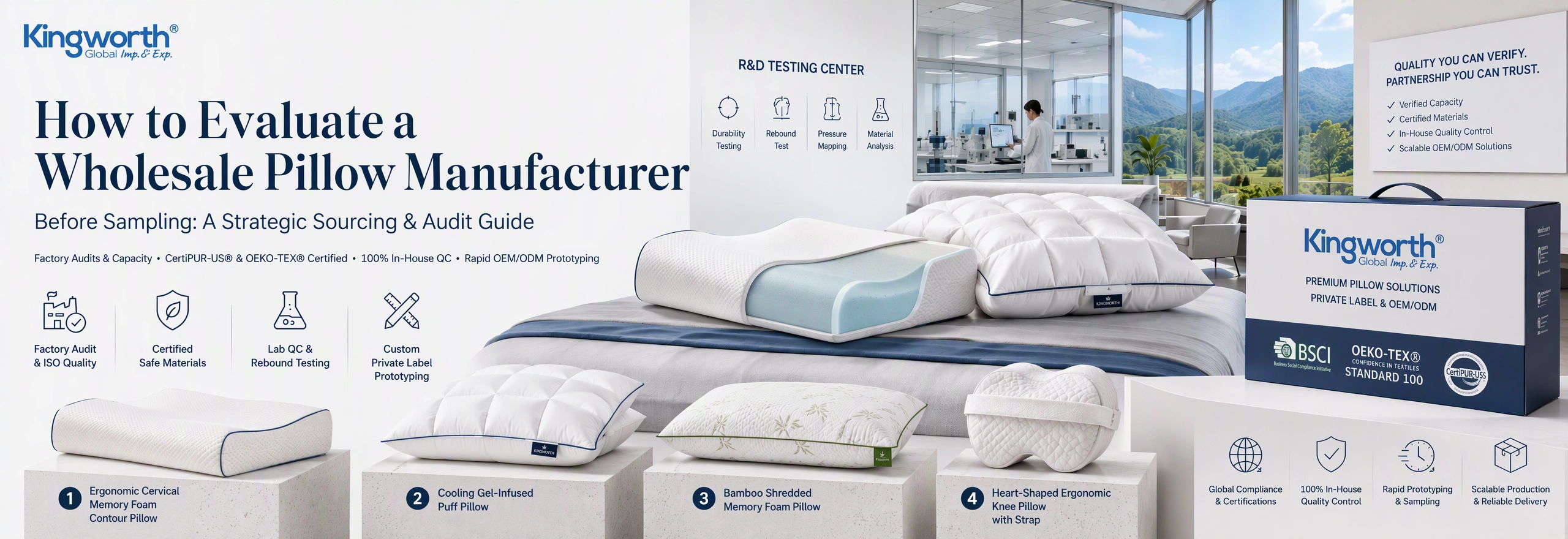
Finding reliable wholesale pillow manufacturers is no longer just about comparing prices. For sleep brands, home textile importers, bedding retailers, and hospitality suppliers, the biggest sourcing risks often appear before the first production sample arrives.
Many suppliers can provide attractive product photos and competitive quotations, but those materials do not necessarily reveal who actually manufactures the product, whether the same materials will be used in bulk production, or how changes are controlled after sample approval.
For private-label pillow programs, early supplier evaluation can reduce delays, unexpected material substitutions, quality inconsistencies, and communication problems later in the project.
At Kingworth, we support OEM and ODM pillow development through sample coordination, specification review, packaging planning, quality control discussions, and export support. Before any bulk order begins, we encourage buyers to verify technical details against the specific pillow model rather than relying on generic marketing claims.
This guide provides a practical evaluation framework—including a supplier audit checklist—that purchasing teams can use before requesting production samples.
Why Supplier Evaluation Should Start Before Sampling
Many buyers begin by requesting a sample immediately after receiving a quotation. While sampling is essential, evaluating the supplier first often saves time and avoids repeated revisions.
Before investing in sample development, purchasing teams should understand:
- Who manufactures the pillow.
- Which products are actually produced in-house.
- Whether technical documents exist for the same model.
- How production changes are managed.
- Whether quoted lead times match production capability.
For B2B buyers, this information becomes especially important when developing a private-label product that will later require consistent repeat orders.
Downloadable Supplier Audit Checklist
The following checklist can be converted into an internal purchasing worksheet or supplier evaluation form during vendor qualification.
Supplier Identity
- Confirm the legal business name.
- Identify whether the supplier is a manufacturer, exporter, or both.
- Verify export communication responsibilities.
- Record factory and business locations.
Production Scope
- List pillow types discussed.
- Confirm which products are manufactured directly.
- Identify outsourced components.
- Verify customization capability.
Technical Documentation
- Request material specifications.
- Request construction details.
- Request available test records.
- Confirm labeling requirements.
Sample Control
- Record sample version.
- Track approved changes.
- Confirm revision history.
- Keep approval records.
Production Consistency
- Compare quoted lead times.
- Review production capacity discussions.
- Confirm packaging requirements.
- Verify shipment planning.
Commercial Review
- Record quotation validity.
- Confirm order assumptions.
- Track packaging costs.
- Keep communication records.
This checklist works best when updated throughout supplier discussions rather than completed only after production begins.
Factory vs. Export Company: Why the Difference Matters
One of the first questions buyers should ask is simple:
Who actually manufactures the pillow?
A supplier may operate as:
- A manufacturer with export capability.
- A manufacturer working with an export company.
- An export company coordinating production.
- A trading company sourcing from multiple factories.
None of these models is automatically better or worse. The important point is understanding which organization performs each responsibility.
Questions to Ask
| Question | Why it matters |
|---|---|
| Who manufactures this pillow model? | Clarifies production responsibility. |
| Who manages export documentation? | Prevents communication gaps. |
| Who approves production changes? | Helps control revisions. |
| Who handles quality discussions? | Defines accountability. |
| Who coordinates shipment? | Reduces delivery confusion. |
For Kingworth projects, production discussions, specification review, sampling coordination, packaging planning, and export communication should remain aligned throughout the project.
Compare Pillow Types with Actual Production Scope
Many suppliers present broad product catalogs, but buyers should distinguish between products that are actively manufactured and products that require additional sourcing or development.
Build a Product Matrix
Instead of assuming every pillow category is available under identical production conditions, create a comparison table.
| Pillow Category | Confirm Before Approval |
|---|---|
| Memory foam | Production scope |
| Fiberfill | Material confirmation |
| Cooling pillow | Fabric documentation |
| Weighted pillow | Construction review |
| Decorative pillow | Cover development |
| Custom OEM pillow | Development requirements |
This comparison helps buyers avoid requesting features that may require additional development.
Separate Existing Products from New Development
For each pillow discussed, confirm:
- Existing product or new development.
- Sample availability.
- Material specification.
- Packaging requirements.
- Production documentation.
This approach creates a clearer sourcing process than relying only on catalog images.
Request Material and Test Records for the Same Model
A common sourcing mistake is accepting documentation from a similar product rather than the exact model being purchased.
Buyers should request records that correspond to the specific pillow under discussion.
Material Documents
Request documentation covering:
- Fabric composition.
- Filling material.
- Construction description.
- Label wording.
- Product identification.
Test Records
Where available and relevant, ask whether records exist for:
- Fabric performance.
- Dimensional stability.
- Colorfastness.
- Construction performance.
- Other project-specific evaluations.
The important point is matching documentation to the same product rather than assuming one report applies across an entire product range.
Review Change Control from Sample to Bulk Production
One approved sample does not automatically guarantee identical bulk production.
Good change control creates a documented connection between the approved sample and the production order.
Create a Sample Approval Record
A useful approval file includes:
- Sample version.
- Product photos.
- Material specification.
- Color reference.
- Packaging version.
- Label approval.
- Revision history.
Track Every Revision
Instead of relying on email memory, record:
| Change | Record |
|---|---|
| Fabric update | Version |
| Filling revision | Approval |
| Label change | Date |
| Packaging update | Revision |
| Color adjustment | Reference |
Even small changes become easier to manage when documented consistently.
Check Lead Time and Capacity Consistency
Lead time should remain consistent across quotations, sampling discussions, production planning, and shipment coordination.
If different departments provide different timelines, buyers should clarify the reasons before confirming the order.
Compare Lead Time Throughout the Project
| Project Stage | What to Compare |
|---|---|
| Quotation | Initial lead time |
| Sampling | Sample schedule |
| Production | Manufacturing timeline |
| Packaging | Packing timing |
| Shipment | Export schedule |
Consistency is often more useful than receiving the shortest estimated delivery date.
Capacity Discussions Should Match the Project
Instead of asking only for a maximum monthly output, buyers can discuss:
- Expected order volume.
- Production scheduling.
- Color variants.
- Packaging complexity.
- Repeat-order planning.
These conversations help determine whether the proposed timeline matches the actual project requirements.
Define Quotation Inputs After Sample Approval
Many quotation revisions happen because important assumptions were never documented.
Once the sample is approved, buyers should convert technical decisions into quotation inputs.
Technical Inputs
- Approved pillow model.
- Material specification.
- Dimensions.
- Filling specification.
- Color reference.
- Label requirements.
- Packaging configuration.
Commercial Inputs
- Order quantity.
- Destination market.
- Shipping preference.
- Packaging format.
- Delivery expectations.
- Documentation requirements.
This process reduces misunderstandings between purchasing, production, packaging, and logistics teams.
Build an Internal Supplier Evaluation Scorecard
Many purchasing teams evaluate suppliers across multiple criteria rather than relying only on unit price.
Example Scorecard
| Evaluation Area | Review Focus |
|---|---|
| Communication | Response quality |
| Documentation | Technical accuracy |
| Sampling | Revision control |
| Production | Process clarity |
| Packaging | Customization |
| Quality | Inspection planning |
| Export Support | Shipment coordination |
Each company can assign its own weighting based on sourcing priorities.
How Kingworth Supports Pillow Development
Kingworth works with B2B buyers developing pillow programs through:
- OEM and ODM discussions.
- Sample coordination.
- Product specification review.
- Packaging planning.
- Label discussions.
- Quality control communication.
- Export support.
Because different pillow models may have different materials, construction methods, and packaging options, every project should be confirmed against the actual approved product specification before production begins.
Final Supplier Evaluation Checklist
Before requesting production samples, confirm that you have completed the following:
- Verified supplier role.
- Compared product scope.
- Requested technical documents.
- Requested model-specific records.
- Created a sample approval process.
- Established change control.
- Reviewed lead-time consistency.
- Clarified production discussions.
- Defined quotation inputs.
- Recorded packaging requirements.
Completing these steps before sampling creates a stronger foundation for private-label pillow sourcing.
Frequently Asked Questions
What should I verify before requesting a pillow sample?
Confirm who manufactures the product, which pillow category is actually within production scope, whether technical documents exist for the same model, and how sample revisions will be managed.
Why is factory verification important?
It helps clarify production responsibility, export communication, quality discussions, and change approval throughout the project.
Should I request test records before sampling?
If relevant records already exist for the same model, reviewing them early can help purchasing teams understand available documentation before moving into production planning.
How do I keep samples and bulk production consistent?
Create a documented approval file with product photos, material specifications, packaging versions, labels, and revision history.
Why should lead times be reviewed multiple times?
Comparing quotation, sampling, production, and shipment schedules helps identify inconsistencies before purchase orders are finalized.
What information should be finalized before requesting a bulk quotation?
Use the approved sample to confirm dimensions, materials, filling, colors, labels, packaging, destination market, and shipment assumptions.
Can Kingworth support private-label pillow projects?
Yes. Kingworth supports OEM and ODM pillow development through specification review, sampling discussions, packaging planning, quality communication, and export support based on the confirmed product configuration.