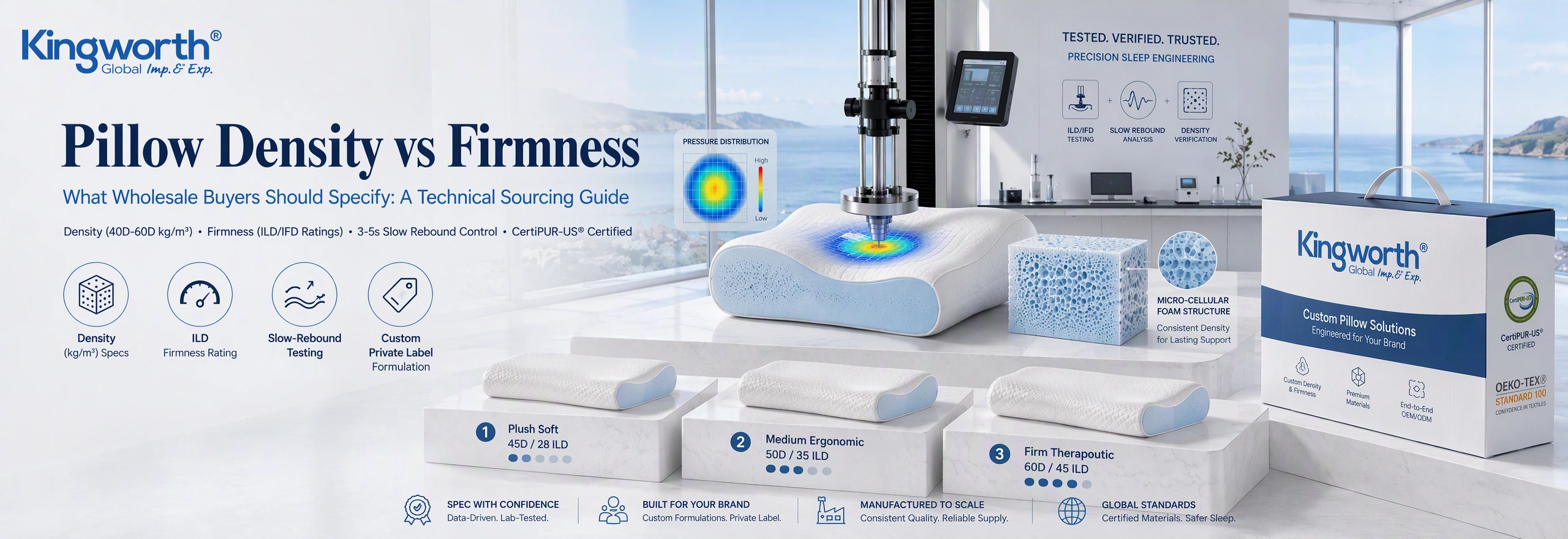
Memory Foam Pillow Density vs Firmness: What Buyers Should Specify
When sourcing memory foam pillows, buyers often encounter two specifications that sound similar but describe different material properties: density and firmness. Confusing them can lead to inconsistent quotations, misleading product comparisons, and disagreements between an approved sample and bulk production. A high density memory foam pillow is not automatically a firm pillow, and a softer pillow is not necessarily made from low-density foam.
For sleep brands, home textile importers, and bedding retailers, understanding memory foam pillow density vs firmness is essential when developing product specifications. Density describes the mass of foam within a given volume. Firmness describes how the foam responds to an applied force under defined test conditions. Both matter, but they should be measured, recorded, and approved separately.
This distinction becomes particularly important in OEM and ODM projects, where a buyer may need to reproduce a specific pillow feel across multiple production batches. A reliable sourcing process should define the foam material, density, indentation response, sample dimensions, conditioning conditions, finished pillow construction, and batch acceptance method. Kingworth, a Ningbo-based comfort-product manufacturer and export supplier, supports B2B product development through specification review, sample coordination, quality-control communication, packaging planning, and export support.
1. Density and Firmness Are Two Different Parameters
What is memory foam density?
Foam density is the mass of a foam specimen divided by its volume. It is commonly expressed in kilograms per cubic metre (kg/m³). The basic relationship is:
Density = Foam mass ÷ Foam volume
For example, if a foam specimen has a mass of 1.5 kg and a volume of 0.05 m³, its density is 30 kg/m³. This is a simplified calculation to explain the parameter, not a specification for a Kingworth pillow.
Density helps identify the material specification and distinguish foam materials that may look similar. It can be relevant to material consistency and durability evaluation, but it does not independently describe how hard or soft a pillow feels. Foam formulation, polymer structure, processing, cell structure, and other material characteristics can influence performance.
What is foam pillow firmness?
Firmness describes the resistance of foam to compression under a defined test method. For flexible foam, one commonly used measurement is Indentation Force Deflection (IFD), also called Indentation Load Deflection (ILD) in some industry contexts. The test measures the force required to compress a foam specimen by a specified percentage of its original thickness.
Depending on the selected method, results may be reported at different indentation levels, such as 25% or 40%. A test report should state the method, indentation percentage, specimen dimensions, conditioning procedure, and relevant measurement conditions. A firmness value without its test method and conditions is incomplete information.
Density vs firmness at a glance
| Parameter | What it measures | Typical unit or format | Procurement purpose |
|---|---|---|---|
| Density | Mass per unit volume of foam | kg/m³ | Identifies the foam material specification |
| Firmness / IFD | Force required to produce a defined indentation | N or lbf, depending on the method | Describes resistance to compression under stated test conditions |
| Finished pillow weight | Total mass of the specified finished product or component | g or kg | Supports product consistency and logistics planning |
| Finished dimensions | Length, width, and height or profile | mm, cm, or inches | Defines the product geometry and fit |
| Recovery behavior | How the foam returns after a defined compression | Time, dimensional change, or test-specific result | Supports product and packaging evaluation |
For procurement, these values should appear as separate fields in the technical specification. A supplier should not use a density figure as a substitute for a firmness result or describe a pillow as firm simply because its foam has a high density.
2. Why Equal-Density Foam Can Feel Different
Two memory foam materials with the same nominal density can still produce different compression responses and user experiences. Density is one material parameter, not a complete description of the foam formulation or its behavior.
Foam formulation and polymer structure
Memory foam is a formulated cellular material. Differences in the polymer system, additives, cell structure, processing conditions, and other formulation variables can affect how the material responds when compressed. Two materials can therefore have similar mass per unit volume but different indentation-force results.
For a buyer, this means that a density match alone does not establish material equivalence. If a project requires a specific feel, the supplier should confirm the firmness-related measurement separately and provide a sample made from the intended production material.
Cell structure and material response
The internal cellular structure influences how foam deforms and recovers. Differences in cell size, openness, uniformity, and processing can affect the way a specimen responds under load. These characteristics should be evaluated through relevant material testing and product sampling rather than inferred from density alone.
Temperature and time-dependent response
Memory foam is often described as temperature-sensitive and viscoelastic. Its response can change with temperature and with the duration of an applied load. A foam sample tested in a cool room may not produce the same result as an otherwise identical sample tested under warmer conditions. The time allowed for recovery after compression can also affect a subsequent measurement.
For this reason, buyers should avoid comparing a supplier’s firmness figure with another supplier’s figure unless the test method and conditions are sufficiently comparable. If the two reports use different methods, specimen sizes, temperatures, or measurement intervals, the values may not represent a direct comparison.
Cover and finished-pillow construction
The foam core is only one part of the finished pillow. The cover fabric, inner liner, quilting, seams, dimensions, and fit can all influence the way the product feels. A tightly fitted cover may restrict the movement or deformation of the foam, while a different cover construction may allow more movement. A pillow with a thick quilted cover may also feel different from a pillow with a thin, closely fitted cover, even if their cores are similar.
Buyers should therefore distinguish between the firmness of the foam material and the perceived feel of the finished pillow. Material test data helps control the foam specification; physical sample evaluation helps confirm the complete product experience.
3. Why Pillow Weight Cannot Replace Density
Finished pillow weight is easy to measure, but it is not a reliable substitute for foam density when comparing pillows with different shapes or constructions.
Different shapes create different volumes
A conventional rectangular pillow, a contoured memory foam pillow, and a shaped cervical pillow may use different amounts of foam even when their material density is identical. Their overall dimensions and internal geometry determine the foam volume. A larger core can weigh more than a smaller core without having a higher density.
For example, a pillow with a deep central contour and raised side sections may have a different volume from a flat rectangular pillow with the same outer length and width. Comparing only their total weights would not establish whether the foam materials have the same density.
Finished weight includes more than foam
A finished pillow may include an outer cover, inner liner, zipper, labels, piping, and other components. If the buyer records only the total product weight, differences in these components can be mistaken for differences in foam quantity or density.
For a molded pillow, record the foam core weight separately from the finished pillow weight when material verification requires it. For a shredded foam pillow, record the net foam filling weight separately from the cover and liner. The specification should state exactly which components are included in every weight figure.
| Weight field | What should be included | Why it must be separate |
|---|---|---|
| Foam core weight | The molded foam core only | Supports material and component consistency checks |
| Shredded foam fill weight | The foam pieces inside the specified filling compartment | Controls filling quantity independently of the cover |
| Cover weight | The removable or fixed textile cover | Prevents fabric variation from distorting foam weight comparisons |
| Finished pillow weight | All components included in the finished product definition | Supports retail specification and product checks |
| Packed shipping weight | Product plus packaging and other packed components | Supports carton and freight calculations |
Density should be calculated from a measured foam specimen’s mass and volume using an agreed method. It should not be estimated by dividing the weight of a complete pillow by its external dimensions, especially when the pillow has contours, cavities, multiple materials, or a removable cover.
4. Make Firmness Test Results Comparable
A firmness number is useful only when the measurement method and sample conditions are understood. For wholesale pillow sourcing, the goal is not simply to obtain a test report. It is to make sure that the result can be compared with the approved material specification and repeated during production.
Specify the test method
ASTM D3574 includes test methods for flexible urethane foam, including indentation force deflection. ISO 2439 addresses indentation hardness testing for flexible cellular materials. These standards cover related material characteristics, but their methods and reported results are not automatically interchangeable. Buyers should identify the required standard and method in the purchase specification and avoid comparing values from different methods as if they were identical.
For example, a report that states 25% IFD should also identify the applicable method, force unit, specimen details, and test conditions. A report that simply states soft, medium, or firm is not a substitute for a defined test result when numerical control is required.
Control specimen dimensions and location
Specimen thickness, surface dimensions, shape, and test location can affect indentation results. A small specimen may behave differently from a larger standard specimen because the edges can influence deformation. Molded or contoured parts may require an agreed sampling location or a suitable support fixture.
For material comparisons, use specimens prepared according to the selected test method. If the buyer and supplier agree to test finished pillow components instead, document the specimen location, dimensions, orientation, and any deviations from the standard procedure.
Control temperature and conditioning
Before testing, foam specimens should be conditioned according to the selected method. The specification should identify the conditioning environment, duration, and any required recovery period after compression or packaging. Temperature should be recorded because memory foam response may be affected by thermal conditions.
Do not compare one supplier’s result taken immediately after unpacking a compressed sample with another supplier’s result taken after a defined recovery period. Both the material and the sample history need to be controlled.
Record the indentation procedure
Depending on the method, test results can be affected by preload, preflex cycles, indentation speed, indentation percentage, dwell time, and the interval before recording force. These details should be consistent when comparing samples or checking production batches.
For a procurement specification, the buyer does not need to invent a testing procedure. Instead, identify the applicable standard and method, require the supplier or laboratory to report the relevant conditions, and agree on any product-specific deviations before testing begins.
5. Procurement Fields That Must Remain Separate
A complete memory foam pillow specification should not combine density, firmness, weight, dimensions, and recovery into one general description. Keeping these fields separate makes quotations clearer and bulk inspections more objective.
| Specification field | What the buyer should record | Approval basis |
|---|---|---|
| Foam type | Material identity and formulation description where available | Approved material documentation |
| Foam density | Target value, unit, method, and tolerance | Density test result |
| Firmness / IFD | Target result, test standard, method, indentation level, and unit | Comparable test report |
| Foam dimensions | Core length, width, thickness, and profile | Drawing and measurement record |
| Foam weight | Core weight or net shredded fill weight | Component weighing record |
| Finished dimensions | Length, width, height, and contour measurements | Approved finished sample |
| Cover specification | Fabric composition, construction, color, closure, and care | Material record and sample approval |
| Recovery | Test method, recovery period, and measurement criteria | Agreed recovery test record |
| Packaging | Compression method, packed dimensions, and storage conditions | Packaging trial approval |
Do not use vague firmness descriptions as the only control
Words such as soft, medium, supportive, and firm can be useful for retail positioning, but they are subjective unless linked to an agreed evaluation system. Different brands may use the same word to describe different experiences. If a product listing uses a comfort category, the buyer should define the category internally and connect it to a reference sample and, where applicable, measurable test data.
For example, a brand may use its own soft, medium, and firm product tiers. Those labels should be supported by approved samples and documented material specifications. They should not be assumed to correspond to a universal industry scale.
6. Design a Blind-Sample Comparison Record
When evaluating multiple foam suppliers or formulations, a blind-sample comparison can reduce the influence of brand names, supplier reputation, or price expectations on the initial feel assessment. It allows the product team to focus on the samples themselves before reviewing the commercial details.
Prepare samples consistently
Each sample should be assigned a neutral code, such as Sample A, Sample B, and Sample C. The supplier identity should be recorded separately by the project coordinator and hidden from the evaluators during the initial assessment.
Before comparison, confirm that samples have the same intended dimensions, cover construction, and conditioning history where the purpose is to compare foam feel. If the samples have different shapes or covers, record those differences rather than treating them as equivalent.
Blind-sample evaluation form
| Record field | Sample A | Sample B | Sample C |
|---|---|---|---|
| Anonymous sample code | A | B | C |
| Foam type / model reference | Record separately | Record separately | Record separately |
| Density result and method | To be recorded | To be recorded | To be recorded |
| Firmness result and method | To be recorded | To be recorded | To be recorded |
| Sample dimensions | To be measured | To be measured | To be measured |
| Core or fill weight | To be measured | To be measured | To be measured |
| Cover construction | To be recorded | To be recorded | To be recorded |
| Initial feel assessment | Evaluator notes | Evaluator notes | Evaluator notes |
| Shape and profile | Evaluator notes | Evaluator notes | Evaluator notes |
| Recovery observation | Evaluator notes | Evaluator notes | Evaluator notes |
| Preferred sample and reason | To be completed | To be completed | To be completed |
Use a consistent evaluation sequence
- Assign anonymous codes and record supplier identities in a separate controlled file.
- Confirm sample dimensions, covers, and conditioning history before evaluation.
- Place samples in the same environment for the agreed conditioning period.
- Evaluate each sample using the same handling sequence and observation time.
- Record initial compression response, perceived support, surface feel, shape, and recovery observations separately.
- Have more than one evaluator complete the record where practical.
- Compare the blind evaluation with the technical data only after the initial assessments are complete.
- Approve the selected sample and document the reasons for selection.
A blind comparison does not replace laboratory testing. It is a structured way to compare the perceived experience of complete samples. Numerical density and firmness data should remain in the technical record, while subjective observations should be retained as a separate evaluation layer.
7. Retained Samples and Batch Acceptance
Once a pillow sample is approved, it should become a controlled reference for production. Retained samples help purchasing and quality teams compare future batches with the agreed material and finished-product requirements.
Establish the approved reference sample
After approval, assign the sample a unique reference number and record its date, model, revision, foam specification, cover specification, dimensions, and relevant test results. Keep photographs of the overall pillow, profile, cover details, labels, and any distinctive construction features.
Where possible, retain a separate foam specimen from the approved material lot. A complete pillow and a foam test specimen serve different purposes: the pillow represents the finished product, while the specimen supports material-level comparison. The record should make clear which reference is used for each inspection.
Control storage conditions
Foam can be affected by storage conditions, compression, temperature, and time. Retained samples should be stored in a way that avoids unnecessary compression, contamination, moisture exposure, or prolonged unsuitable conditions. Record the storage date and any handling that could affect the sample’s dimensions or response.
If a retained sample has been compressed for storage or shipping, allow it to recover according to an agreed procedure before using it as a comparison reference. Do not compare a compressed retained sample with a fully recovered production sample.
Batch acceptance workflow
- Identify the batch: Record the production lot, material lot, model, and order reference.
- Verify documents: Check the material specification and relevant density and firmness records for the same model and material lot.
- Check dimensions and weight: Measure the foam core or filling separately from the cover and finished pillow.
- Conduct comparable testing: Use the agreed method, specimen preparation, conditioning, temperature, and measurement conditions.
- Compare with the reference: Review the test results and finished sample against the approved specification and retained sample.
- Record deviations: Identify the affected parameter, measured result, sample location, and batch quantity.
- Decide acceptance: Apply the agreed tolerance and inspection plan, then document approval, rework, or rejection.
- Retain batch evidence: Keep inspection records and, where agreed, a sample from the accepted production batch.
Define tolerances before production
Do not wait until a batch fails inspection to decide what variation is acceptable. Buyers and suppliers should agree on density tolerance, firmness tolerance, dimensions, component weight, and the relevant test method before the purchase order is confirmed. The tolerance should reflect the product design, material capability, and measurement method.
If a batch falls outside the agreed limits, the supplier should investigate the cause rather than simply adjusting the reported result. Possible areas for review include raw material variation, processing conditions, specimen preparation, conditioning, measurement equipment, and test location.
8. What Buyers Should Request from a Memory Foam Pillow Supplier
A supplier evaluation should establish whether the manufacturer can explain and control the actual foam specification. A broad statement such as high-density memory foam is not enough for a repeatable private-label program.
Technical information
- Foam type and material description.
- Density target, unit, test method, and tolerance.
- Firmness or IFD target, test method, indentation level, and unit.
- Foam dimensions and finished pillow dimensions.
- Core weight or net shredded fill weight.
- Cover composition, construction, and closure details.
- Recovery and compression-packaging requirements.
- Care instructions and any supporting test records.
Quality-control information
- Incoming material inspection process.
- First-sample approval procedure.
- In-process checks for material and construction consistency.
- Final inspection criteria.
- Equipment calibration and test record availability where applicable.
- Batch identification and traceability arrangements.
- Deviation reporting and corrective-action process.
- Retained-sample identification and storage procedure.
Commercial information
Once the product specification is clear, the buyer can request a quotation based on the approved construction, materials, dimensions, order quantity, cover, labels, packaging, inspection requirements, destination market, and delivery assumptions. MOQ, sample costs, lead time, and production arrangements should be confirmed for the selected model rather than assumed from a general catalog.
9. Implications for Different Sales Channels
Sleep brands
Sleep brands should define the desired customer experience first, then translate it into measurable foam requirements. Density and firmness should be separate technical fields, while subjective feel should be evaluated using blind samples and an approved reference. This creates a more reliable foundation for product positioning and repeat orders.
Home textile importers and bedding retailers
Importers and retailers need clear specifications that can be used in quotations, purchase orders, quality inspections, and product listings. Keeping core weight, finished weight, dimensions, density, and firmness separate reduces confusion when comparing suppliers or adding new pillow models to an assortment.
Hotel and hospitality buyers
Hotels should evaluate the complete pillow under the intended use and cleaning conditions. A foam density or firmness figure alone does not establish whether a pillow is suitable for repeated commercial laundering. Cover construction, care instructions, drying limits, dimensional stability, and post-wash feel should be checked through an agreed trial before the product is approved for hospitality use.
10. Frequently Asked Questions
Does higher memory foam density mean a firmer pillow?
No. Density measures mass per unit volume, while firmness describes the force required to compress foam by a specified amount under defined test conditions. A high-density foam can have different firmness characteristics depending on its formulation and structure.
What is a high density memory foam pillow?
A high-density memory foam pillow is made with foam that has a relatively high mass per unit volume compared with the selected reference or product category. The term should be supported by a numerical density specification and a stated measurement method. There is no single density figure that automatically defines every pillow as high density across all markets and product designs.
Can two pillows with the same density feel different?
Yes. Foam formulation, cell structure, processing, temperature, test conditions, cover construction, and pillow geometry can all affect the perceived feel or measured compression response. Density alone does not fully describe the finished pillow experience.
Can I compare firmness results from different laboratories?
Only when the test methods and relevant conditions are sufficiently comparable. Confirm the standard, method, indentation level, force unit, specimen dimensions, conditioning, temperature, and measurement procedure. Results from different standards should not automatically be treated as interchangeable.
Can finished pillow weight be used to calculate foam density?
Not reliably when the pillow includes a cover, liner, zipper, or other components, or when its shape is contoured. Density should be measured from a foam specimen with a defined volume and mass. Record foam weight separately from finished-product and packed weight.
Should density and firmness both appear in a purchase order?
Yes, when both are important to the product specification. Record density and firmness as separate parameters, including the unit, test method, target value, and agreed tolerance. Also specify dimensions, core or fill weight, cover construction, and other relevant product details.
Why should buyers use blind samples?
Blind samples allow evaluators to compare the product feel without being influenced by supplier names or quoted prices during the initial assessment. The results can then be compared with technical test data and commercial information to support a more objective selection.
Why retain an approved sample?
A retained sample provides a physical reference for future production batches. When it is linked to a documented specification, test record, and revision number, it helps buyers and suppliers investigate differences and make more consistent acceptance decisions.
Specify the Foam, Not Just the Feel
For a repeatable memory foam pillow program, density and firmness must be defined independently. Density identifies the mass per unit volume of the foam. Firmness describes its resistance to indentation under a specified test procedure. Finished pillow weight, foam weight, dimensions, cover construction, and recovery behavior provide additional information and should not be used as substitutes for either parameter.
For sleep brands, importers, and bedding retailers, the practical process is straightforward: define the material specification, agree on the firmness test method and conditions, compare samples consistently, approve a controlled reference, and use retained samples and batch records for production acceptance. Hospitality buyers should add a product-specific cleaning and drying evaluation before approving a pillow for repeated commercial use.
Kingworth supports B2B comfort-product development through OEM/ODM discussions, sample coordination, specification review, packaging planning, quality-control communication, and export support. To discuss a memory foam pillow project, contact info@king-worth.com or call +86 133 3687 4040. Share your target pillow design, density requirement, firmness target, cover preference, intended sales channel, and order expectations so the project can be reviewed against a clear product specification.