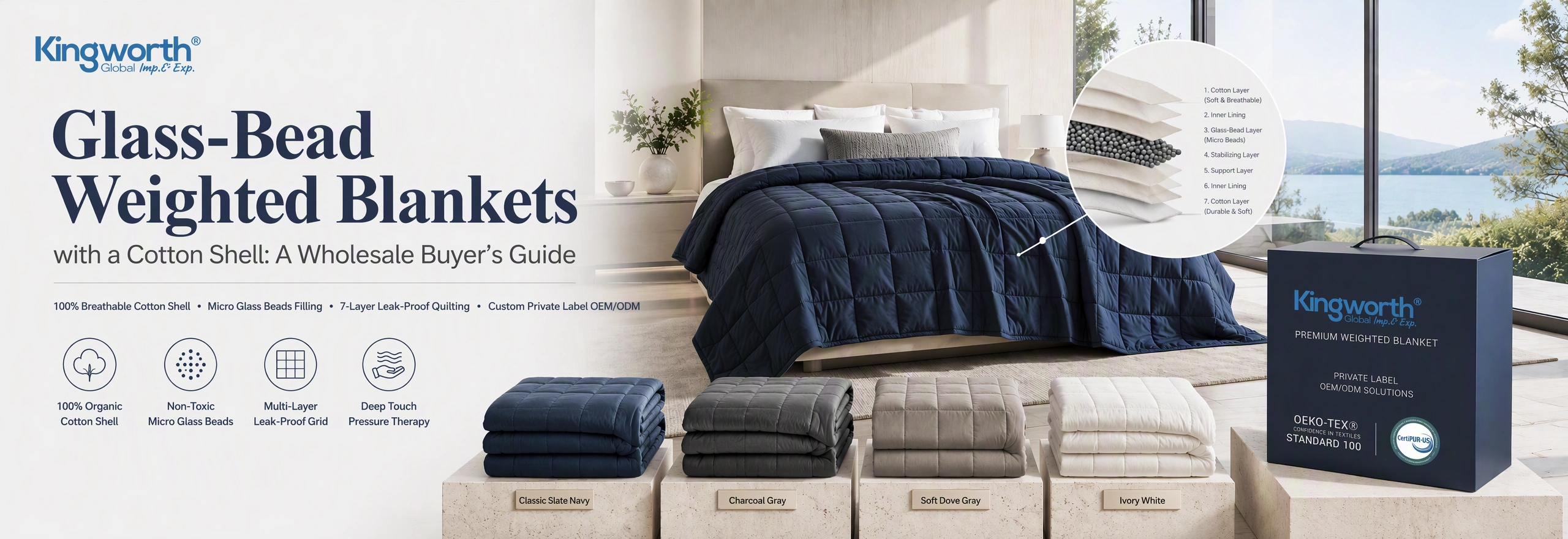
Glass-Bead Weighted Blanket with a Cotton Shell: A Wholesale Buyer’s Guide
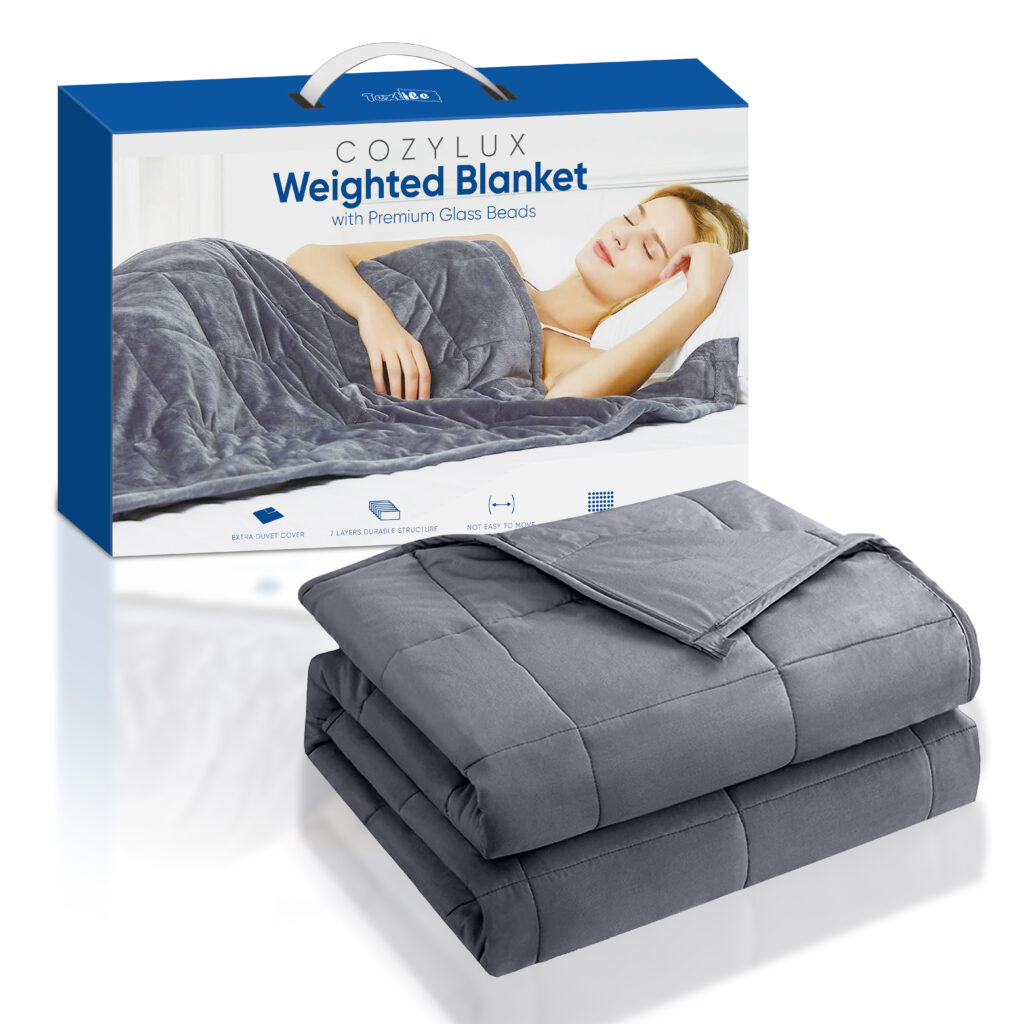
A glass bead weighted blanket with a cotton shell combines a familiar textile surface with a compartmentalized weighted filling. For home textile brands, home retail buyers, gift wholesalers, and import distributors, the product is more than a blanket with added weight. Its commercial performance depends on the relationship between the cotton shell, inner containment layers, glass-bead filling, quilting construction, attachment points, care requirements, packaging, and product documentation.
When sourcing a cotton weighted blanket or a weighted blanket with glass beads, buyers should evaluate the finished product as a complete construction system. A soft cotton hand feel does not by itself establish filling security. A neat quilting pattern does not prove that every pocket contains the correct amount of filling. Likewise, a removable duvet cover may improve everyday care, but it should not be confused with the weighted insert or treated as a substitute for a properly constructed inner shell.
As a China-based comfort-product manufacturer and export supplier, Kingworth supports B2B buyers with product specification review, sampling, OEM/ODM development, private-label details, packaging coordination, and production quality-control planning. Exact fabric composition, finished dimensions, available weights, certifications, minimum order quantities, and production schedules should be confirmed for each project before they are published or included in a purchase order.
1. How a Glass-Bead Weighted Blanket Is Constructed
The outer cotton shell
The cotton shell is the textile surface buyers see and touch. Depending on the approved specification, it may be made from plain-weave cotton, percale-style cotton, sateen-style cotton, or another suitable cotton fabric. These options can differ in surface smoothness, texture, breathability, drape, appearance, and cost. The word cotton alone does not establish thread count, fabric weight, weave, shrinkage performance, or the percentage of cotton in every component.
For a wholesale program, specify the fiber composition and construction instead of relying on a general product name. Confirm whether the cotton requirement applies to the visible shell only, both sides of the insert, the inner lining, or the optional removable cover. If binding, thread, backing, or other components use different fibers, those distinctions should be recorded in the product specification and reflected in labeling where required.
The inner containment layers
The inner construction is responsible for containing the weighted filling and helping the blanket retain its intended shape. Depending on the design, the assembly may include an inner liner, separate filling compartments, quilting stitches, and reinforcement at selected seams. The exact layer count and material composition must be confirmed for the specific model; they should not be assumed from photographs or from the phrase glass-bead weighted blanket.
Buyers should ask suppliers to provide a cross-sectional construction description or a sample showing the relationship between the shell, lining, filling pockets, and seams. This makes it easier for product developers to assess how the design can be inspected, cleaned, repaired, packaged, and explained to the end customer.
Glass beads and the bill of materials
The glass beads provide the added mass. A well-defined bill of materials (BOM) should identify the filling material, the shell fabric, the inner containment fabric, quilting thread, binding, attachment loops, labels, and any optional cover or packaging components. If a project specifies a particular bead grade, particle size, material declaration, or restricted-substance requirement, that requirement should be written into the approved specification and verified using appropriate documentation or testing.
| Component | What buyers should specify | What should be checked |
|---|---|---|
| Outer shell | Fiber composition, weave, color, fabric weight, hand feel, dimensional tolerance | Appearance, shade consistency, defects, measurements, and agreed test results |
| Inner containment layer | Material, layer arrangement, seam construction, pocket design | Seam integrity, filling containment, and consistency with the approved sample |
| Glass-bead filling | Material identity, target total weight, distribution plan, any required declarations | Filling quantity, visible leakage, and distribution across compartments |
| Quilting and thread | Pattern, stitch layout, thread specification, reinforcement requirements | Skipped stitches, loose threads, seam openings, and pattern consistency |
| Attachment loops | Number, position, dimensions, stitching, and compatibility with the cover | Loop count, placement, seam strength, and attachment usability |
| Labels and packaging | Branding, care wording, warnings, barcode, carton and retail-pack details | Artwork approval, label accuracy, packing quantity, and shipment identification |
This BOM is a specification template, not a declaration of the materials used in every Kingworth model. The approved version should identify the actual materials and any permitted substitutions. Unapproved changes to the filling, lining, thread, or shell can affect weight, handling, durability, and compliance, so material substitutions should require documented approval.
2. Why Pocket Construction and Quilting Matter
A weighted blanket commonly uses quilted compartments to help keep the filling distributed instead of allowing all of it to collect at one end. The shape and dimensions of those compartments, the stitch layout, and the consistency of filling placement all influence the finished product. However, a decorative quilting pattern should not be treated as proof of even weight distribution or long-term durability.
Designing the filling pockets
During product development, the supplier and buyer should agree on the compartment layout before bulk production. The drawing or specification should show the number of rows and columns, pocket dimensions, seam allowances where relevant, edge construction, and any reinforced areas. If a pattern uses different pocket sizes around the perimeter or at the corners, those differences should be documented.
- Pocket layout: Define the grid and record any non-standard compartments.
- Filling allocation: Establish a target filling quantity per pocket or per defined group of pockets.
- Seam integrity: Identify the seams that contain the filling and the stitching requirements that protect them.
- Edge control: Inspect the perimeter for gaps, incomplete stitching, or other routes through which filling could escape.
- Repeatability: Use the approved sample and production specification as the reference for every batch.
How to inspect pocket weight distribution
Buyers should agree on an inspection plan rather than relying only on touch or visual appearance. The following procedure can be adapted to the actual product design and the agreed quality standard.
- Confirm the reference: Use the approved sample, pocket map, target total weight, and documented tolerance as the inspection reference.
- Check the complete blanket: Inspect the shell, perimeter, quilting lines, and visible seams for openings, skipped stitches, damage, or leakage.
- Weigh the finished unit: Use a calibrated scale and record the result against the approved net-weight specification. State clearly whether the target includes the cover, labels, or packaging.
- Sample individual pockets: Where the construction permits practical verification, open or assess designated sample compartments under an agreed sampling procedure. Record actual filling weights and compare them with the pocket-level tolerance.
- Map the results: Record measurements by row, column, or selected location so that localized underfilling or overfilling is easier to identify.
- Check distribution after handling: Gently reposition and inspect the blanket using an agreed method to identify unusual clustering, migration, or empty-looking sections.
- Document nonconformities: Record the location, measured deviation, photographs, affected quantity, corrective action, and reinspection result.
Not every finished blanket can be destructively checked pocket by pocket. For production inspection, buyers can agree on a combination of non-destructive checks, total-weight verification, selected destructive samples where appropriate, and seam-integrity testing. Any destructive sampling method should be planned in advance because it can make the inspected unit unsuitable for sale.
Acceptance limits should be defined before production. A supplier should not invent a universal pocket-weight tolerance or imply that a visual check alone proves uniform distribution. The buyer and manufacturer should agree on the sampling plan, the measurement method, the tolerance, and the treatment of failed samples. If an AQL-based inspection is selected, the applicable inspection level and acceptance criteria should be stated in the purchase agreement rather than assumed to be identical for every order.
3. Size and Weight Combinations for Wholesale Planning
Size and weight are separate specification decisions. A larger blanket with the same total weight as a smaller blanket distributes that mass over a different area. A blanket’s listed dimensions should therefore be considered together with its total weight, intended user, intended use, and the way the product is expected to fit on a bed or around the body.
The combinations below are illustrative product-development options only. They are not confirmed Kingworth stock models, approved recommendations for every user, or a statement of currently available inventory. Actual combinations should be selected after sampling, safety review, costing, and market validation.
| Development concept | Illustrative finished size | Illustrative total weight | Questions to resolve before approval |
|---|---|---|---|
| Compact throw | Approximately 40 × 60 in | Approximately 5–8 lb | Is the coverage area appropriate? Can the intended user move freely and remove it independently? |
| Single-user blanket | Approximately 48 × 72 in | Approximately 8–12 lb | Does the weight suit the target user and intended use? How will the product be labeled? |
| Full/queen development option | Approximately 60 × 80 in | Approximately 12–20 lb | Is the weight distribution suitable across the larger area? Can the blanket be handled and cleaned safely? |
| Large-bed development option | Size to be confirmed against the target market | Weight to be confirmed after design review | Will the product be used by one person or shared? Does the design require different coverage and safety instructions? |
These example ranges are not a substitute for user-specific suitability assessment or clinical advice. The often-repeated suggestion to choose a weighted blanket around 10% of body weight is not a universal safety guarantee. Individual mobility, breathing, circulation, temperature regulation, ability to remove the blanket, and other health considerations can affect suitability. A commercial product page should not present a weight chart as medical advice or promise that a particular weight is safe for everyone.
How to define the finished-size specification
- Record the target length and width and the permitted dimensional tolerance.
- State whether the measurement is taken before or after an agreed conditioning or washing procedure.
- Clarify whether the stated size refers to the weighted insert, the removable cover, or both.
- Define whether edge binding, loops, or other protruding components are included in the measurement.
- Confirm whether the listed weight is the insert weight, the combined insert-and-cover weight, or the packed shipping weight.
- Approve the final size-and-weight combinations before generating retail listings, carton labels, and barcode data.
For importers and retail buyers, consistent naming is particularly important. If the product is sold by size and weight, the SKU structure should make those variables clear. A 10 lb insert and a 10 lb blanket-and-cover set should not share a product description that leaves the included components ambiguous.
4. Eight Attachment Loops: A Feature That Must Be Verified
Some weighted blanket inserts use attachment loops to connect to a compatible removable cover. An eight-loop arrangement can be specified as a design feature when the approved product actually includes eight loops. It should not be advertised as a standard feature of every glass-bead weighted blanket without confirming the model.
How to specify the loops
For an eight-loop design, the product drawing should identify the position of each loop, the attachment method, the loop material, and the stitch construction. The buyer should also confirm that the intended cover has matching ties or another compatible fastening system. The presence of loops alone does not establish universal compatibility with all duvet covers.
- Loop count: Confirm eight loops on the approved sample and production specification.
- Position: Define the location of each loop, including the corners and any intermediate points.
- Attachment: Record how the loops are secured to the insert and what reinforcement is required.
- Compatibility: Match loop positions to the optional cover’s internal ties or fastening points.
- Inspection: Check for missing loops, incorrect placement, loose stitching, fraying, and attachment failure.
A practical functional check is to attach the insert to the matching cover according to the approved instructions, then gently handle and reposition the assembled product. The check should confirm that the fastening points can be used as intended and that the cover and insert remain properly aligned during normal handling. Any force, cycle count, or acceptance limit used for a formal durability test should be agreed and recorded rather than improvised during inspection.
5. Weighted Insert vs. Optional Removable Cover
One of the most important points in a glass bead weighted blanket listing is to explain exactly what the buyer receives. The weighted insert contains the filling and provides the product’s mass. A removable cover is a separate textile layer designed to fit around the insert. Depending on the product configuration, the cover may be included in the set or sold separately.
| Product element | Main function | Questions for the product specification |
|---|---|---|
| Weighted insert | Contains the glass-bead filling and defines the weighted construction | What are the size, total weight, shell materials, pocket design, and cleaning limitations? |
| Optional cover | Provides a removable outer layer and a separate surface for styling and routine care | Is it included? What are its dimensions, fabric composition, closure, attachment ties, and care method? |
| Retail set | Combines specified components into one sellable package | Which components are included, how are they packed, and how are they represented on the label and barcode? |
A removable cover may simplify routine cleaning because it can allow the user to wash the cover separately. However, care instructions depend on the actual fabric, construction, and product design. A cover should not be described as machine washable unless that instruction has been confirmed for the approved material and construction. Similarly, a removable cover does not automatically mean that the weighted insert can be machine washed.
How a separate cover can support a retail range
For home textile brands and retailers, the insert-and-cover model can create a flexible product assortment. A single approved insert design may be paired with multiple cover colors or patterns, provided each cover is dimensionally and functionally compatible. Buyers can develop seasonal colors, gift-oriented packaging, or coordinated bedding collections without implying that every cover is universally interchangeable.
When developing this assortment, confirm the insert dimensions, cover dimensions, fastening positions, shrinkage expectations, and acceptable fit before approving multiple designs. A cover that is too tight may make installation difficult, while excessive looseness can affect the appearance and alignment of the assembled blanket.
6. Adult-Use Safety and Responsible Product Information
Weighted blankets are consumer textile products, but their added mass creates use considerations that differ from those of ordinary throws. Safety information should be clear, specific to the finished product, and reviewed for the destination market. Marketing language should not imply that a weighted blanket diagnoses, treats, or cures a medical condition unless the relevant claims and regulatory pathway have been properly substantiated.
Independent removal and freedom of movement
The intended adult user should be able to move freely and remove the blanket independently. People who have difficulty breathing, impaired mobility, reduced strength, or conditions that may affect safe use should seek appropriate professional advice before using a weighted blanket. Caregivers and purchasers should not assume that a product suitable for one adult is suitable for another.
The blanket should not be used as a restraint. It should not cover the face or obstruct breathing, and it should be removed if the user experiences breathing difficulty, overheating, discomfort, or difficulty moving out from under it. Product instructions should be written for the intended adult audience and should identify any restrictions established by the product’s safety assessment.
Keep glass-bead filling contained
Glass beads must remain securely contained within the finished product. If the shell or seams are damaged and filling becomes accessible, discontinue use until the product has been assessed and appropriately repaired or replaced. Loose beads can pose a choking or ingestion hazard, particularly to children and pets. Users should inspect the blanket for damage before use and after cleaning, and should keep damaged products away from children and animals.
Do not assume that all users or ages are suitable
This article focuses on adult-oriented sourcing and product development. A blanket intended for adults should not be marketed for infants or young children without a separate, appropriate safety assessment and review of applicable requirements. Retailers should not rely on a generic adult weight chart to make decisions about children. Any product intended for a different age group requires its own instructions, labeling, and compliance review.
Use evidence-based marketing language
Some products are marketed using phrases such as calming, relaxing, or deep-pressure comfort. Evidence and individual experiences vary, and these phrases should not be turned into unsupported medical promises. Buyers should review product-page wording, packaging, and advertising claims together. A supplier can help prepare accurate construction information, but claims about health outcomes, therapeutic effects, or suitability for specific medical conditions require appropriate substantiation and regulatory review.
7. Cleaning, Washing, and Long-Term Care
Cleaning instructions should be finalized for the exact combination of shell fabric, inner lining, glass-bead filling, seams, and optional cover. There is no single washing method that is appropriate for every weighted blanket. Because the finished product can be heavy when dry and heavier to handle when wet, buyers should consider the limits of domestic washing machines and dryers when developing the care label.
Recommended care-label development checklist
- Confirm whether the insert is machine washable, hand washable, spot-clean only, or subject to another specific care method.
- State the permitted water temperature, cycle, detergent requirements, and any restrictions on bleach or fabric softener, based on approved testing and material guidance.
- Specify whether tumble drying is permitted and, if so, the approved setting.
- Provide separate instructions for the removable cover when its care requirements differ from those of the insert.
- Tell users to check the washing machine and dryer load limits before attempting to clean a heavy product.
- Require inspection for damaged seams, leakage, or filling migration after cleaning and before reuse.
- Explain the correct drying method and require the product to be fully dry before use or storage.
Where the design and care instructions permit machine washing, a gentle cycle and mild detergent may be appropriate, but the final label must follow the approved product-specific instructions. If the insert is too heavy for a domestic appliance or is labeled for spot cleaning only, the user should follow the stated alternative rather than attempting an unsuitable wash cycle. Commercial laundry equipment may be necessary for some heavier designs, depending on the product instructions and equipment capacity.
For products with removable covers, buyers should evaluate the cover and insert separately. The cover may tolerate more frequent washing than the weighted insert, but repeated laundering can still affect shrinkage, color, texture, ties, and fit. Product testing should reflect the cleaning method that will actually appear on the care label.
8. Cotton Shell Options and Product Differentiation
Cotton is a broad material category rather than a complete performance specification. Different cotton fabrics can produce different surface textures, drape, thickness, and visual character. The best choice depends on the target customer, intended climate, price positioning, and the way the blanket will be displayed and cared for.
Questions to resolve when selecting cotton fabric
- Fiber content: Is the shell 100% cotton or a blend? Which components use the stated fiber?
- Weave and texture: Does the product require a crisp, smooth, soft, or textured surface?
- Fabric weight: What fabric weight is required, and how will it affect the finished product’s handling and cost?
- Color and shade: Which color standard or approved swatch will control bulk production?
- Dimensional stability: What shrinkage and dimensional-change limits apply after the stated care method?
- Colorfastness: Which tests are appropriate for the target market and intended care instructions?
- Touch and appearance: What sample-approval criteria will be used for surface feel, shade, and visible defects?
Private-label buyers should approve a physical sample and retain a clear record of the selected fabric. Terms such as premium cotton, breathable cotton, or soft cotton are too broad to replace measurable specifications. Where a product page makes a specific claim about fiber content, environmental performance, or a textile certification, the supporting documentation should relate to the actual material and product being sold.
9. OEM/ODM Customization for Private-Label Brands
OEM and ODM development allows a brand to align the blanket with its target market and retail strategy. The scope may include fabric selection, color development, quilting patterns, product labels, packaging, and the configuration of the insert and optional cover. Each customization should be reviewed for its effect on construction, cost, inspection, care, and delivery requirements.
| Customization area | Possible development choices | Approval point |
|---|---|---|
| Shell fabric | Agreed cotton composition, weave, surface texture, color | Fabric specification and signed-off sample |
| Quilting pattern | Grid layout, pocket proportions, stitch appearance, visual pattern | Approved drawing and filling-distribution review |
| Weight and size | Market-specific SKU assortment and agreed dimensions | Final product specification and sample measurement |
| Attachment loops | Eight-loop configuration or another documented design | Count, position, stitching, and cover compatibility |
| Brand labels | Woven label, printed label, care label, logo placement | Artwork, required information, and placement approval |
| Retail packaging | Color box, branded bag, insert card, barcode, carton marks | Packaging sample, pack-out review, and shipping data |
| Optional cover | Coordinated colors, patterns, fabric choices, fastening design | Fit test, care review, and included-component statement |
Labels and product documentation
Labels should communicate the actual fiber content, care method, product identity, and other information required in the destination market. Depending on the sales channel and jurisdiction, additional requirements may apply to country-of-origin information, responsible-party identification, warnings, packaging, or claims. The applicable rules should be confirmed for each market instead of using one label template for all countries.
If a buyer requests a certification such as OEKO-TEX STANDARD 100 or another textile-related certification, the supplier should clarify which material, component, or finished product is covered and provide valid documentation for verification. A factory’s general statement or a certificate for a different fabric does not establish that the specific blanket is certified. Certification, test reports, and compliance declarations should only be referenced in marketing after their applicability and validity have been checked.
Retail packaging and shipping preparation
Packaging design should protect the textile surface, keep the product and accessories together, and communicate the SKU accurately. A gift-oriented package may require a branded box or bag, a product-information insert, and a barcode label. Wholesale cartons need clear SKU identification, pack quantity, and shipping marks that match the purchase order and packing list.
Compression or compact packing should be evaluated through sampling. Buyers should confirm the packed dimensions, unpacking appearance, recovery expectations, and whether compression affects the shell or quilting. Do not promise a specific carton quantity, shipping volume, or freight saving until the final package has been measured and the packing configuration approved.
10. Quality Control from Sampling to Shipment
For a glass-bead weighted blanket, quality assurance should address more than surface appearance. A structured plan can combine incoming-material checks, first-sample approval, in-process inspection, finished-product checks, and packing verification. The exact inspection scope and acceptance criteria should be documented before production begins.
Incoming quality control
Incoming quality control (IQC) should verify that the received shell fabric, lining, filling, thread, labels, and packaging materials match the approved specifications. Relevant checks may include fiber or material documentation, shade, dimensions, visible defects, and quantity. Where the project requires laboratory testing or restricted-substance documentation, the responsible party should define the test method, sampling requirements, and acceptance limits.
First-piece approval and in-process checks
Before mass production proceeds, the first approved unit should be checked against the product specification. In-process quality control (IPQC) can then focus on the features most likely to affect product performance: pocket layout, filling allocation, stitch quality, seam closure, attachment-loop placement, and finished dimensions. When an issue is identified, the corrective action should be verified before the same process continues.
Final inspection and packing confirmation
Final quality control (FQC) should confirm the finished appearance, measurements, weight, construction, labels, and accessories according to the agreed plan. Packing confirmation should verify that the correct insert, optional cover, care information, and retail packaging are included for each SKU. Carton quantities and shipping marks should reconcile with the approved packing list.
For traceability, buyers can request production-batch identification and inspection records that connect the shipment to the approved materials and specification. If the contract uses an AQL sampling plan, define the standard, inspection level, defect categories, and acceptance numbers in advance. AQL is an inspection sampling framework, not a guarantee that every unit is defect-free.
11. How to Evaluate a Glass-Bead Weighted Blanket Supplier
For importers and distributors, supplier evaluation should consider the ability to define and repeat the product, not just the sample’s initial appearance. A capable manufacturer and supplier should be able to explain the construction, identify specification gaps, coordinate sampling, document approved changes, and establish a practical inspection plan.
- Specification clarity: Can the supplier provide a BOM, size chart, weight definition, pocket map, and component list?
- Material traceability: Can the supplier identify the actual shell and filling materials and provide relevant documentation when required?
- Sampling discipline: Is there a clear process for submitting, reviewing, revising, and approving samples?
- Construction control: Are pocket distribution, seam integrity, attachment loops, and dimensional tolerances included in inspection?
- Compliance support: Can the supplier coordinate market-specific labels and testing without claiming certifications that have not been verified?
- Packaging control: Can the approved packaging artwork, barcode, pack quantity, and carton marks be checked before shipment?
- Change management: Are substitutions in fabric, filling, thread, labels, or packaging subject to approval?
- Commercial transparency: Are MOQ, sample charges, lead time, payment terms, production capacity, and shipment arrangements confirmed in writing?
Kingworth’s B2B approach is to coordinate product requirements from concept review and sampling through specification control, private-label details, quality checks, packaging, and shipment coordination. The final scope depends on the project and must be agreed with the buyer. Before committing to a purchase order, confirm the selected model, material details, target quantity, inspection criteria, destination-market requirements, and commercial terms in writing.
12. Frequently Asked Questions
What is a glass-bead weighted blanket?
A glass-bead weighted blanket is a textile blanket that uses glass beads as its weighted filling. The beads are typically contained within a sewn internal construction, often divided into quilted compartments. The actual materials, compartment layout, total weight, and care requirements vary by model and should be verified in the product specification.
Is a cotton weighted blanket always made from 100% cotton?
No. The phrase cotton weighted blanket does not by itself confirm that every component is 100% cotton. The outer shell, inner lining, binding, thread, filling compartments, and optional cover may use different materials. Buyers should check the full BOM and ensure that fiber-content claims accurately describe the product and comply with destination-market labeling rules.
What size and weight combinations should a retailer offer?
The assortment should reflect the target market, intended use, user suitability, and retail positioning. Buyers can explore compact throw and larger single-user or bed-oriented formats, but each size and weight combination should be assessed and approved separately. Example combinations in this article are development concepts, not confirmed Kingworth inventory or medical recommendations.
How can buyers check that the glass beads are evenly distributed?
Use an agreed inspection plan that combines finished-unit weighing, pocket-layout checks, selected pocket-weight measurements where practical, seam inspection, and documented results. Define the permitted tolerance and sampling method before production. A visual inspection alone cannot establish the exact filling quantity in every pocket.
Does every weighted blanket have eight attachment loops?
No. The number and placement of loops depend on the model. If a product is marketed with eight attachment loops, verify the count and position on the approved sample and production specification. The compatible removable cover should have matching attachment points.
Is the removable cover included with the weighted blanket?
Not necessarily. Some product configurations include only the weighted insert, while others are sold as a set with a removable cover. Product pages, quotations, barcodes, and packaging should state clearly which components are included in the SKU.
Can a glass-bead weighted blanket be machine washed?
Only if the approved product’s care instructions permit it. Washing suitability depends on the materials, seams, construction, product weight, and appliance capacity. Buyers should validate the care method before printing labels and should distinguish the insert’s instructions from those for a removable cover.
Can a weighted blanket be marketed as a treatment for anxiety or insomnia?
Do not make medical or therapeutic claims without appropriate evidence and regulatory review. Research and individual experiences vary, and a general comfort product should not be presented as a replacement for professional care. Marketing claims should accurately reflect the evidence available for the specific product and the requirements of the destination market.
What information should a wholesale buyer send for an OEM or ODM quotation?
Provide the intended market, target customer, preferred dimensions, proposed weight options, shell material, desired quilting pattern, optional-cover requirements, loop configuration, branding, packaging, estimated order quantity, testing or documentation requirements, and target delivery schedule. If some details are undecided, identify them as open items so they can be resolved during sampling instead of being treated as confirmed specifications.
Develop Your Private-Label Weighted Blanket Program with Kingworth
A successful glass bead weighted blanket program starts with a clear product specification and a repeatable manufacturing process. For home textile brands, retail buyers, gift wholesalers, and import distributors, the essential decisions include the cotton shell, inner containment layers, filling distribution, size-and-weight assortment, attachment loops, optional cover, care labeling, quality-control plan, and packaging configuration.
Kingworth supports B2B comfort-product development, OEM/ODM customization, sampling coordination, private-label packaging, and export-oriented project communication. We recommend confirming the BOM, dimensions, total-weight definition, pocket inspection method, safety wording, destination-market requirements, and commercial terms before bulk production. These steps help reduce ambiguity between the approved sample, production order, retail listing, and delivered shipment.
To discuss a glass-bead weighted blanket project, contact Kingworth at info@king-worth.com or call +86 133 3687 4040. Share your target market, proposed size and weight range, cotton-shell preference, cover configuration, and private-label requirements to begin a project-specific review.