November 2, 2026 News
How to Choose Pillow Loft for a Private Label Collection
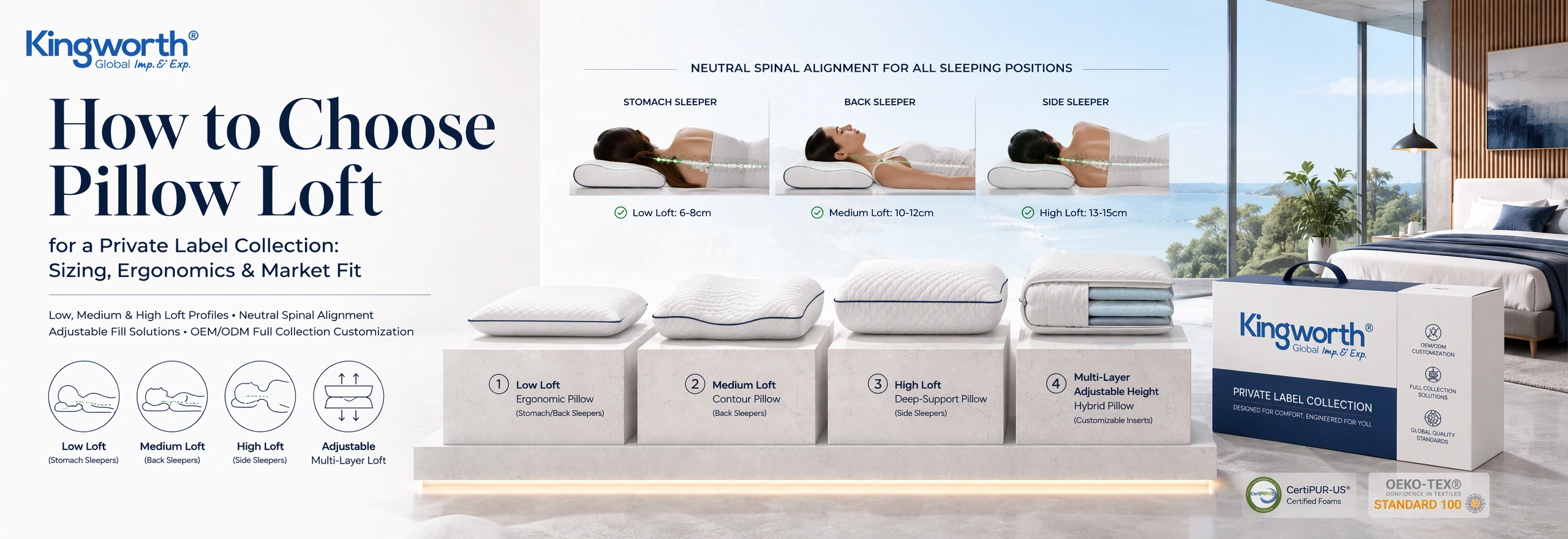
Choosing pillow loft is one of the most important decisions when developing a private label pillow collection. A pillow may look attractive, use premium materials, and carry a well-designed cover, but if its height does not suit the intended sleeper, customers may find it uncomfortable after only a few nights. For sleep brands, homeware importers, and bedding retailers, the challenge is not simply to source a low, medium, or high pillow. It is to translate different sleeping habits, body proportions, mattress characteristics, and material behavior into a clear and manageable product range.
This pillow loft guide explains how to evaluate pillow height, compare low vs high loft pillow options, conduct practical sample trials, and build a commercially sensible assortment. It also outlines the information buyers should include in a product specification, how to collect useful trial feedback, and how to work with an experienced pillow manufacturer and supplier during OEM and ODM development.
For a private label collection, the objective is not to create the largest possible number of height options. It is to create a small, understandable range that addresses meaningful customer differences, performs consistently in production, and can be explained clearly across product pages, packaging, and retail channels.
1. What Pillow Loft Really Means
Loft is more than uncompressed pillow thickness
Pillow loft generally describes the height or thickness of a pillow. However, a measurement taken when a pillow is lying unused on a table does not necessarily represent the height that supports a sleeper’s head during the night. Different filling materials respond differently to pressure. A soft fiber-filled pillow may look tall before use but compress substantially under the head. A resilient foam pillow may retain more of its original profile. An adjustable-fill pillow may also change shape depending on how the filling is distributed.
For this reason, buyers should distinguish between two measurements:
- Unloaded loft: the pillow’s height when it is not carrying a load, measured under an agreed test condition.
- Loaded or supported loft: the remaining height when a defined load is applied to the pillow under a specified test condition.
These measurements answer different questions. Unloaded loft helps buyers compare the product’s manufactured profile and check dimensional consistency. Loaded loft provides a more useful indication of how the pillow behaves when compressed. Neither figure should be reported without its measurement conditions, because the applied load, contact area, measurement location, and test duration can affect the result.
A private label buyer should therefore avoid approving a pillow based only on a supplier’s statement that it is 5 inches high. Ask whether the figure refers to the center, edge, or highest point; whether the pillow is measured immediately after unpacking; and whether the measurement is taken before or after compression.
Loft, firmness, and support are related but different
Loft describes height. Firmness describes how soft or resistant the pillow feels under pressure. Support describes how effectively the pillow maintains a suitable head and neck position for a particular sleeper. These characteristics interact, but they are not interchangeable.
For example, two pillows may have the same unloaded height but feel very different because one compresses more easily. A high-loft pillow with a soft filling may settle to a relatively low supported height. A medium-loft pillow with a more resilient construction may maintain a higher profile under the same test conditions. Buyers should evaluate all three characteristics rather than assuming that a taller pillow automatically provides better support.
| Specification | What it describes | What buyers should record |
|---|---|---|
| Unloaded loft | Height without an applied load | Measurement point, conditioning, and method |
| Loaded loft | Height under a defined load | Load, contact area, duration, and measurement point |
| Firmness | Resistance to compression or perceived softness | Test method and evaluation scale |
| Support | How the pillow holds the head and neck in use | Position-based trial feedback and observations |
Keeping these fields separate makes supplier comparisons more meaningful and reduces the risk of approving a sample that looks correct but performs differently in actual use.
2. Low vs High Loft Pillow: Which Sleepers Should Buyers Consider?
Low, medium, and high loft are useful retail descriptions, but they should be treated as starting points rather than universal fit rules. Sleep position is an important selection factor, yet body proportions, mattress response, filling behavior, and personal preference also influence the result.
One commonly used consumer classification describes low loft as less than 3 inches, medium loft as approximately 3 to 5 inches, and high loft as more than 5 inches. These categories can help organize a product range, but they are not a universal technical standard. Brands should define their own product categories using a consistent measurement method and validate the intended use through trials.
Low-loft pillows
A low-loft pillow has a relatively shallow profile. It may suit customers who prefer less elevation, including some stomach sleepers and some back sleepers. It can also be relevant for customers whose shoulders and upper bodies sink deeply into a soft mattress, reducing the gap between the head and the sleeping surface.
For product development, a low-loft option should not simply be made by reducing the amount of filling without checking its shape and stability. The pillow still needs to provide an even sleeping surface and avoid becoming excessively flat under normal use. Buyers should evaluate whether the filling shifts, whether the cover creates empty corners, and whether the pillow retains a consistent profile after repeated compression.
Medium-loft pillows
A medium-loft pillow can serve as a practical starting point for a broad retail audience, particularly customers who primarily sleep on their backs or change positions during the night. However, a medium label does not guarantee that the pillow will suit every combination sleeper. A customer who spends much of the night on their side may need more effective height, while another customer may prefer a flatter profile.
Medium loft is often a useful central option in a private label assortment because it gives retailers a reference product between lower and higher profiles. It can also provide a starting point for comparing alternative fillings, firmness levels, and cover constructions without introducing too many height variations at once.
High-loft pillows
A high-loft pillow is often considered by side sleepers because the head needs to be supported across the space between the shoulder and the mattress. A higher profile may be appropriate for some customers with broader shoulders or a mattress that does not allow much shoulder sink.
However, high loft is not automatically better for side sleeping. If the pillow is too tall or does not compress sufficiently, it may push the head upward. If it is too soft, it may collapse and fail to maintain the expected height. Buyers should therefore evaluate the pillow’s loaded profile and firmness together rather than selecting a high-loft specification based on appearance alone.
| Loft category | Potential customer fit | Key development consideration |
|---|---|---|
| Low | Some stomach sleepers and customers who prefer a shallow profile | Prevent excessive flattening and uneven filling distribution |
| Medium | Some back sleepers and combination sleepers | Balance head elevation, compression, and shape retention |
| High | Some side sleepers and customers with a larger shoulder-to-head gap | Check loaded height, firmness, and head alignment |
These descriptions should guide product development and customer communication, not replace individual fit testing. A brand should avoid presenting a single loft category as the correct choice for every person who sleeps in a particular position.
3. Compare Side-Sleeping and Back-Sleeping Requirements
Side sleepers: evaluate the shoulder-to-head gap
When a person sleeps on their side, the shoulder creates a space between the head and the mattress. The pillow needs to fill an appropriate part of this space without forcing the head upward or allowing it to drop toward the mattress. This is why side sleepers are often directed toward medium- or higher-loft pillows.
For a private label trial, buyers should pay attention to:
- Shoulder width: a wider shoulder structure may create a larger gap to fill, although body shape and sleeping posture also matter.
- Shoulder sink: the amount the shoulder settles into the mattress changes the remaining gap.
- Loaded pillow height: the height after the sleeper’s head has compressed the pillow is more informative than appearance alone.
- Firmness and recovery: the pillow should not collapse too easily or push back so strongly that the customer feels excessive elevation.
- Surface stability: the head should not roll toward an edge or sink into an uneven area.
Buyers should include testers with different shoulder widths and body proportions. A sample that suits one side sleeper cannot establish the ideal loft for the entire customer group.
Back sleepers: avoid excessive head elevation
Back sleepers generally need a different profile from side sleepers. A pillow that is too high may push the head forward, while one that is too low may provide insufficient support for the preferred neck position. The aim of a trial is to identify a comfortable, stable relationship between the head, neck, and upper back.
During testing, observe whether the pillow creates an obvious forward tilt, allows the head to fall backward, or leaves the neck without the intended support. The pillow should also be tested for several minutes rather than judged only during the first moment of contact. Some materials soften or settle after sustained pressure.
Combination sleepers: test transitions, not only one position
Customers who move between side and back sleeping can be more difficult to serve with a fixed-height pillow. A product that feels appropriate on the side may feel too elevated when the customer rolls onto their back. An adjustable-fill construction may offer more flexibility, but it also introduces additional development and quality-control considerations.
For combination sleepers, buyers should ask testers to move naturally between positions during the trial. Record whether the pillow shifts, whether the head remains supported, and whether the tester needs to fold, bunch, or reposition the pillow repeatedly. Such behavior can reveal a product-fit problem that a static demonstration would miss.
4. Why Shoulder Width and Mattress Sink Must Be Included in Trials
A pillow is not used in isolation. Its effective height depends partly on the sleeper’s body and the mattress beneath the shoulder. If the shoulder sinks farther into a soft mattress, the head-to-mattress gap may become smaller. If the shoulder remains higher on a firm mattress, the pillow may need to fill a larger gap. This means that the same pillow can feel different on two mattresses even when the sleeper is unchanged.
Build a simple shoulder-width and mattress test matrix
Buyers do not need a complicated laboratory to identify obvious fit differences. A structured sample trial can begin with a small group of testers and a consistent record sheet. Include more than one shoulder-width group and more than one mattress feel. The purpose is not to create a medical recommendation, but to discover whether the proposed loft options cover the intended customer segments.
| Trial variable | Suggested grouping | What to observe |
|---|---|---|
| Shoulder width | Narrower, medium, broader | Whether the pillow fills the side-sleeping gap without excessive elevation |
| Mattress feel | Soft, medium, firm | How much the shoulder settles into the mattress |
| Sleep position | Side, back, combination | Head position, perceived support, and need for repositioning |
| Pillow construction | Fixed fill, adjustable fill, contoured foam | Compression, recovery, shape stability, and fit flexibility |
Where possible, use the same mattress for the first comparison so that the pillow is the main changing variable. A second round can test the shortlisted pillows on different mattress feels. This two-stage process helps buyers distinguish a pillow-construction issue from a mattress-related fit difference.
Do not turn a small trial into a universal height formula
A small sample group can identify patterns, but it cannot establish a universal pillow-height formula for every customer. The results should be treated as product-development evidence for the target market. If a brand sells into multiple regions or customer segments, it may need additional trials before finalizing the assortment.
5. How to Measure Pillow Loft Consistently
Before comparing suppliers or approving a sample, define how the height will be measured. A pillow’s surface is often curved, filled unevenly, or shaped with different contours. A single measurement taken at an arbitrary point can therefore be misleading.
For a standard rectangular pillow
Record the unloaded height at the center and, where relevant, at defined points toward the left and right sides. Use the same flat reference surface and measurement tool for every sample. If the pillow is filled with loose fiber or shredded foam, allow it to settle under the same conditioning and handling procedure before measuring.
For loaded measurements, define the applied load, contact area, duration, and measurement point. Do not compare a measurement taken with a small concentrated weight against one taken with a broad contact plate as if they were equivalent. The test method should be documented and repeated in the same way for each sample.
For dual-height or contoured pillows
Contoured pillows require more than one measurement because the two sides may have different heights. The central sleeping area may also have a different profile from the raised neck-support zones.
For a dual-height contour, buyers should identify and label the following measurement points:
- Low-side edge: measure the highest stable point along the lower contour, using a fixed location from the edge.
- High-side edge: measure the corresponding point along the higher contour.
- Central head cradle: record the height or depth of the central resting area according to the agreed geometry.
- Neck-support region: record the raised contour intended to contact the neck.
- Transition area: check the slope between the central area and each raised edge for consistency.
The exact measurement locations should be shown in a drawing or sample specification. A supplier and buyer should not rely on informal descriptions such as low side and high side without defining where the measurement begins and ends.
For contoured foam products, buyers should also check the shape after unpacking and after the agreed recovery period. If a product is compressed for shipping, the inspection procedure should specify how long it must recover before dimensional approval.
6. Choose the Right Pillow Construction for the Loft Strategy
Loft is influenced by the filling and construction, not just the outer dimensions. A private label collection should consider whether each product will use a fixed profile, an adjustable filling system, or a shaped core.
Memory foam pillows
Memory foam pillows can be developed in different profiles and firmness levels. A molded foam core may provide a more defined shape, while shredded memory foam can allow some adjustment through redistribution or removal of filling. These constructions should not be treated as identical.
For molded foam, buyers should specify the intended contour, dimensions, foam characteristics, and cover fit. For shredded foam, they should evaluate how easily customers can adjust the fill, whether the filling stays evenly distributed, and whether the pillow maintains a stable profile after repeated use.
Cervical and contoured pillows
Cervical pillows often use shaped zones to provide different levels of elevation across the product. Their suitability depends on the relationship between the contour, the user’s body, and the preferred sleeping position. Buyers should record both the low and high sides, the central cradle, and the neck-support geometry.
Because the shape is more specialized than a standard rectangular pillow, product photography and diagrams should clearly show the intended orientation. Retail descriptions should explain which side is higher and how customers should position the pillow, without making unsupported medical claims.
Adjustable-fill pillows
Adjustable-fill pillows can be useful when a brand wants to serve customers with different height preferences without creating a separate fixed-height SKU for every segment. However, adjustability must be practical. Buyers should confirm whether the pillow can be opened easily, whether filling can be added or removed, whether the adjustment range is meaningful, and whether customers can store excess filling cleanly.
Record the as-shipped loft as well as the lowest and highest practical settings. If the brand advertises an adjustable height range, validate that range through repeatable measurements rather than estimating it from the amount of filling supplied.
7. Build a Limited Loft Assortment Without Creating SKU Complexity
One of the most common private label development mistakes is launching too many pillow heights before the brand understands customer demand. More variations can increase sampling work, inventory requirements, packaging complexity, forecasting difficulty, and the risk of slow-moving stock.
A more controlled approach is to start with a limited assortment that has a clear purpose for each option. For example, a brand may develop one lower-profile option, one central or medium-profile option, and one higher-profile option. The final structure should depend on the product construction and target customer research, not on a requirement to offer three options in every collection.
Use customer needs to justify each SKU
Each height variation should have a defined role. If two options perform almost identically in customer trials, the brand may not need both. If one option serves a distinct customer group or sleeping position, it may justify a separate SKU.
| Assortment option | Possible role | Decision question |
|---|---|---|
| Low profile | Customers who prefer less elevation | Does it remain supportive rather than becoming too flat? |
| Medium profile | Central range option for broader retail coverage | Does it perform consistently across the intended tester group? |
| High profile | Customers who need more height or prefer a fuller pillow | Does it maintain a suitable loaded height without over-elevating the head? |
| Adjustable profile | Customers whose height preference varies | Is the adjustment range easy to understand and use? |
Separate height variations only when the difference is meaningful
Buyers should consider whether height variations can share the same cover, packaging structure, labeling system, and production workflow. Shared components may simplify procurement, but they must not create a poor fit or misleading product presentation. If a contoured pillow requires a different cover pattern for each height, that additional complexity should be included in the product-cost and inventory review.
For an initial launch, a brand can prioritize a small number of validated options, monitor sales and return reasons, and expand only when the evidence supports another SKU. This approach helps maintain a more manageable OEM/ODM product development process and reduces the risk of investing in variations that customers do not understand.
8. Record Trial Feedback and Return Reasons
A sample trial should produce more than a general comment such as comfortable or too high. Buyers need structured feedback that can be compared across testers and linked to a specific sample version. A useful trial record includes the pillow model, filling construction, unloaded loft, loaded loft, mattress feel, sleeping position, and tester profile.
Use a consistent feedback form
Ask each tester to evaluate the pillow under the same instructions. A simple rating scale can be used for perceived height, firmness, support, and overall comfort. Include open comments so testers can describe issues that a rating alone may not capture.
| Feedback field | Example entry | Why it matters |
|---|---|---|
| Primary sleeping position | Side, back, or combination | Connects the result to intended use |
| Shoulder width group | Narrower, medium, or broader | Helps identify body-proportion differences |
| Mattress feel | Soft, medium, or firm | Provides context for shoulder sink |
| Perceived loft | Too low, suitable, or too high | Captures the customer’s height preference |
| Support and stability | Stable, uneven, or collapses too much | Identifies construction issues |
| Adjustment behavior | Easy, difficult, or not applicable | Checks the usability of adjustable designs |
| Overall decision | Keep, modify, or reject | Turns feedback into a development action |
Classify return reasons instead of treating every return as a product defect
After launch, customer returns and complaints can help identify whether the loft assortment is working. However, return reasons should be categorized carefully. A customer may return a pillow because it is too high, too low, too firm, too soft, or different from the product description. Other reasons may relate to odor, packaging recovery, cover feel, delivery damage, or a mismatch between the customer’s expectations and the product’s intended use.
For useful analysis, separate at least the following categories:
- Height mismatch: the pillow feels too high or too low.
- Compression mismatch: the pillow compresses more or less than expected.
- Shape or stability issue: the filling shifts, the pillow becomes uneven, or a contour does not feel suitable.
- Material or sensory issue: the customer dislikes the cover texture, filling feel, or other material characteristics.
- Expectation mismatch: product images or descriptions do not explain the height or intended sleeping position clearly enough.
- Packaging or recovery issue: the pillow does not recover to the expected shape within the stated handling period.
Review these reasons by SKU, sales channel, market, and product batch where possible. If a particular height receives repeated complaints from one customer segment, the answer may be a specification adjustment, a clearer product description, or a better-matched assortment. Do not automatically change the entire collection based on a small number of unclassified returns.
9. What to Include in a Private Label Pillow Loft Specification
A clear specification reduces misunderstandings between the brand, product developer, factory, and quality-control team. It also creates a reference point for sample approval and future production inspections.
For each pillow SKU, buyers should consider documenting the following information:
- Product identity: model name, SKU, intended customer group, and intended sleeping positions.
- Overall dimensions: length, width, and agreed dimensional tolerances.
- Loft measurements: unloaded height and, where required, loaded height.
- Measurement method: reference surface, measurement points, conditioning, load, contact area, and test duration.
- Construction: filling type, core design, cover construction, and any removable components.
- Firmness target: the agreed evaluation method or reference sample.
- Shape details: contour heights, central cradle, edge profile, and transition geometry where applicable.
- Care information: washing or cleaning instructions based on the actual materials and approved test results.
- Packaging: retail presentation, compression method if applicable, recovery instructions, and shipping carton requirements.
- Quality criteria: visual inspection points, dimensional checks, workmanship requirements, and approved sample reference.
Do not rely on a product name such as high-loft memory foam pillow as the full specification. The name communicates a market position, but it does not define measurable product characteristics. If the brand intends to use a height claim on packaging or an online listing, confirm the measurement method and tolerance before artwork approval.
10. Sample Approval and Production Quality Control
Once the buyer has selected the preferred loft strategy, the next step is to convert the approved sample into a repeatable production specification. A sample that performs well is only useful if the factory can reproduce its dimensions, filling distribution, contour, and cover fit in bulk production.
Use a controlled sample approval process
- Initial brief: share the target market, intended sleeping positions, product construction, target loft categories, and packaging requirements.
- First sample: review the overall shape, dimensions, cover fit, material appearance, and preliminary loft measurements.
- Functional trial: test the sample with the intended customer group and record position-based feedback.
- Revision: adjust the filling quantity, foam profile, contour, or cover construction where justified by trial results.
- Final approval: confirm the reference sample, specification sheet, measurement method, and approved artwork.
- Production verification: check incoming materials, first-piece output, in-process consistency, final product dimensions, and packing condition.
Keep the approved reference sample and records
The approved sample should be retained as a physical reference or documented through an agreed sample-control system. Keep photographs, dimensional records, material details, and approval dates together. If the factory changes a filling source, foam formulation, cover fabric, or construction process, assess whether the change could affect loft or compression behavior before accepting it as equivalent.
At Kingworth, the development and supply process can be organized around sample review, specification confirmation, incoming quality inspection, first-piece approval, in-process quality control, final inspection, and packing confirmation. The exact inspection plan and acceptance criteria should be agreed for each order. Buyers who require a particular sampling level or inspection standard should state it in the purchase specification rather than assume that every order uses the same plan.
11. How to Evaluate a Pillow Manufacturer and OEM/ODM Supplier
For sleep brands and homeware importers, choosing a pillow manufacturer involves more than comparing quotations. The supplier should be able to understand the intended loft strategy, explain the construction options, and translate an approved design into consistent production.
During supplier evaluation, buyers should ask:
- Can the supplier develop different pillow heights using the proposed filling or core construction?
- Can it provide measurement records for unloaded dimensions and agreed loaded-height tests?
- Can it produce molded, contoured, or adjustable-fill designs where required?
- Can the supplier confirm the filling and cover materials used in the sample?
- Can it maintain a reference sample and production specification for repeat orders?
- Can it support private label branding, woven labels, care labels, packaging, and retail presentation?
- Can it explain its incoming, in-process, and final quality-control procedures?
- Can it identify which specifications require additional testing or market-specific compliance review?
Kingworth is a Ningbo-based manufacturer and B2B supplier supporting comfort-product development, OEM/ODM customization, wholesale supply, and export coordination. Its broader pillow product direction includes memory foam, cervical, cooling, CPAP, pregnancy, and side-sleeper pillow categories. Buyers can discuss the intended market position, preferred construction, height range, cover requirements, and private label presentation before confirming a specific product brief.
For hotel and hospitality buyers, pillow loft should be evaluated alongside laundering and maintenance requirements. A pillow that performs well in a home trial may behave differently after repeated commercial washing, drying, handling, or replacement cycles. Hotel projects should therefore confirm the care method, cover construction, and product condition after the agreed wash trial before making a bulk commitment.
12. Practical Product Development Recommendations for a Private Label Collection
A successful pillow collection does not need a separate SKU for every possible body type. It needs a clear product architecture, honest product descriptions, and a repeatable process for validating height and support.
For many brands, a practical development sequence is:
- Define the target customer: identify the main sales channel, target market, price position, and primary sleeping-position groups.
- Select the construction: decide whether the range will use fiber fill, memory foam, contoured foam, adjustable fill, or a combination.
- Set initial loft targets: create a limited number of profiles with clear differences and documented measurement methods.
- Build a representative sample group: include different shoulder widths, mattress feels, and sleeping positions.
- Evaluate loaded behavior: compare how each sample compresses and recovers rather than relying on appearance.
- Reduce unnecessary variations: remove options that do not provide a meaningful customer or commercial benefit.
- Approve the specification: lock dimensions, materials, measurement conditions, packaging, and quality criteria.
- Review post-launch data: monitor sales, customer feedback, and return reasons before expanding the range.
This process allows a brand to develop a collection based on customer needs and product evidence rather than adding height options simply because competitors offer them. It also gives the OEM/ODM supplier a clearer brief and helps reduce avoidable sample revisions.
Frequently Asked Questions About Pillow Loft
What is the difference between pillow loft and pillow height?
The terms are often used interchangeably in retail descriptions. In product development, however, buyers should define exactly what is being measured. A pillow’s unloaded height is not necessarily the same as its supported height after compression. A clear specification should state the measurement condition and location.
Is a high-loft pillow always better for side sleepers?
No. Some side sleepers need a higher profile because of the gap between the head and mattress, but shoulder width, mattress sink, pillow firmness, and filling compression all influence the result. A pillow that is too high can elevate the head excessively. Side-sleeping suitability should be confirmed through a structured trial.
Should back sleepers choose a low- or medium-loft pillow?
Many back sleepers begin by evaluating medium or relatively low profiles, but there is no single height that suits everyone. The pillow should be tested for head elevation, neck support, and compression under the sleeper’s head. The final choice should reflect the product’s loaded behavior and the customer’s preference.
How should buyers compare two pillows with the same advertised height?
Compare their construction, firmness, loaded height, recovery behavior, and shape stability. Make sure both pillows are measured using the same reference surface, load, contact area, duration, and measurement points. Otherwise, the numbers may not be directly comparable.
How many loft options should a new private label collection launch with?
There is no fixed number for every brand. A limited range with clearly differentiated low, medium, and high profiles may be a useful starting structure, but the final assortment should depend on customer research and sample trials. An adjustable model may be considered when it provides a meaningful alternative to multiple fixed-height SKUs.
How do buyers measure a dual-height cervical pillow?
Record the low-side height, high-side height, central head-cradle profile, and neck-support region at defined measurement points. The locations should be marked in a drawing or specification. If the pillow is compressed for shipping, define the recovery period before measurement and approval.
Can a pillow manufacturer customize loft for a private label brand?
Yes, depending on the construction and production process. Customization may involve filling quantity, foam profile, contour geometry, cover dimensions, or an adjustable-fill design. Buyers should provide a clear target brief and confirm the final dimensions and performance through sample approval before bulk production.
What should buyers check before placing a bulk pillow order?
Confirm the approved reference sample, product dimensions, loft measurement method, filling and cover materials, firmness expectations, packaging, labeling, inspection criteria, and any market-specific compliance requirements. Also confirm project-specific MOQ, sample arrangements, production schedule, and shipping details with the supplier.
Develop a Better-Fitted Private Label Pillow Collection with Kingworth
A well-planned pillow loft range begins with a clear understanding of the customer, but it succeeds through accurate specifications and consistent production. By separating unloaded height from loaded support, testing different sleeping positions, accounting for shoulder width and mattress sink, and using real customer feedback to control SKU decisions, brands can build a collection that is easier to source, explain, and manage.
Kingworth supports B2B buyers with comfort-product development, OEM/ODM customization, sample coordination, specification review, quality-control processes, and export supply support. Whether you are developing a memory foam pillow, a cervical pillow, a cooling pillow, or a broader private label bedding collection, our team can discuss the product structure and customization requirements for your target market.
To discuss your pillow loft guide, product concept, or private label sourcing project, contact Kingworth at info@king-worth.com or +86 133 3687 4040. Share your target customer, preferred pillow construction, proposed height range, and branding requirements so the project can begin with a clear and practical product brief.