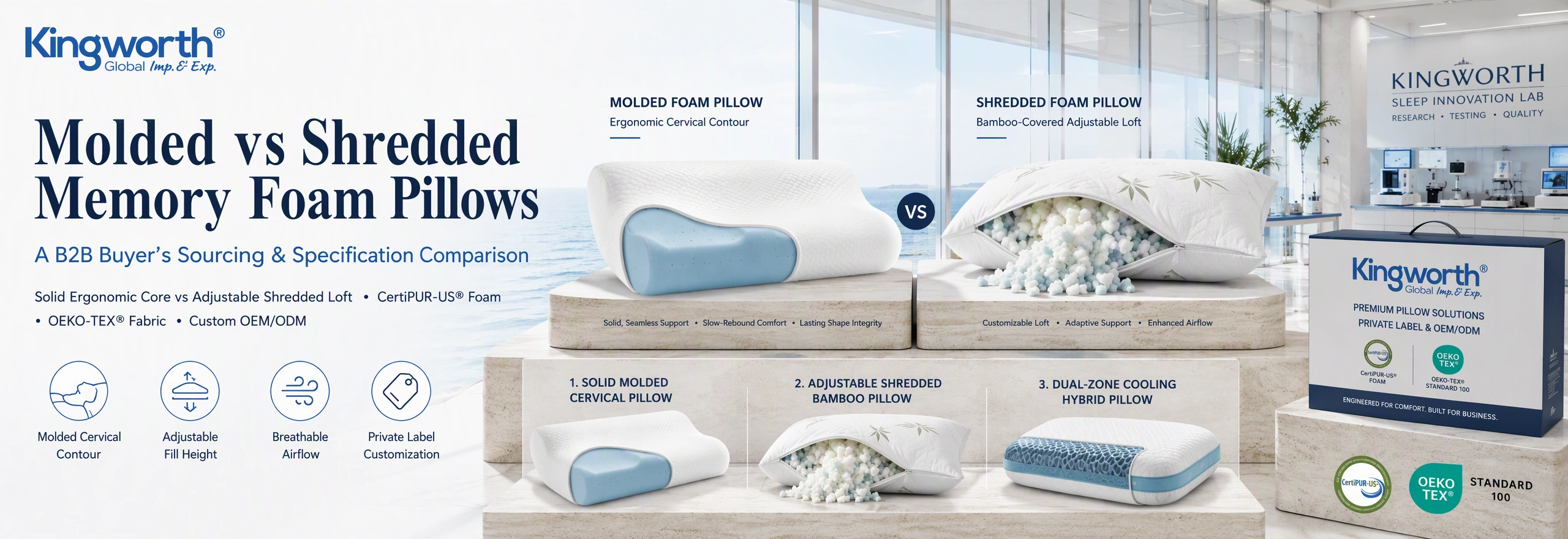
Molded vs Shredded Memory Foam Pillows: A Buyer’s Comparison
Choosing between a molded and a shredded memory foam pillow is an important product-development decision for sleep brands, home textile importers, bedding retailers, and hospitality buyers. Although both designs use memory foam, their internal construction creates different product characteristics. A molded memory foam pillow uses a shaped foam core, while a shredded foam pillow contains multiple pieces of foam inside an outer cover. These structural differences influence shape stability, adjustability, product handling, packaging, care instructions, and retail positioning.
For B2B buyers comparing molded vs shredded memory foam pillows, the most useful question is not which construction is universally better. It is which design fits the target customer, price positioning, distribution channel, packaging strategy, and product specification. A molded pillow may suit a brand seeking a defined contour and consistent core geometry. A shredded memory foam pillow may suit a program that prioritizes a flexible fill structure or a design with an adjustable filling system, provided that adjustability is actually built into the product.
Kingworth, a Ningbo-based comfort-product manufacturer and export supplier, supports B2B product development through OEM/ODM discussions, sample coordination, specification review, packaging planning, and export communication. The right pillow configuration should be established through a model-specific review and approved sample. Actual foam formulation, density, fill weight, dimensions, cover composition, washability, compression limits, and production arrangements must be confirmed for each product rather than inferred from its category name.
1. Molded vs Shredded Memory Foam Pillows: The Basic Difference
What is a molded memory foam pillow?
A molded memory foam pillow generally uses a single shaped foam core produced or finished to a defined geometry. The core may have a conventional pillow profile or a contoured shape with different heights or curves. The final geometry depends on the specific design, foam formulation, and manufacturing process.
Because the core is one formed piece rather than a collection of loose foam pieces, the pillow has a defined internal shape. Buyers can evaluate its height, contour, dimensions, and recovery characteristics against a reference sample. However, a molded core does not automatically guarantee a particular firmness, softness, cooling effect, or ergonomic outcome. Those characteristics depend on the actual foam and complete pillow construction.
What is a shredded memory foam pillow?
A shredded memory foam pillow contains multiple foam pieces inside an outer shell. The pieces may vary in shape and size according to the approved manufacturing specification. Their arrangement can allow the filling to shift when the user presses, fluffs, or repositions the pillow.
Some shredded foam pillows include a zippered inner liner that allows the user to remove or add filling. Others are sealed and are not intended to be adjusted. This distinction matters for retail claims: a shredded construction alone does not prove that the pillow is adjustable. Buyers should verify the closure, access to the filling, availability of replacement filling, and instructions for safe handling before describing a product as customizable by the end user.
Cross-section comparison
The following simplified diagrams illustrate the difference in internal construction. They are explanatory illustrations, not engineering drawings or representations of a specific Kingworth SKU.
| Molded memory foam pillow | Shredded memory foam pillow |
|---|---|
Outer cover ┌─────────────────────┐ │ Shaped foam core │ │ ┌───────────────┐ │ │ │ │ │ │ │ Single formed │ │ │ │ foam structure│ │ │ │ │ │ │ └───────────────┘ │ └─────────────────────┘ | Outer cover ┌─────────────────────┐ │ /\/\ /\ /\/\ │ │ Foam pieces in a │ │ flexible filling │ │ arrangement │ │ \/\/ /\/\ \/ │ └─────────────────────┘ Optional inner liner and access closure |
| One defined foam core with a specified profile. | Multiple foam pieces contained within a shell or liner. |
For sourcing purposes, the most important distinction is how the core or filling is controlled. A molded pillow is specified primarily through core geometry and material characteristics. A shredded pillow requires additional controls for filling composition, piece characteristics, total fill weight, distribution, and—if applicable—the adjustment system.
2. Shape Stability, Contouring, and Adjustability
Shape stability in molded pillows
A molded core retains a defined shape because the foam itself establishes the pillow’s geometry. This can make the product suitable for a brand that wants a consistent silhouette across its assortment. For contoured models, the height and shape of the core can be specified and inspected against an approved sample.
Nevertheless, the core’s profile is only one part of the finished pillow. Foam firmness, resilience, compression behavior, cover tension, and manufacturing tolerances all influence how the pillow feels and performs in use. Buyers should evaluate the complete product rather than assuming that two pillows with the same outline will provide the same experience.
Flexibility in shredded pillows
Shredded foam can move within the pillow shell, allowing the filling to redistribute under pressure. Depending on the filling quantity and shell design, users may be able to fluff the pillow, shape the edges, or alter the way the fill is arranged. These characteristics can support a different user experience from a pillow with a fixed molded profile.
However, flexibility is not the same as guaranteed adjustability. A sealed shredded pillow may allow the filling to move but may not allow the user to change the amount of filling. For a genuinely adjustable design, buyers should confirm that the product has a suitable opening, a secure closure, clear adjustment instructions, and an agreed method for handling removed filling.
| Evaluation point | Molded core | Shredded foam |
|---|---|---|
| Internal geometry | Defined by the shaped core | Influenced by the arrangement and amount of filling |
| Shape adjustment | Generally limited by the core’s design | May be possible by redistributing filling |
| Fill removal | Not applicable to a single-piece core unless the product has a different construction | Possible only when the design provides access to the filling |
| Specification focus | Core profile, dimensions, density, firmness, and recovery | Foam composition, fill weight, piece characteristics, distribution, and closure |
| Inspection focus | Geometry, dimensions, surface condition, and core consistency | Filling quantity, distribution, closure integrity, and consistency between units |
How should a buyer choose?
Choose a molded construction when a defined profile and repeatable core geometry are central to the product concept. Consider shredded foam when the desired experience involves a more flexible filling arrangement or a verified user-adjustment feature. In either case, confirm the actual sample’s behavior, and avoid promising a specific sleeping posture, pain-relief effect, or health outcome without appropriate product-specific evidence.
3. Fill Weight Is Not Foam Density
One of the most common technical misunderstandings in pillow sourcing is treating fill weight and foam density as interchangeable measurements. They describe different properties and should be recorded separately in the product specification.
What foam density means
Foam density describes the mass of foam per unit of volume, commonly expressed in kilograms per cubic metre (kg/m³). It is a material characteristic used to identify and compare foam specifications. Density alone does not fully determine firmness, softness, resilience, comfort, or durability. Those properties also depend on the foam formulation, structure, processing, and other material characteristics.
For molded pillows, the density specification generally applies to the core material. For shredded pillows, buyers should clarify whether the density requirement refers to the source foam before shredding and whether the filling may contain multiple foam types or grades. A blended filling should not be described as a single uniform foam specification unless the supplier can support that description.
What fill weight means
Fill weight is the total mass of the filling inside the pillow. In a shredded pillow, it refers to the combined foam pieces contained within the product. In a molded pillow, the comparable measurement is usually the mass of the core, although the technical specification should identify the measurement precisely.
A pillow with a higher fill weight is not necessarily made from higher-density foam. Two pillows can have different dimensions, core shapes, fill quantities, and foam densities. They can therefore have different total masses while producing different experiences in use.
| Specification | What it describes | Why buyers need it |
|---|---|---|
| Foam density | Mass of foam per unit volume | Helps identify the intended material specification |
| Core or fill weight | Total mass of the foam core or loose foam filling | Supports product consistency and weight verification |
| Pillow dimensions | Length, width, and finished height or profile | Defines the product size and fit within the cover |
| Firmness or indentation response | Response under an agreed test method or evaluation protocol | Helps characterize the intended feel without relying only on density |
| Recovery behavior | How the material returns after compression under specified conditions | Supports packaging evaluation and sample comparison |
How to specify foam correctly
- State the foam type and the required density separately.
- For shredded foam, define the approved filling composition and target net fill weight.
- For molded foam, define the core dimensions, profile, and relevant material requirements.
- Clarify the permitted tolerances for dimensions and weight.
- Identify the method and conditions used to measure density or other material properties when those measurements are required.
- Record any approved blend, recycled-content requirement, or alternative material in the BOM.
Buy