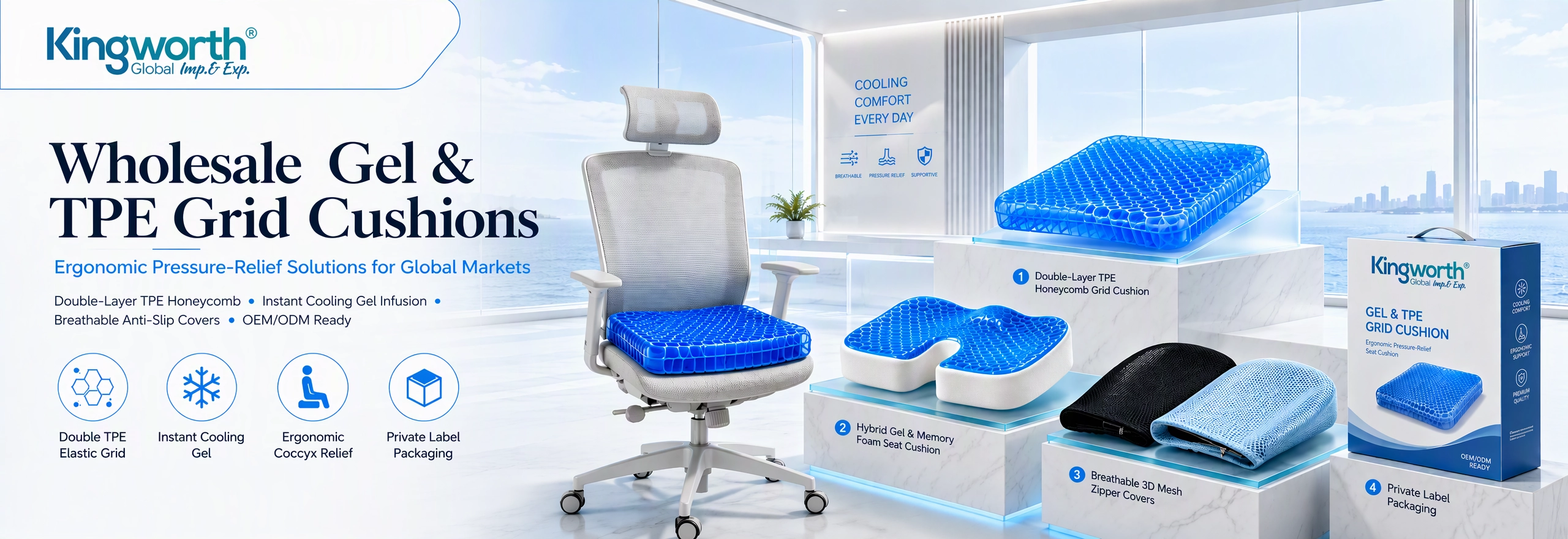
Wholesale Gel Seat Cushions and TPE Grid Cushions
Choosing a reliable gel seat cushion manufacturer involves more than finding a soft seat pad with an attractive appearance. Ergonomic product brands, office supply distributors, and comfort product importers need to understand the differences between solid gel cushions, TPE grid cushions, and gel-composite foam designs before selecting a product for wholesale or private-label distribution. Material identification, seat-fit dimensions, thickness, base construction, cleaning instructions, packaging, and substantiated performance claims all influence product suitability and long-term sourcing reliability.
Kingworth, Ningbo Kingworth Global Imp. & Exp. Co., Ltd., is a China-based comfort product manufacturer and export supplier established in 2016. We support B2B buyers with product specification review, OEM/ODM development coordination, sample evaluation, customization planning, quality-control coordination, and export supply arrangements. Our wider comfort product range includes ergonomic cushions, pillows, bedding, functional blankets, and related comfort products.
This guide explains how to evaluate gel seat cushions and TPE seat cushions for wholesale programs, how to distinguish different material constructions, which specifications should be confirmed before ordering, and how to develop a product that meets the requirements of your target market. It is intended for businesses sourcing products for office seating, home use, mobility-related seating, retail distribution, and other suitable applications.
What Is a Gel Seat Cushion Manufacturer Expected to Supply?
A professional gel seat cushion manufacturer should be able to identify the product’s actual construction, document its important dimensions, explain applicable care instructions, and establish a repeatable specification for sampling and bulk production. For B2B buyers, these capabilities are more useful than relying on broad descriptions such as orthopedic, pressure-relieving, or cooling without supporting product information.
Gel seat cushions are not all constructed in the same way. A product may use a solid or molded gel structure, an open-grid thermoplastic elastomer structure, or a combination of gel-related components and foam. These constructions have different material properties and may require different inspection, cleaning, packaging, and product-description practices.
Key information to confirm before sourcing
- Material identity: Confirm whether the product is solid gel, TPE grid, gel-composite foam, or another defined construction.
- Dimensions: Record the actual length, width, thickness, and any relevant shape or contour measurements.
- Seat compatibility: Compare the cushion dimensions and shape with the intended chair, car seat, wheelchair, or other seating surface.
- Base construction: Identify the actual non-slip material or other attachment feature, if present.
- Cleaning instructions: Establish which components can be washed, wiped, or removed for cleaning.
- Performance evidence: Confirm which claims are supported by testing of the specific model.
- Customization: Review feasible options for colors, covers, labels, packaging, and dimensions.
- Order conditions: Confirm model-specific MOQ, sample arrangements, production lead time, and shipping requirements.
At Kingworth, the goal of product development coordination is to align these details before a product moves into bulk production. The exact specifications and commercial terms must be confirmed for the selected model and order rather than assumed to apply across every cushion design.
Solid Gel, TPE Grid, and Gel-Composite Foam: What Is the Difference?
For buyers comparing a TPE seat cushion with a gel cushion, material terminology is a critical starting point. Products may look similar in online photographs but use different materials and construction methods. A transparent product specification should describe the actual structure rather than treating solid gel, TPE, and gel-composite foam as interchangeable terms.
Solid gel seat cushions
A solid gel seat cushion uses a gel material as a major part of its cushioning structure. Depending on the specific design, the material may be molded or formed into a particular profile. Buyers should confirm the precise material description and construction because the term gel alone does not identify a single standardized formulation.
When evaluating a solid gel cushion for wholesale, consider the following:
- Exact material identification and any available technical documentation.
- Finished length, width, thickness, and overall shape.
- Flexibility and shape behavior under the intended use conditions.
- Surface texture and any integrated grid or contour features.
- Whether the cushion includes a separate cover.
- Whether the product can be washed or should only be wiped clean.
- Whether the base includes a non-slip component and what material it uses.
- Packaging requirements and any restrictions on compression or folding.
Solid gel construction should not automatically be described as providing a quantified cooling effect or a clinically demonstrated pressure-distribution benefit. Those claims require evidence appropriate to the specific model and the wording used.
TPE grid seat cushions
TPE stands for thermoplastic elastomer. A TPE grid cushion uses a TPE-based material arranged in a grid or lattice structure. Depending on the design, the structure may contain open spaces between grid elements, which can influence flexibility, air movement around the structure, weight, and the way the cushion deforms under load.
For wholesale buyers, the relevant questions include:
- Is the grid material confirmed as TPE?
- What is the actual grid pattern and overall cushion geometry?
- What are the measured dimensions and thickness?
- How does the structure behave when compressed under the agreed evaluation conditions?
- Can the cushion be rinsed or wiped clean according to the manufacturer’s instructions?
- Does the design include a cover, a separate base, or an integrated non-slip feature?
- What packaging method is suitable for the grid structure?
Not all grid cushions use the same polymer, geometry, wall thickness, or material formulation. A product photograph is not sufficient to establish the material or exact structure. Buyers should obtain a product specification or material documentation for the selected model.
Gel-composite foam seat cushions
A gel-composite foam cushion combines a foam component with a gel-related component or layer. The precise construction can vary. The gel may be incorporated into a particular section, positioned as a layer, or combined with foam in another defined arrangement. Buyers should ask for a cross-section or construction description if the relationship between the components affects the product’s intended positioning.
For this type of cushion, confirm:
- The foam type and the identity of the gel-related component.
- Whether the gel is integrated, layered, or arranged in another configuration.
- The dimensions and thickness of the assembled product.
- Whether the cover is removable and washable.
- Which components must remain dry during cleaning.
- Whether the product can be compressed for shipping and how it should recover.
- Which material and performance claims are supported by documentation.
A gel-composite foam cushion should not be described simply as a solid gel cushion if foam makes up a substantial part of its construction. Clear material descriptions help reduce customer confusion and allow distributors to prepare accurate product listings.
Construction comparison for B2B sourcing
| Construction | What defines it | Key sourcing checks |
|---|---|---|
| Solid gel | Gel material forms a major part of the cushioning structure | Material identity, dimensions, shape, cleaning, packaging, and verified performance |
| TPE grid | Thermoplastic elastomer arranged in a grid or lattice structure | Polymer identification, grid geometry, thickness, deformation behavior, and cleaning |
| Gel-composite foam | Foam combined with a gel-related component or layer | Component materials, cross-section, care requirements, dimensions, and compression suitability |
This comparison describes general construction categories, not a guarantee that every configuration is available as a standard Kingworth product. The actual product model and construction should be confirmed before the buyer approves the quotation or final product description.
Grid Shapes and Thickness: What Buyers Should Specify
Grid geometry is an important part of TPE seat cushion design. The pattern affects the visible structure and may influence flexibility and deformation behavior. However, a grid pattern alone does not establish that a cushion has better pressure distribution, greater airflow, or superior comfort. These outcomes depend on the complete design and should be evaluated when they are central to the product’s positioning.
Grid geometry
Grid cushions may use different cell shapes, spacing, wall arrangements, and overall contours. The exact available patterns depend on the manufacturer’s product range, tooling, and material construction. Buyers should request photographs or physical samples of the specific grid designs being considered rather than selecting a pattern from a generic description.
When comparing designs, review:
- Cell shape: Identify the actual geometry of the grid openings.
- Grid spacing: Confirm the pattern dimensions and spacing where these are controlled product characteristics.
- Wall or web structure: Review the thickness and arrangement of the material connecting the grid elements.
- Overall contour: Confirm whether the top surface is flat, contoured, or otherwise shaped.
- Edge construction: Check the border, perimeter, and how the grid transitions to the cushion edge.
- Surface and base: Determine whether a separate cover or non-slip base is included.
For a private-label program, the approved sample should become the reference for grid appearance and dimensions. If the grid design changes during development, the revised product should be reviewed to determine whether its fit, flexibility, packaging, or claimed performance requires further evaluation.
How to specify thickness
Thickness affects the overall profile of the cushion and can influence whether it fits the intended seat without raising the user excessively or interfering with the seating arrangement. Buyers should state the target thickness and the measurement method instead of using vague terms such as thick, extra thick, or high profile.
For a repeatable specification, define:
- The target thickness and acceptable tolerance.
- Whether the measurement is taken without load or under a defined compressive condition.
- The points at which thickness is measured if the product is contoured.
- Whether a removable cover is included in the finished measurement.
- Any packaging or conditioning requirements before measurement.
Do not publish a thickness value until it has been measured on the actual model. The same principle applies to grid depth, cell dimensions, and other construction details. If the supplier has not confirmed these values, list them as specification items requiring sample verification.
Choose grid construction according to the application
Buyers should assess the complete seating context rather than selecting a grid pattern in isolation. An office chair, a vehicle seat, and a wheelchair may differ in usable surface area, edge shape, seat depth, and other design constraints. The selected cushion should be evaluated against the actual intended application.
For products intended for institutional or mobility-related use, buyers should also review stability, retention on the seat, ease of cleaning, and the specific product instructions. A general-purpose TPE grid cushion should not automatically be represented as suitable for every wheelchair, medical setting, or extended-use scenario.
Seat-Fit Dimensions and Non-Slip Base Materials
A cushion can have an appropriate material construction and still be unsuitable for a particular chair if its dimensions, shape, or base do not match the intended seating surface. For wholesalers and ergonomic product brands, seat fit should be treated as a defined product requirement rather than a secondary detail.
Dimensions to record
At minimum, record the finished length, width, and thickness of the cushion. If the design has a contoured front edge, curved sides, a cutout, or another non-rectangular shape, additional measurements or a dimensioned drawing may be needed.
The buyer should also consider:
- The usable seating surface of the target chair or seat.
- The cushion’s front-to-back orientation.
- The intended position of any contour or cutout.
- The total height added to the seat.
- The effect of a cover on the finished dimensions.
- The dimensional tolerances needed for consistent bulk production.
For online retail, clear product measurements help customers determine whether a cushion is likely to fit their seating arrangement. For wholesale distribution, consistent dimensions make it easier to maintain product data across catalogs and repeat orders.
Non-slip base construction
A non-slip base may help limit movement on a seating surface, but its effectiveness depends on the actual material, surface texture, contact area, seat material, and conditions of use. Buyers should confirm whether the product has an integrated non-slip surface, a separate base layer, or another retention feature.
Possible specification questions include:
- What is the base material?
- Is the base integrated into the cushion or attached as a separate component?
- Does the base cover the entire underside or only selected areas?
- Is the material compatible with the intended cleaning procedure?
- Has movement resistance been evaluated on the relevant seating surfaces?
- Are there any restrictions for smooth, textured, or upholstered seats?
Do not assume a specific base material, such as silicone, rubber, or a particular coating, without confirmation. If non-slip performance is a major selling point, define a suitable test or evaluation method and apply it to the exact model.
Seat-fit checklist for buyers
| Check | What to verify |
|---|---|
| Length and width | Compare the actual cushion measurements with the intended seat surface |
| Thickness | Confirm the measured profile and whether it changes under load |
| Shape and orientation | Identify front, rear, cutouts, contours, and other fit-related details |
| Base material | Confirm the material and construction of any non-slip feature |
| Movement resistance | Evaluate performance under defined conditions if a non-slip claim is required |
| Cleaning | Check that the base and cushion materials are compatible with the approved care method |
Material Identification and Cleaning Instructions
Clear material identification is essential for product safety, customer communication, and accurate care instructions. Gel cushions, TPE grid cushions, and gel-composite foam cushions may look similar in product photography, but their components can respond differently to water, cleaning products, heat, and mechanical handling.
Request material information for the exact model
Buyers should request a specification identifying the main material and any separate components. Where relevant, the documentation may identify the grid material, foam component, cover fabric, base layer, and other included parts. Material names should match the actual construction and the information used in product labeling.
Do not infer material identity from color, transparency, softness, or appearance alone. If a product is described as TPE, gel, memory foam, or a gel-foam composite, the supplier should confirm the term against the actual model specification.
Cleaning solid gel and TPE grid cushions
Cleaning instructions should follow the manufacturer’s guidance for the specific material and construction. Some products may be suitable for wiping or rinsing, while others may require a more restricted method. Buyers should confirm the approved cleaning agent, water temperature if specified, drying method, and any restrictions on heat or prolonged exposure to cleaning chemicals.
For a TPE grid design, the open structure may make it easier to access some surfaces during cleaning, but this should not be treated as proof that every model is dishwasher-safe, machine-washable, or compatible with every detergent. The actual product instructions should govern the claim.
Cleaning gel-composite foam cushions
For a gel-composite foam cushion, it is especially important to distinguish between the cover and the internal components. A removable cover may have its own washing instructions, while the core may need to remain dry or require a different cleaning method. The care label should explain the approved process without implying that the complete cushion can be washed when only the cover is washable.
Recommended care information for retail
Before approving product labels or online listings, confirm the following:
- Which components can be cleaned and which must be kept dry.
- Whether the cover is removable and washable.
- Which cleaning method is permitted for the core or grid structure.
- Whether particular detergents, solvents, high temperatures, or mechanical processes should be avoided.
- How the product should be dried and stored after cleaning.
- Whether any cleaning or durability testing supports additional claims.
Care instructions should be based on the actual material and approved evaluation. Avoid broad claims such as easy to clean or fully washable unless the wording accurately reflects the specific cleaning method and product construction.
Pressure Distribution and Ergonomic Performance: What Can Be Claimed?
Pressure distribution is a common consideration when evaluating seat cushions, particularly for ergonomic product brands and buyers serving specialized seating markets. However, a product’s appearance or material category does not establish a specific pressure-distribution result. Any performance statement should be limited to the model, conditions, and test evidence that support it.
Why material alone does not prove performance
A gel cushion, a TPE grid cushion, and a gel-composite foam cushion can differ in geometry, thickness, stiffness, deformation behavior, and contact area. Even two products using the same broad material category may behave differently because their dimensions and construction are different.
For that reason, statements such as distributes pressure evenly, reduces pressure by a specified percentage, or prevents pressure injuries should not be inferred from the material name or product appearance. They require appropriate evidence and, for health-related claims, careful review of the applicable regulatory and marketing requirements.
What a useful evaluation should identify
If a buyer requires pressure-distribution evidence, the evaluation should identify the exact model and document the test conditions. Depending on the intended claim, relevant information may include:
- The tested product model and construction.
- The test equipment and method used.
- The loading conditions and any relevant test setup.
- The measurement points, parameters, and reporting units.
- The tested sample and any relevant conditioning procedure.
- The result, limitations, and intended scope of the conclusion.
Results from one model should not automatically be applied to another cushion that has a different grid pattern, thickness, foam component, or overall shape. A new construction may require additional evaluation before the same performance statement can be used.
Use accurate and limited product language
For general wholesale listings, buyers can focus on verified construction details, dimensions, materials, and intended seating applications. If a model has supporting performance data, the product page can explain the tested result with suitable context. If no relevant test has been completed, avoid making quantified pressure-distribution or medical outcome claims.
This approach helps brands maintain consistency between the physical product, the technical file, the retail description, and any documentation supplied to distributors.
OEM and ODM Customization for Wholesale Gel Cushions
Private-label buyers may need to adapt a seat cushion to a specific brand identity, retail category, target seating application, or packaging format. Kingworth supports OEM/ODM coordination for comfort products, with the available options depending on the selected cushion model, material availability, and technical feasibility.
Color customization
Color selection may be possible for certain constructions, but the available colors depend on the material, manufacturing process, and order requirements. Buyers should confirm whether a requested color is available for the selected model and whether it requires a material-specific minimum quantity or additional production arrangements.
Color approval should use a defined reference, such as an approved physical sample or an agreed color standard. Screen images are useful for initial communication but may not accurately represent the final material color.
Cover customization
Where the product includes a cover, customization may involve fabric selection, color, texture, branding, labels, and other agreed details. Buyers should confirm the cover’s composition, fit, closure method, cleaning requirements, and compatibility with the cushion’s material.
A cover change can affect the finished dimensions, surface feel, appearance, care instructions, and product positioning. If the cover is part of a performance claim, the revised construction should be reviewed to determine whether the existing evidence remains relevant.
Dimension and construction customization
Changes to length, width, thickness, contour, or grid structure may affect the way the cushion fits a seat and behaves under load. These changes should be assessed for feasibility and documented in the revised specification.
Buyers should not assume that a dimension or grid pattern can be changed without affecting tooling, production setup, material use, packaging, or minimum order requirements. The supplier should review the requested change and confirm the applicable commercial terms.
Private-label branding and packaging
Depending on the selected product and project, customization may include logo placement, labels, printed inserts, retail packaging, barcodes, and master-carton markings. The buyer should provide the correct brand assets, artwork files, packaging preferences, and destination-market information before final approval.
Packaging artwork should use only verified product specifications and approved claims. If a performance test or certification is still pending, the corresponding claim should not be printed as a confirmed product attribute.
Customization planning table
| Customization area | What the buyer provides | What must be confirmed |
|---|---|---|
| Color | Preferred color or approved reference | Material suitability, availability, and project-specific order conditions |
| Cover | Fabric preference, color, branding, and care expectations | Composition, fit, closure, cleaning, and performance implications |
| Dimensions | Target length, width, thickness, and shape | Manufacturing feasibility, measurement method, and tolerances |
| Grid structure | Reference sample or requested geometry | Actual available design, technical feasibility, and any tooling implications |
| Packaging | Retail format, barcode, artwork, and carton requirements | Pack-out method, dimensions, quantity per carton, and commercial terms |
Sample Approval Before Bulk Production
Sample approval is an important stage in a wholesale cushion project because it establishes a shared reference for the buyer and supplier. A sample should be reviewed against the product brief, and its approved characteristics should be documented before bulk production begins.
Physical sample checklist
- Confirm the model name and material construction.
- Verify the length, width, and thickness using the agreed measurement method.
- Inspect the grid pattern, contour, and overall appearance where relevant.
- Confirm the cover and non-slip base materials, if included.
- Review surface quality, edges, seams, closures, and assembly.
- Evaluate fit against the intended seat or a representative seat surface.
- Check the approved cleaning instructions against the actual construction.
- Evaluate packaging suitability if the product will be compressed or packed in a restricted space.
- Record any test results required for the planned product claims.
Documentation checklist
- Approved product specification and revision number.
- Material descriptions and applicable material documentation.
- Approved dimensions, thickness, and tolerances.
- Cleaning instructions and relevant test reports.
- Packaging specification and carton configuration.
- Approved branding and final artwork.
- Inspection requirements and acceptance criteria.
- Confirmed MOQ, order quantity, sampling terms, and lead time.
If the material, dimensions, grid design, cover, or base changes after sample approval, the buyer and supplier should review whether a revised sample or additional testing is needed. An approved sample should not be treated as covering an unapproved construction change.
Quality Control for Gel and TPE Seat Cushion Manufacturing
Quality control should be based on the approved specification and the risks associated with the selected construction. For gel and TPE seat cushions, relevant checkpoints may include material identification, dimensions, thickness, visual condition, construction consistency, base attachment, cleaning-related requirements, and packaging.
Incoming Quality Control
Incoming Quality Control (IQC) checks materials and components received for production. Depending on the model, this may include reviewing material descriptions, checking visible defects, verifying color references, inspecting covers or base components, and confirming required documentation.
First-piece approval
The first completed units should be checked against the approved sample and specification. This may include measurements, material identity, grid geometry, cover fit, surface appearance, base construction, and packaging. Identifying a discrepancy early helps prevent it from being repeated throughout a production batch.
In-process quality control
In-Process Quality Control (IPQC) monitors relevant characteristics while production is underway. The applicable checks depend on the product, but may include dimensions, material consistency, assembly, visible defects, component attachment, and conformity to the approved design.
Final inspection and packing confirmation
Final Quality Control (FQC) checks finished goods against the agreed acceptance criteria. Depending on the order, the inspection may include visual appearance, dimensions, thickness, labeling, packaging, carton quantities, and shipping marks.
If an AQL-based pre-shipment inspection is required, the inspection standard, AQL level, sample size, defect classifications, and acceptance criteria should be agreed for the specific order. AQL 2.5 may be used for selected inspections when contractually agreed, but it should not be assumed to apply automatically to every product or order.
Traceability for repeat orders
Buyers should retain the approved specification, sample reference, material information, inspection records, and any approved changes. This is particularly useful when a project includes multiple cushion constructions or when a product is revised for a new market, color, cover, or packaging format.
Packaging and Shipping for Wholesale Gel Cushions
Packaging requirements depend on the cushion’s shape, material, thickness, and intended sales channel. A product shipped directly to a retail customer may need a different individual package from a product supplied to a distributor for local repacking.
Individual packaging
Confirm the package type, material, dimensions, and presentation requirements for the selected model. Depending on the project, the packaging may include product information, a brand label, barcode, care instructions, or printed artwork. These details should be approved before bulk packaging begins.
Compression and shape protection
Not every gel or TPE cushion is suitable for compression, folding, or rolling. Packaging methods should be evaluated against the actual material and construction. A TPE grid may require protection from deformation or damage to its structure, while a composite design may have different handling requirements. The correct method must be confirmed for the selected product.
If compression is proposed, the buyer should review the packaging method, storage conditions, recovery behavior where applicable, and any visible changes after unpacking. Do not assume that a packing method suitable for one cushion model is suitable for another.
Carton and shipping information
For export orders, confirm the individual package dimensions, net product weight, gross packaged weight, master-carton dimensions, quantity per carton, and shipping marks. These details support warehouse planning, freight coordination, and accurate logistics documentation.
Where different models are included in one order, specify each model and its packaging configuration separately. Mixed-model shipment arrangements, carton quantities, and any consolidation options should be confirmed with the supplier for the actual order.
How to Choose a Wholesale Gel Cushion Supplier
Choosing a wholesale gel cushion supplier requires evaluating both product suitability and the supplier’s ability to support the complete sourcing process. A supplier should be able to explain what is known about the product, identify missing specifications, and confirm which customization and documentation requirements can be met.
Supplier evaluation checklist
- Can the supplier clearly distinguish solid gel, TPE grid, and gel-composite foam constructions?
- Can the supplier provide material identification for the actual model?
- Are finished dimensions and thickness documented?
- Can the supplier explain the construction of the base and any non-slip feature?
- Are cleaning instructions appropriate to the materials and components?
- Are performance claims supported by evidence for the specific model?
- Can the supplier review color, cover, dimension, and packaging customization?
- Is the sample approval process clearly documented?
- Are inspection points and acceptance criteria agreed before production?
- Are MOQ, sampling terms, production lead time, and shipment arrangements confirmed for the project?
Compare quotations using equivalent specifications
A meaningful price comparison requires the same material construction, dimensions, thickness, cover configuration, base requirements, packaging, quantity, and inspection scope. If one quotation includes a cover or customized packaging while another does not, the unit prices do not represent equivalent products.
Buyers should also identify any assumptions in the quotation. If a material, color, grid structure, or packaging format has not been finalized, ask the supplier to explain how that open item affects the offer. This makes it easier to assess the complete commercial requirement rather than focusing only on the initial unit price.
MOQ, Sampling, and Production Lead Time
Minimum order quantity, sampling arrangements, and production lead time depend on the selected model and project requirements. Custom colors, cover fabrics, special dimensions, packaging artwork, or additional testing may affect the sourcing schedule. For this reason, buyers should request confirmed terms for the actual specification rather than rely on a general estimate.
A practical purchasing plan should identify the main milestones:
- Confirm the intended application, destination market, and product construction.
- Review the material information and define the target dimensions.
- Confirm customization requirements and request a sample where appropriate.
- Evaluate the sample and document the approved specification.
- Complete any required material, cleaning, or performance evaluation.
- Approve the labels, packaging artwork, and carton configuration.
- Confirm order quantities, MOQ, lead time, inspection criteria, and shipment arrangements.
This sequence helps buyers identify unresolved requirements before they become production or packaging problems. The exact schedule should be agreed with the supplier based on the actual order and the required approval activities.
Why Work with Kingworth for Ergonomic Comfort Products?
Ningbo Kingworth Global Imp. & Exp. Co., Ltd. is a Ningbo-based manufacturer and export supplier of comfort products, established in 2016. We support B2B buyers sourcing pillows, cushions, bedding, functional blankets, kids’ soft furniture, and related comfort products.
For ergonomic cushion projects, our role is to coordinate the requirements needed to move from a product concept to an approved specification and a workable supply plan. Depending on the project, this can include product requirement review, sample coordination, OEM/ODM customization discussions, packaging planning, quality-control checkpoints, and export shipment coordination.
A specification-led sourcing process
We encourage buyers to define the product’s actual construction, dimensions, materials, intended application, care requirements, and required evidence before finalizing product claims. This helps ensure that the product description, approved sample, inspection plan, and delivered goods refer to the same specification.
Customization based on project requirements
Available customization options depend on the model, materials, order quantity, and technical feasibility. Buyers can share their requirements for colors, covers, dimensions, branding, and packaging so the project can be reviewed and the applicable commercial terms confirmed.
Clear communication for repeat orders
Repeat orders benefit from retaining approved samples, specifications, material references, and inspection records. When a product changes, the revision should be documented and reviewed so the buyer can understand whether further sampling, testing, or artwork updates are necessary.
Our aim is to support practical B2B sourcing decisions through clear product information and coordinated project requirements, rather than making unverified claims about materials, certifications, or performance.
Frequently Asked Questions About Gel Seat Cushions and TPE Seat Cushions
What is the difference between a gel seat cushion and a TPE seat cushion?
A gel seat cushion uses a gel material as a major part of its cushioning structure, while a TPE seat cushion uses thermoplastic elastomer. A TPE product may use an open grid or lattice structure. The actual material, shape, and construction should be confirmed for the selected model because broad product names do not establish the complete specification.
What is a gel-composite foam cushion?
A gel-composite foam cushion combines a foam component with a gel-related component or layer. The exact arrangement depends on the design. Buyers should request the material description and, where useful, a construction cross-section so the product can be accurately described and its care instructions established.
What grid shapes and thicknesses are available?
Grid patterns and thicknesses depend on the actual product range and manufacturing configuration. Buyers should request the available model references, measured dimensions, thickness, and grid details. Any custom design or dimension must be reviewed for feasibility and confirmed in the approved specification.
How do I choose the right cushion size for a chair?
Measure the usable seating surface and compare it with the cushion’s finished length, width, thickness, and shape. Also consider the front-to-back orientation, contours, and any height added to the seat. The final product measurements should be confirmed against an approved sample using an agreed method.
What material is used for the non-slip base?
The base material depends on the specific model. Buyers should ask whether the product has an integrated non-slip surface, a separate base layer, or another retention feature. Do not assume a particular material without confirmation, and request relevant evaluation if non-slip performance is an important product claim.
Can gel and TPE cushions be washed?
Cleaning requirements depend on the material and construction. Some products may be suitable for wiping or rinsing, while others may require a restricted cleaning method. If the cushion has a cover or multiple components, each component’s care requirements should be confirmed separately. The approved product instructions should determine the final retail care label.
Can pressure-distribution claims be used on every gel cushion?
No. Pressure-distribution findings should only be applied to the models and conditions supported by appropriate test evidence. Results from one grid pattern, thickness, or composite construction should not automatically be applied to another. Claims about preventing injuries or treating medical conditions require additional scrutiny and should not be made without appropriate support.
Can I customize the color, cover, and packaging?
Customization may be possible depending on the selected model, material availability, and project requirements. Buyers should provide the requested color, cover details, brand assets, packaging format, and order quantity. The supplier should confirm feasibility, sample requirements, minimum quantities, and any associated commercial conditions.
Can I approve a sample before placing a bulk order?
Sample arrangements should be confirmed for the specific project. Buyers should review the sample’s materials, dimensions, thickness, grid or contour structure, base, cleaning instructions, and packaging where applicable. The approved sample and specification should be documented before bulk production.
What information should I provide for a wholesale quotation?
Provide the destination country, model or construction, required quantity, target dimensions, material preferences, cover and base requirements, customization details, packaging needs, and any required test or inspection documents. If the model is not finalized, explain which characteristics are essential and which remain open for discussion.
Request a Wholesale Gel Cushion Quotation from Kingworth
If you are sourcing products from a gel seat cushion manufacturer or looking for a wholesale gel cushion supplier for your ergonomic product brand, office supply business, or comfort product distribution program, start with a clear product brief. Identify the construction you need, the intended seating application, the target dimensions, and any material or performance requirements.
Kingworth can review your sourcing requirements and discuss the next steps for product specification, sample coordination, OEM/ODM customization, packaging, and quality-control planning. Model availability, exact specifications, MOQ, sampling terms, production lead time, and shipment arrangements will be confirmed for the individual project.
To help us assess your request, please include:
- Destination country and sales channel.
- Preferred construction: solid gel, TPE grid, gel-composite foam, or a design still under evaluation.
- Target length, width, thickness, and seat-fit requirements.
- Required cover, base, color, and cleaning characteristics.
- Order quantity per model and any mixed-model requirements.
- Branding, labeling, and individual packaging preferences.
- Required material documents, test reports, and inspection standards.
- Target schedule and shipping requirements.
Contact Kingworth
- Email: info@king-worth.com
- Phone: +86 133 3687 4040
- Office: Room 505, 5th Floor, Building 1, Yidu One Culture Plaza, No. 1349 Liyuan North Road, Haishu District, Ningbo, Zhejiang, China
Share your requirements to begin a sourcing discussion for wholesale gel seat cushions and TPE grid cushions. With confirmed material information, clear dimensions, appropriate performance evidence, and documented sample approval, your team can build a more reliable product specification for private-label development and bulk purchasing.