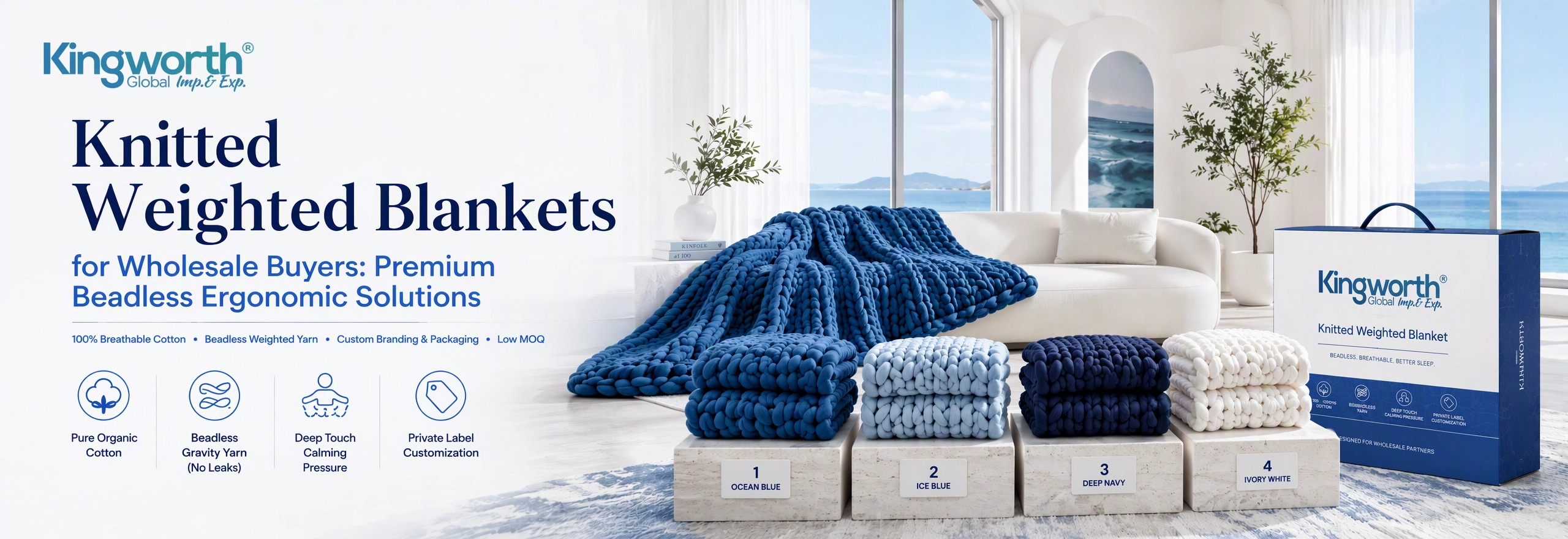
Knitted Weighted Blankets for Wholesale Buyers
For home textile brands, homeware retailers, gift wholesalers, and import distributors, choosing a knitted weighted blanket manufacturer involves more than selecting a color and requesting a price. The knit structure, yarn composition, source of weight, finished dimensions, loop stability, care requirements, and packaging method all influence how the product performs in retail, during shipping, and after repeated use.
Kingworth is a Ningbo-based manufacturer and export supplier supporting OEM and ODM development across comfort textiles and related products. For buyers exploring knitted weighted blankets, our development discussions can cover product specifications, sample review, branding, packaging, quality inspection, and shipment coordination. The most effective starting point is a clear construction brief that connects the product’s appearance with measurable manufacturing requirements.
This guide explains how to evaluate a knitted weighted blanket manufacturer, distinguish bead-free knit designs from other weighted blanket constructions, verify the bill of materials, and establish a practical validation plan before committing to bulk production.
1. What Wholesale Buyers Should Know About Knitted Weighted Blankets
A knitted weighted blanket combines a textile structure with a substantial finished weight. Unlike a conventional quilted blanket, which may distribute weight through filling enclosed in stitched compartments, a knitted design uses visible loops and an open or chunky surface structure. The exact way a particular product achieves its weight depends on its yarn and construction, so buyers should confirm the actual design rather than assume all knitted weighted blankets are made in the same way.
Bead-Free Weighted Blankets and Conventional Weighted Blankets
The phrase bead free weighted blankets is useful when buyers want to distinguish a product marketed without loose weighting beads from conventional weighted blankets that use glass beads, plastic pellets, or other filling materials. However, the term alone does not establish the complete bill of materials. A buyer should verify whether the product contains any separate weighting component and how the finished weight is achieved.
| Evaluation point | Knitted weighted blanket | Conventional filled weighted blanket |
|---|---|---|
| Visible construction | Loops, stitches, joins, and open knit spaces may be visible. | Quilted panels or fabric compartments may be visible. |
| Weight source | Must be confirmed from the yarn specification and construction BOM. | May come from separate filling materials held inside the product. |
| Inspection priorities | Loop consistency, snagging, joins, edge finish, dimensions, and weight. | Filling distribution, compartment integrity, seams, leakage, dimensions, and weight. |
| Care considerations | Stretching, loop distortion, and dimensional change require evaluation. | Care depends on the filling, shell, stitching, and product construction. |
| Retail presentation | Texture and stitch pattern are prominent design features. | Surface fabric, quilting pattern, and overall thickness may be more prominent. |
Neither construction should automatically be considered superior in every application. The appropriate choice depends on the target customer, retail price point, visual design, care expectations, and verified product performance. For private-label buyers, the most important requirement is that the product description accurately reflects the construction supplied.
Are Cotton Knit Weighted Blankets Always Made Entirely of Cotton?
No. The keyword cotton knit weighted blankets can describe a buyer’s preferred product category, but a commercial product should only be described as cotton or 100% cotton when its fiber composition supports that wording. A chunky knit appearance does not prove that the yarn is cotton, and a soft hand feel does not establish the fiber percentages.
Kingworth’s current P041 product profile identifies a chunky knitted weighted blanket in a wheat color and lists mixed yarn and gravity yarn. The available profile does not provide a verified percentage breakdown for the yarn fibers or a complete technical explanation of the weighting construction. Buyers should request a product-specific BOM and confirm the fiber content before approving a cotton-specific product title, label, packaging statement, or online listing.
2. Reviewing the Available Knitted Weighted Blanket Range
Before comparing quotations from a knitted weighted blanket manufacturer, buyers should establish which product versions are documented and which variations still require development or approval. A product image can communicate appearance, but it cannot confirm the material composition, weight tolerance, stitch specifications, or wash performance.
Current Reference Product: Chunky Knit Weighted Blanket in Wheat
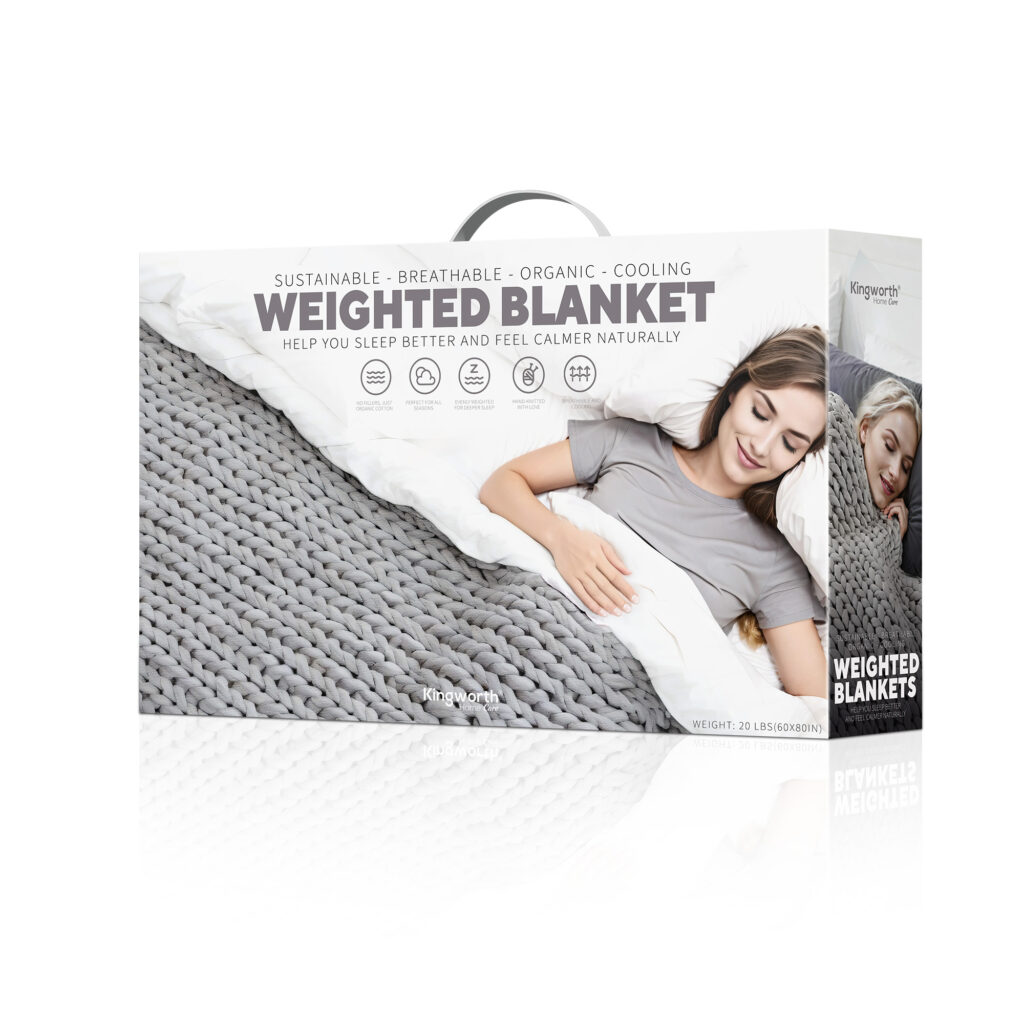
Kingworth’s P041 reference profile identifies a knitted weighted blanket with a cozy chunky appearance, a wheat color, and a queen-size designation. The profile lists mixed yarn and gravity yarn and describes the product as a no-beads weighted blanket. This is a starting reference for product discussion, not a substitute for a complete technical specification.
| Product attribute | Currently documented information | What the buyer should confirm |
|---|---|---|
| Product reference | P041 | Final SKU and version code |
| Construction | Knitted, chunky-style appearance | Stitch structure, loop dimensions, joining method, and edge construction |
| Color | Wheat | Approved physical color reference and any additional available shades |
| Size | Queen-size designation | Finished length and width, measurement method, and tolerances |
| Yarn description | Mixed yarn and gravity yarn listed | Full fiber composition, component percentages, yarn specifications, and supplier details where applicable |
| Weight construction | Profile describes a no-beads design | Complete BOM confirming how weight is achieved and whether any separate weighting component is present |
| Care performance | Product-specific validated results not provided in the available profile | Approved care method and test results for dimensional and structural stability |
This transparent approach helps prevent a common sourcing problem: a buyer approves a photograph, but the delivered product differs in composition, weight, dimensions, or care requirements. A written specification should define the exact version that the sample and bulk order must match.
How to Develop Additional Colors and Sizes
Retailers may want to offer wheat alongside neutral, seasonal, or brand-specific colors. They may also want to sell a throw size alongside a queen-size version. These are reasonable development directions, but buyers should not assume that every color or size is already available as an approved production option.
For each proposed variation, confirm whether the same yarn, stitch structure, joining method, and finishing process can be used. A different yarn can affect the appearance, dimensions, weight, hand feel, and care requirements. A different size can affect the total weight, packaging dimensions, and how the blanket hangs or stretches under its own weight.
- Color approval: Use a physical sample or agreed color reference. Record the approved version and identify any acceptable color variation.
- Size approval: Define finished dimensions and measurement conditions instead of relying on a retail size name alone.
- Material approval: Confirm whether all variants use the same fiber composition and yarn specification.
- Construction approval: Compare stitch appearance, loop spacing, joins, edges, and surface consistency.
- Packaging approval: Check whether each size and color requires a different package, label, barcode, or carton configuration.
A Customizable product program should document each approved variation clearly. This makes it easier for brand teams, purchasing departments, and quality inspectors to identify the correct version throughout sampling and bulk production.
3. Request a Teardown BOM Before Confirming the Weight Construction
One of the most important questions for a wholesale buyer is deceptively simple: where does the weight come from? The answer should be documented in the actual product’s bill of materials and supported by a clear construction description. The words knitted, chunky, weighted, or bead-free are not sufficient on their own to establish every material and component inside the product.
What a Product-Specific BOM Should Include
A teardown BOM is a structured record of the materials and components used in the finished item. For a knitted weighted blanket, it should explain the yarn and construction in enough detail for the buyer to evaluate material claims, compare supplier quotations, and approve labeling.
| BOM field | Information to request |
|---|---|
| Yarn composition | Fiber names, percentage of each fiber, and the relevant yarn specification |
| Yarn identification | Yarn type, count or other applicable specification, color reference, and component identification |
| Weight mechanism | Confirmation of whether weight comes from the yarn itself, a separate weighted component, internal filling, or a combination |
| Additional materials | Any thread, reinforcement, joining material, label, or other component used in the finished product |
| Component quantities | Applicable consumption or quantity information for the defined product size |
| Finished-product weight | Target total weight, measurement method, and acceptable tolerance |
| Labeling basis | Confirmed fiber-content wording and any material declarations required for the intended market |
How Buyers Can Verify Bead-Free Claims
If a product is marketed as bead-free, the buyer should ask the manufacturer to confirm that statement against the actual construction. The BOM should identify the components responsible for the finished weight and clarify whether separate beads or pellets are used. If the product contains another internal weighting element, the product description should not leave buyers with a misleading impression about its construction.
For a private-label program, this review should happen before packaging artwork, product-page copy, and care instructions are finalized. If the construction changes during development, the BOM and product claims should be reviewed again.
Why Accurate Composition Matters for Cotton Knit Products
Material descriptions affect customer expectations and may be subject to destination-market labeling requirements. If a brand plans to sell a blanket as cotton knit, the fiber composition must support that description. If a blended yarn is used, the brand should use the verified composition and appropriate wording rather than relying on a supplier’s informal product nickname.
For buyers sourcing from a knitted weighted blanket manufacturer, the BOM is not simply a technical document. It connects purchasing, product development, compliance review, packaging, retail content, and incoming quality control.
4. Dimensions, Total Weight, and Tolerance Control
A retail size such as queen is useful for initial product selection, but it is not a complete manufacturing specification. Different brands may use different target dimensions, and a knitted textile may change shape depending on how it is laid flat, supported, stored, or measured.
Define the Measurement Method
Before sample approval, the buyer and supplier should agree on how the blanket will be measured. The specification should state the target length and width, the condition in which measurements are taken, and the acceptable tolerance for each measurement. For an open-loop construction, the method should also address how the product is positioned without artificially stretching or compressing the knit.
- Record the target finished length and width for each SKU.
- Define whether measurements are taken after finishing, after a conditioning period, or after any agreed care test.
- Identify the measurement points and the method used to lay the blanket flat.
- Specify the target total weight and the weighing method.
- Set agreed dimensional and weight tolerances before bulk production.
- Record any differences permitted between approved variants.
Use a Specification Table Rather Than an Unverified Claim
When a buyer has not yet approved the technical values, the development sheet can use fields that must be completed during sampling. This is more reliable than publishing generic numbers that may not match the actual product.
| Specification field | Approval requirement |
|---|---|
| Finished dimensions | Enter approved length and width for the SKU |
| Finished weight | Enter approved target weight and unit |
| Dimension tolerance | Define the acceptable variation and measurement method |
| Weight tolerance | Define the acceptable variation and weighing method |
| Stitch and loop appearance | Attach reference photographs or an approved physical sample |
| Edge and joining details | Record the approved finish and acceptance criteria |
| Care requirements | Attach product-specific instructions supported by validation |
There is no universal tolerance that should be applied to every knitted weighted blanket without considering its yarn, structure, dimensions, and intended use. The appropriate limits should be agreed for the specific project and written into the approved specification.
5. Knit Openings, Stitch Consistency, and Snagging Risks
The open structure of a chunky knitted blanket is often central to its visual appeal. At the same time, loop size, stitch consistency, joins, and edge finishing are important inspection points. A product may look attractive in a staged photograph but still need further evaluation before it is suitable for repeat wholesale orders.
Evaluate the Actual Knit Structure
Buyers should request clear photographs of the blanket surface, edges, corners, joins, and any areas where yarn ends are secured. If possible, inspect the physical sample under normal handling conditions. The purpose is to determine whether the structure is consistent with the approved reference and whether any visible irregularities require correction.
For an open-knit design, a technical sheet can document loop spacing or other relevant construction measurements. These values should be defined for the specific product rather than copied from a different design. A single generic measurement cannot describe every stitch pattern or yarn structure.
Practical Snagging and Structural Checks
- Loop consistency: Compare the size, shape, and spacing of loops across the product.
- Yarn joins: Inspect transitions and joins for visible defects, loose ends, or inconsistent finishing.
- Edge stability: Check that edges and corners match the approved sample and remain secure during normal handling.
- Surface inspection: Look for unintended pulls, damaged yarn, uneven tension, and obvious visual defects.
- Handling assessment: Observe whether ordinary handling causes loops to distort or yarn ends to loosen.
- Variant comparison: Compare the same areas across different colors or sizes if the range includes multiple versions.
Buyers should avoid treating an attractive open-knit appearance as proof of durability. Likewise, a single snag check is not a substitute for a defined test protocol. If a brand needs a specific snag-resistance or durability claim, the method, acceptance criteria, and results should be documented before the claim is published.
Why the Approved Sample Matters
A physical sample gives the purchasing and quality teams a common reference. It allows the buyer to review the product’s texture, drape, dimensions, total weight, finishing, and overall presentation. The sample should be identified by SKU and revision so that the approved version can be compared with production output.
For OEM and ODM programs, the sample approval record should include the product specification, BOM, color reference, construction details, labeling, packaging, and any applicable test results. This reduces the risk of approving one configuration and receiving another.
6. Production Process Visibility: What Photographs Should Show
For remote sourcing teams and international buyers, production photographs can help clarify how a product is assembled and finished. However, generic factory imagery does not prove that a specific product is made using the process shown. Buyers should request current, product-relevant photographs and confirm which stages apply to the actual knitted weighted blanket.
Useful Production Photo Checklist
- Material preparation: Show the yarn or other confirmed materials before processing, with identification where practical.
- Knitting or forming: Show the actual manual or machine operation used for the selected construction, where applicable.
- Joining and finishing: Capture relevant joins, secured ends, corners, and edge-finishing details.
- In-process inspection: Show how dimensions, visible defects, and construction consistency are checked.
- Final inspection: Show the finished blanket being reviewed against the agreed specification.
- Packing preparation: Show the approved folding, compression if used, inner packaging, and retail packaging.
Photographs should be current and representative of the actual production process. If a stage is performed manually, do not describe it as automated. If a product is manufactured using a machine, the buyer should not be shown unrelated manual work as evidence of that SKU’s process.
Kingworth can discuss product documentation and quality checkpoints as part of the OEM/ODM development process. The availability of specific photographs, production records, or inspection evidence should be confirmed for each project rather than assumed from a general supplier profile.
7. Wash and Deformation Validation Before Bulk Production
Washability is a product-specific performance question, not a claim that should be inferred from the appearance of the yarn. Knitted weighted blankets can be affected by the combination of fiber composition, loop structure, joins, finishing, total weight, and the cleaning method. A care instruction suitable for one design may not be appropriate for another.
Agree on the Care Method First
Before testing, confirm the proposed care method for the exact sample. This may involve spot cleaning, hand washing, machine washing, professional cleaning, or another method, depending on the actual construction. Do not assume that machine washing or tumble drying is suitable unless the product has been evaluated for that treatment.
What to Record Before and After Testing
| Inspection item | What to compare |
|---|---|
| Dimensions | Length and width before and after the agreed care procedure |
| Overall shape | Squareness, edge alignment, and visible distortion |
| Knit structure | Loop appearance, spacing, pulled yarn, and changes in stitch consistency |
| Joins and edges | Visible loosening, damage, or changes to finishing |
| Color and surface | Visible color change, pilling, fuzzing, or other surface changes |
| Weight and condition | Recorded finished weight and any visible structural change, where relevant |
| Drying condition | Whether the sample reaches the agreed inspection condition before final measurements |
The test record should identify the sample, the method used, the conditions applied, the observations, and the agreed acceptance criteria. If a product has not been tested for machine washing, the website and packaging should not promise that it is machine washable.
Turn Test Results into Accurate Care Instructions
Once the care method has been evaluated, the buyer can prepare care-label wording and supporting product information. Instructions should be clear about permitted washing and drying methods, temperature limits where applicable, and any restrictions. The final wording should reflect the tested construction and the requirements of the destination market.
For brands planning to launch several colors or sizes, confirm whether the variants use the same materials and construction. If the composition or structure changes, the previous test result may not automatically apply to the new version.
8. Packaging Compression and Shipping Validation
Packaging is an important part of wholesale sourcing because the blanket’s volume, weight, presentation, and protection requirements can affect warehousing and international transportation. Compression may reduce package volume for some products, but it should not be assumed suitable for every chunky knit structure.
Evaluate Compression Before Approving the Packing Method
If a buyer is considering compressed or vacuum-packed packaging, the proposed method should be evaluated using the actual product. The objective is to determine whether the packing method is appropriate for the construction and whether the blanket returns to an acceptable appearance after unpacking and recovery under defined conditions.
- Record the blanket’s dimensions and weight before packing.
- Document the folding method and packaging materials.
- Record the package dimensions and the compression method, if applicable.
- Inspect the blanket immediately after unpacking.
- Allow the agreed recovery period and inspect the product again.
- Compare loop appearance, overall shape, edges, joins, and dimensions against the approved sample.
- Check the retail packaging for damage and confirm that required labels remain legible.
For shipping validation, buyers may also define packaging durability checks appropriate to their distribution channel. Any compression, transit, or recovery claim should be supported by the relevant test records rather than an unverified statement that the product is suitable for all packing methods.
Retail Packaging for Homeware and Gift Channels
Homeware retailers and gift wholesalers may have different priorities. A bulk importer may prefer efficient cartons and straightforward product identification, while a gift retailer may require a more presentation-focused box, hangtag, or insert. These requirements should be discussed before the final sample is approved.
Packaging specifications can include the retail package dimensions, carton configuration, product identification, barcode placement, care information, and any branding elements. The final package should be checked with the actual blanket rather than designed solely around a digital image.
9. OEM and ODM Development with a Knitted Weighted Blanket Manufacturer
For brands building a private-label collection, OEM and ODM provide different ways to approach product development. OEM projects typically begin with a buyer-defined specification or reference sample. ODM projects may begin with a broader concept and require more joint development of the product configuration.
Customization Options to Discuss
- Product dimensions: Define the target finished measurements and tolerances.
- Yarn and composition: Review suitable materials and confirm the exact fiber breakdown.
- Color development: Establish an approved color reference and confirm which variations are feasible.
- Knit appearance: Discuss the desired loop structure, texture, joins, and edge finish.
- Brand identity: Review woven labels, care labels, hangtags, and other agreed branding elements.
- Retail packaging: Evaluate practical bulk packing, branded packaging, or gift-oriented presentation.
- Documentation: Establish the BOM, specification sheet, sample approval record, and inspection requirements.
Not every customization is automatically available for every design. The final scope depends on the chosen construction, materials, order requirements, and sample evaluation. It is better to establish feasibility during development than to promise an unverified feature in a retail listing.
Recommended Development Workflow
- Define the brief: Share the intended market, target customer, reference design, preferred size, target weight, color direction, and packaging needs.
- Review construction: Confirm the yarn composition, weight mechanism, BOM, and key technical details.
- Prepare the sample: Evaluate the proposed product and record any changes required.
- Approve the specification: Finalize dimensions, weight tolerances, stitch details, labels, packaging, and inspection criteria.
- Validate performance: Complete the agreed care, deformation, packaging, or other relevant checks.
- Confirm the order: Agree on the approved version, quantity, commercial terms, production schedule, and required documentation.
- Inspect and coordinate shipment: Check finished goods against the approved requirements and confirm packing details before shipment.
This process helps keep the buyer, supplier, product-development team, and quality team aligned. It also provides a practical basis for comparing manufacturers beyond unit price alone.
10. Quality Control for Wholesale Knitted Weighted Blankets
For importers and retail chains, quality control should be based on agreed requirements that can be checked consistently. A clear specification makes it easier to identify defects and resolve differences between a sample and the delivered goods.
Incoming Material and In-Process Checks
Incoming material checks can verify that the supplied yarn or other components match the approved material specification. In-process checks can focus on construction consistency, visible defects, dimensions at the agreed production stage, and correct execution of joins and finishing. The precise inspection points should be adapted to the manufacturing process used for the product.
Final Inspection and Packing Confirmation
Final inspection should compare the finished product with the approved sample and written specification. Typical checkpoints include SKU identification, color, dimensions, total weight, stitch appearance, edges, visible defects, labels, and packaging. Where an AQL-based inspection is requested, the buyer and supplier should agree on the applicable standard, sampling plan, inspection level, and acceptance criteria for the order. An AQL value should not be assumed to apply to every order without agreement.
For multi-variant orders, identification and traceability are especially important. Each color and size should be matched to the correct specification and packaging artwork. A clear record helps prevent mix-ups during production, carton packing, and warehouse receiving.
11. How to Compare Wholesale Suppliers Beyond Price
A competitive quotation matters, but a useful supplier comparison also considers specification control, sample quality, production communication, inspection evidence, packaging capability, and export coordination. A low initial price may not represent the best overall value if the product requirements are unclear or changes are discovered after bulk production begins.
Questions to Ask Before Placing an Order
- Can the supplier provide a product-specific BOM and explain how the blanket achieves its weight?
- Are fiber composition and material claims supported by a clear specification?
- Can the supplier identify the current product versions and confirm which colors and sizes are approved?
- Can a physical sample be reviewed before bulk production?
- Are dimensions, total weight, and acceptable tolerances documented?
- Can the supplier provide relevant production photographs and inspection records for the project?
- Has the proposed care method been evaluated for the actual construction?
- Has compressed packaging been checked for appearance and recovery if compression is proposed?
- Are the final labels, barcodes, packaging, and carton details confirmed before production?
- Are commercial terms, order quantity, schedule, and shipment responsibilities clearly agreed?
The strongest supplier relationship is built on clear specifications and verifiable evidence. For a knitted weighted blanket manufacturer, product knowledge should be reflected in the documents, samples, inspection process, and production communication—not only in a marketing description.
12. Why Work with Kingworth on Your Next Weighted Blanket Project?
Kingworth supports B2B buyers seeking comfort products and home textile development through OEM/ODM discussions, sampling coordination, specification review, branding, packaging, and export support. For knitted weighted blanket projects, the goal is to align the proposed product with the buyer’s market positioning and the requirements that can be confirmed during development.
Our current P041 reference provides a starting point for discussing a chunky knitted weighted blanket in wheat color. Additional material details, weight-construction documentation, exact dimensions, tolerances, color options, and performance evidence should be confirmed for the specific project before final claims or production specifications are approved.
Buyers can prepare for a more efficient discussion by sharing their target market, preferred product size, weight requirements, color direction, packaging concept, expected order volume, and any reference product. If a buyer already has a technical specification or physical sample, that information can help clarify the development requirements from the beginning.
Request a Knitted Sample and Construction Sheet
If you are developing a new private-label collection or evaluating a new wholesale supplier, request a physical sample and the relevant construction documentation before making a final sourcing decision. Review the sample together with the BOM, specification sheet, care requirements, and packaging proposal so that the approved product is defined clearly.
Contact Kingworth to discuss your knitted weighted blanket sourcing project:
- Email: info@king-worth.com
- Phone: +86 133 3687 4040
- Location: Ningbo, Zhejiang, China
Share your product brief or reference sample, and our team can discuss the relevant OEM/ODM development requirements, sample review, specification confirmation, and packaging options for your project.
Frequently Asked Questions
What should I look for in a knitted weighted blanket manufacturer?
Look for a supplier that can explain the actual construction, provide a product-specific BOM, define fiber composition, confirm dimensions and weight tolerances, support sample approval, and document relevant inspection and packaging requirements. For private-label orders, also review the supplier’s ability to coordinate labels, retail packaging, and export documentation.
Are all knitted weighted blankets bead-free?
No. The term knitted describes a construction style, while bead-free describes a particular material or weighting characteristic. Buyers should verify the actual BOM and confirm whether the finished product contains loose beads, pellets, or another separate weighting component before approving a bead-free claim.
Are cotton knit weighted blankets always 100% cotton?
No. The product name or knitted appearance does not establish fiber content. Ask for a verified material breakdown and use the appropriate composition wording on product pages, labels, and packaging. For Kingworth’s P041 reference, the available profile lists mixed yarn and gravity yarn but does not provide a confirmed fiber-percentage breakdown.
What dimensions and weight tolerances should I specify?
Define the target finished dimensions and weight for the exact SKU, then agree on measurement methods and acceptable tolerances with the supplier. A queen-size designation alone is not sufficient. The limits should reflect the product’s construction and be recorded in the approved specification rather than assumed from a generic industry figure.
Can a chunky knitted weighted blanket be machine washed?
That depends on the yarn, construction, joins, total weight, and validated care method. Buyers should obtain product-specific instructions and confirm whether the proposed cleaning method has been evaluated. Do not publish a machine-washable claim based solely on the fact that the blanket is knitted or bead-free.
Can knitted weighted blankets be compressed for shipping?
Compression may be considered for some products, but suitability must be checked using the actual construction and packaging method. Evaluate the blanket after unpacking and after the agreed recovery period, checking its dimensions, loop appearance, edges, and overall shape. Do not assume that a compressed packing method is suitable for every knitted design.
Can Kingworth discuss custom colors, labels, and packaging?
Kingworth supports OEM/ODM development discussions that can include branding and packaging requirements. The feasibility of additional colors, sizes, labels, and packaging formats should be confirmed for the specific product and project. Each approved version should be documented before bulk production.
What documents should I request before bulk production?
Request the approved product specification, BOM, sample approval record, dimensions and weight requirements, care instructions, agreed inspection criteria, and final packaging details. Where relevant, also request the supporting test reports and compliance documentation applicable to the destination market. Only make claims that the available documentation can substantiate.
How can I compare quotations from different wholesale suppliers?
Compare quotations against the same product requirements, including material composition, weight construction, dimensions, tolerances, sample quality, packaging, inspection criteria, order quantity, lead time, and agreed commercial terms. This makes it easier to understand whether the quotations cover equivalent products and services.
How do I start an OEM or ODM knitted weighted blanket project?
Begin with a product brief that identifies the target customer, size, target weight, material preference, color, packaging, and expected order quantity. Share a reference product or specification if available. The next step is to review the construction, confirm the BOM, develop a sample, and approve the written specification before bulk production.