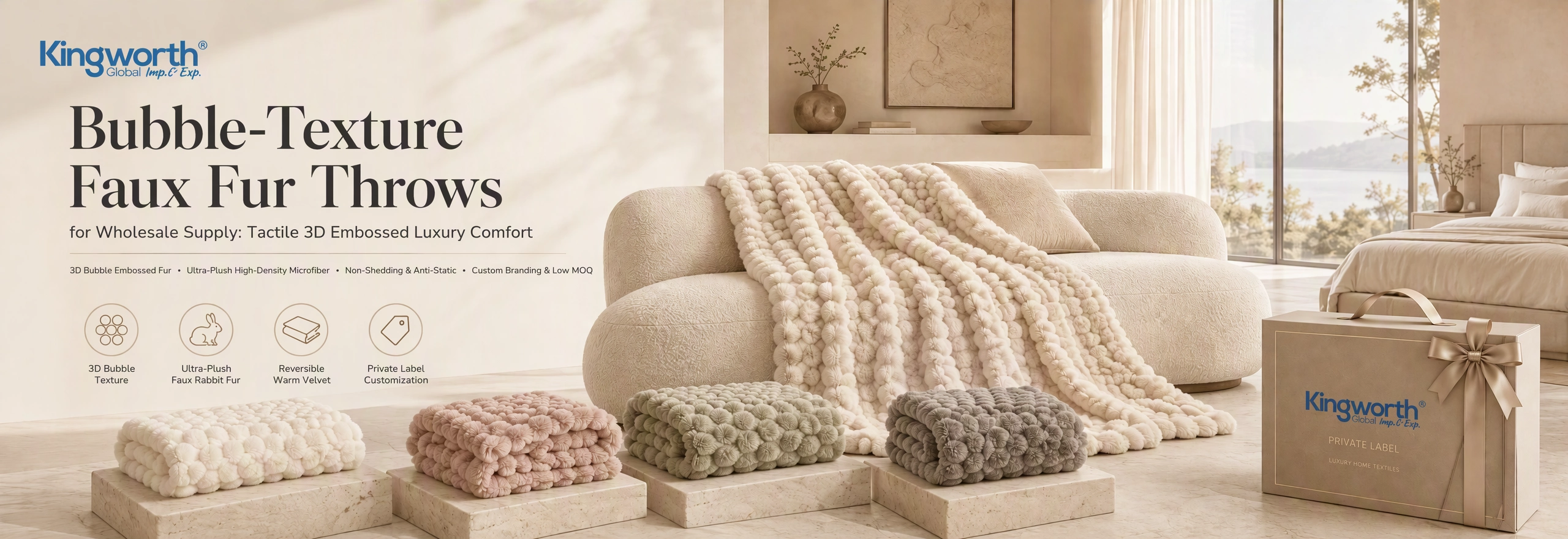
Bubble-Texture Faux Fur Throw for Wholesale Supply
A bubble faux fur blanket combines a plush surface with a raised, rounded texture that adds visual depth to home textiles. For home textile brands, homeware retailers, gift wholesalers, and import distributors, this design can support a distinctive product collection across sofa throws, bedroom accessories, seasonal gifts, and decorative home comfort products.
However, sourcing a bubble-texture faux fur throw for wholesale supply involves more than selecting an attractive color or fabric swatch. Buyers need to confirm the face and reverse fiber composition, bubble height, surface feel, fabric weight, finished product weight, edge construction, shedding performance, and appearance after washing. They should also establish how colors will be approved, how retail packaging will be customized, and how color variation will be controlled across bulk production.
Kingworth is a Ningbo-based comfort product manufacturer and export supplier supporting B2B product development, OEM and ODM discussions, sample review, packaging coordination, quality inspection, and shipment arrangements. For buyers considering a new bubble faux fur blanket, the goal is to turn a visual product concept into a documented specification that can be sampled, evaluated, and consistently reproduced.
This guide explains the key sourcing considerations for bubble-texture faux fur throws, including material verification, dimensional options, fabric testing, private label development, packaging, and supplier evaluation. It is designed to help buyers prepare a clear product brief before requesting samples or confirming a bulk order.
1. What Is a Bubble Faux Fur Blanket?
A bubble faux fur blanket is a plush textile throw featuring a raised surface pattern made up of rounded or bubble-like forms. Depending on the fabric construction, these raised areas may vary in height, spacing, size, density, and softness. The visual effect can make the blanket look fuller and more dimensional than a conventional smooth plush throw.
The term faux fur describes an artificial fur-like textile surface, while bubble texture describes the appearance of the raised pattern. Neither term independently confirms the exact fiber composition, manufacturing method, fabric weight, or performance of a finished product. Those details should be verified against the supplier’s material specification and approved sample.
Why Bubble Texture Matters to Retail Buyers
Texture is an important part of the purchasing decision for decorative home textiles. A raised surface creates visible highlights and shadows, allowing a throw to contribute to a room’s appearance even when it is folded over a sofa or placed at the foot of a bed.
For retailers, a bubble-texture design may provide a way to differentiate a plush throw from standard smooth-finish faux fur blankets. For gift wholesalers, the dimensional surface can create a tactile product story that works well with close-up photography and coordinated gift packaging. For private label brands, the pattern can become a recognizable design feature within a broader home comfort collection.
- Visual texture: Raised rounded forms create depth across the blanket surface.
- Tactile experience: The surface can feel different from smooth plush fabrics, depending on fiber, pile construction, and finishing.
- Decorative appeal: Texture can help the throw coordinate with cushions, bedding, and other home accessories.
- Retail flexibility: A single approved design may be presented through different colorways and seasonal merchandising themes, subject to confirmed production options.
Bubble Texture Is Not a Complete Product Specification
Two blankets may both be described as bubble faux fur blankets but differ substantially in pile height, surface density, backing material, softness, weight, and construction. A product photograph cannot establish these technical characteristics reliably.
Buyers should request a physical swatch or finished sample and document the characteristics that matter to their market. If the product’s distinctive appearance depends on the size and shape of the raised bubbles, the approved sample should be supported by close-up reference images and, where appropriate, measurable construction requirements.
2. Verify the Face and Reverse Fiber Composition
One of the first steps in wholesale sourcing is confirming what each side of the blanket is made from. A plush face may use a different textile construction from the reverse, so a single general description may not provide enough information for purchasing, labeling, or product-page development.
What to Record for the Face Fabric
The face fabric creates the visible bubble pattern and contributes to the blanket’s touch, appearance, and surface performance. Buyers should ask the supplier to identify the fiber composition and the relevant fabric construction. If the surface uses a pile or other raised structure, the technical documentation should explain the construction sufficiently to distinguish the approved fabric from similar-looking alternatives.
The material specification should record the following information where applicable:
- Fiber names and verified percentage composition.
- Fabric construction and pile characteristics.
- Bubble pattern reference and any agreed dimensions.
- Surface color and approved color reference.
- Fabric weight and the measurement basis.
- Applicable care instructions and supporting test information.
What to Record for the Reverse Fabric
The reverse side affects the blanket’s overall hand feel, drape, construction, and finished weight. It should be documented separately from the face rather than treated as an unspecified backing.
Buyers should confirm whether the reverse uses a smooth fabric, plush surface, or another construction. The exact composition must be verified before making claims such as polyester reverse, cotton backing, or double-sided faux fur. These descriptions should reflect the actual material specification of the selected product.
| Specification field | Face fabric | Reverse fabric |
|---|---|---|
| Fiber composition | Confirm fiber names and percentages | Confirm fiber names and percentages |
| Construction | Document the raised bubble or pile structure | Document the backing or reverse construction |
| Fabric weight | Record the agreed value and measurement basis | Record the agreed value and measurement basis |
| Appearance | Approve texture, color, and surface consistency | Approve color, texture, and surface condition |
| Care requirements | Confirm the applicable cleaning method | Confirm the applicable cleaning method |
Kingworth can discuss the specification and sample requirements for a proposed faux fur blanket project. Because a confirmed bubble-texture SKU specification is not established in the available product information, buyers should confirm the actual face and reverse materials before approving product claims or packaging artwork.
3. Bubble Height, Surface Density, and Tactile Details
The raised bubble pattern is the defining visual feature of this product category. Small changes in the surface structure can alter how the blanket looks under lighting, how the texture feels when touched, and how consistent the product appears across different production batches.
How to Evaluate Bubble Height
Bubble height describes the elevation of the raised surface relative to the surrounding fabric. It should not be confused with the total fabric thickness or the height of the pile fibers themselves. For a wholesale specification, the buyer and supplier should agree on the most relevant measurement method for the selected construction.
If bubble height is a key selling feature, the technical sheet should state the agreed measurement approach and acceptable variation. Measurements should be taken consistently on the approved fabric or finished sample. A generic value should not be copied from another faux fur product, because different constructions can produce different surface profiles.
Evaluate Shape, Spacing, and Density
Bubble shape and spacing influence the visual rhythm of the blanket. Larger raised forms may create a bold decorative appearance, while smaller or more closely spaced forms can produce a different overall texture. The correct design depends on the target market and the intended retail positioning.
During sample review, examine whether the bubble pattern remains visually consistent across the center, edges, and corners. Look for uneven raised forms, flattened areas, irregular spacing, or visible differences between the approved reference and the sample being evaluated.
Assess the Hand Feel of the Finished Surface
Touch evaluation should consider the overall softness, pile feel, surface density, and flexibility of the blanket. A fabric may feel soft when viewed or touched briefly but behave differently after handling, folding, packaging, or washing.
- Compare the sample with the approved reference under similar conditions.
- Check whether the raised texture feels reasonably consistent across the surface.
- Observe whether the pile lies uniformly or shows obvious irregularities.
- Inspect whether the reverse fabric supports the intended drape and overall hand feel.
- Record any areas that feel noticeably different from the rest of the sample.
For private label development, photographs and descriptive notes should accompany the approved physical sample. Where bubble height or density is a critical product requirement, define the measurable criteria rather than relying solely on terms such as extra plush or premium texture.
4. Confirm Size Variants Before Publishing a Wholesale Range
Size is one of the most important specifications for a plush throw. It influences product positioning, retail price architecture, package dimensions, shipping volume, and how the blanket fits the intended furniture or bedding setting.
Buyers may be interested in common throw dimensions such as 50 x 60 inches or larger formats such as 60 x 80 inches. These are useful size targets to discuss during development, but they should not be presented as confirmed Kingworth stock sizes unless availability has been verified for the actual product.
How to Define the Finished Dimensions
A written specification should identify the target length and width and explain how the finished blanket is measured. Buyers should also establish the acceptable dimensional tolerance and whether the measurement is taken before or after any agreed care test.
For plush fabrics, the method used to lay the product flat can affect the recorded dimensions. The measurement process should therefore be consistent and should avoid unintentionally stretching or compressing the textile.
| Potential size program | Buyer objective | Confirmation required |
|---|---|---|
| Compact throw, for example 50 x 60 inches | Explore a format for sofa use, gifting, or smaller retail packages | Manufacturing feasibility, final dimensions, tolerance, and sample approval |
| Larger throw, for example 60 x 80 inches | Explore a larger format for broader coverage or a different retail position | Manufacturing feasibility, material consumption, finished weight, and packaging size |
| Brand-specific dimensions | Match a retailer’s range plan or target market | Custom specification, sample review, and commercial terms |
These dimensions are examples for planning, not confirmed standard specifications for a Kingworth bubble faux fur blanket. The final size range should be established through product development and documented in the approved specification.
Why Size Changes May Affect Other Requirements
Increasing the blanket’s dimensions can change material consumption, finished weight, folding method, and carton configuration. If the raised bubble pattern must maintain a particular visual scale, buyers should also check whether the pattern looks consistent across the proposed sizes.
Each approved size should have its own SKU or clear version identification, along with the correct dimensions, weight, label, and packaging details. This helps prevent mix-ups during production and warehouse receiving.
5. Fabric Weight, Finished Net Weight, and Binding
Fabric weight and finished blanket weight are related but different specifications. Fabric weight generally refers to a defined amount of fabric per unit area, while finished net weight refers to the weight of the completed blanket without its packaging. A buyer should not use these values interchangeably.
What Fabric Weight Tells the Buyer
Fabric weight can help buyers compare materials and understand the substance of the textile. However, the number alone does not fully determine softness, warmth, durability, or perceived quality. Fiber type, pile structure, backing, finishing, and construction all influence the final experience.
For a bubble-texture faux fur blanket, the specification should clarify which fabric layer is being measured and whether the value refers to the face fabric, reverse fabric, combined fabric construction, or another defined material unit. If the supplier uses a particular fabric-weight measurement convention, the buyer should record it in the technical sheet.
Record the Finished Net Weight Separately
The finished net weight should refer to the completed blanket and exclude the retail box, protective bag, insert, and shipping carton. If a retail program also needs gross packed weight, that should be recorded separately.
- Face fabric weight: Record the applicable specification and measurement basis.
- Reverse fabric weight: Record separately if required for product development.
- Finished net weight: Weigh the completed blanket using an agreed method.
- Packed product weight: Record the weight of the blanket together with its retail packaging.
- Shipping carton weight: Record the gross carton weight for logistics planning where required.
Binding and Edge Finishing
Binding or other edge finishing can affect the visual appearance and perceived quality of the finished throw. Buyers should review the proposed edge construction rather than assume that all faux fur blankets use the same binding method.
During sample approval, check whether the edges are even, whether corners are neatly finished, and whether the binding color and texture complement the face and reverse. Inspect for loose threads, skipped stitches, puckering, exposed backing, and other visible inconsistencies.
The approved specification should identify the edge finish and any requirements for color matching or visual uniformity. If the binding material differs from the main fabric, its composition should be documented when relevant to product labeling or customer requirements.
6. Shedding Tests and Post-Wash Loft Retention
Shedding and changes in surface loft are important considerations for faux fur blankets. A new product may have loose fibers remaining from manufacturing or finishing, and handling or cleaning may affect the appearance of the pile. Buyers should evaluate these characteristics using a defined process instead of relying on a brief visual inspection.
Why Shedding Should Be Evaluated
Excessive loose-fiber release can affect the customer experience and create concerns during retail handling. However, the expected behavior depends on the fabric construction, fiber characteristics, finishing, and care method. A single informal test cannot establish a universal shedding-performance claim.
Before bulk production, buyers should agree with the supplier on an appropriate evaluation method and acceptance criteria. The process should be suitable for the intended product and should be recorded so that different samples or batches can be compared consistently.
Practical Shedding Evaluation
- Inspect the blanket before handling and record its initial surface condition.
- Apply the agreed handling or test procedure consistently across samples.
- Observe loose fibers and visible changes to the surface.
- Check whether raised bubbles remain visually distinct after the evaluation.
- Record the method, observations, and agreed acceptance criteria.
If the buyer requires a formal shedding test or a specific performance claim, the test method should be identified and the results documented. Do not describe a blanket as non-shedding or shed-free unless the wording is appropriate and supported by evidence.
Evaluate Loft After Washing
Loft refers to the apparent fullness or height of a pile or raised textile surface. For a bubble-texture blanket, loft retention matters because washing or drying may alter the surface appearance, texture, and dimensions.
The care procedure should be confirmed before testing. The sample should then be evaluated under the agreed conditions, with observations recorded before washing, after washing, and after the defined drying and recovery period.
| Test stage | Inspection focus |
|---|---|
| Before washing | Record dimensions, surface appearance, bubble profile, pile condition, and initial hand feel. |
| After the agreed wash procedure | Check visible changes, loose fibers, surface distortion, and seam or binding condition. |
| After drying and recovery | Compare the surface fullness, bubble definition, dimensions, and overall appearance with the original sample. |
| Final assessment | Record the method, observations, results, and whether the sample meets the agreed acceptance criteria. |
Wash testing should follow the care method intended for the product. Machine washing, tumble drying, or other cleaning methods should not be assumed suitable without confirmation. Any claim about retained loft after a specified number of washes should be supported by testing using the relevant product construction.
7. Keep Multiple Colors on One Product Page
For a wholesale collection, presenting color variants on one product page can make the range easier to understand. It allows buyers to compare the same design across different color options while keeping the core product description and technical requirements organized in one place.
However, the available color range must be confirmed for the actual product. A color shown in a concept image or reference photograph should not be treated as an approved production option until the material and color have been reviewed.
Build a Clear Color Variant System
Each approved color should have a defined reference and clear identification. If the product uses different materials on the face and reverse, buyers should confirm whether the selected color applies to the face, the reverse, the binding, or multiple components.
- Assign a clear color name and SKU or variant code.
- Keep a physical or otherwise agreed color reference for approval.
- Confirm whether the face and reverse use matching or contrasting colors.
- Record any binding color requirements.
- Use product photographs that accurately represent the approved colorways.
- Keep the same verified technical information across variants unless a material or construction difference requires an update.
Use Consistent Product Photography
Color presentation can be affected by lighting, camera settings, display devices, and image processing. Retail photography should therefore be produced and reviewed consistently, with the physical sample serving as the reference for the approved color.
For a bubble faux fur blanket, close-up images are particularly useful because the raised texture can appear different under different lighting angles. A consistent photography setup can help buyers compare colors without confusing lighting differences with changes in the actual material.
8. Bulk Color-Difference Control
Color consistency is a practical sourcing concern when a product is manufactured in multiple batches or supplied to several retail channels. Even when the same color name is used, differences in material lots, dyeing, finishing, lighting, or photography can affect how the finished blanket appears.
Approve a Physical Color Standard
Before production, the buyer and supplier should agree on a physical color reference or another clearly defined approval standard. The reference should be identified and retained so that incoming materials, samples, and finished products can be compared against the same target.
For a multi-color collection, each color should have its own approval record. If the face, reverse, and binding use different materials, their color requirements should be documented separately where necessary.
Control Color Across Production Batches
- Identify the approved color standard for each variant.
- Confirm the color references used for the relevant materials.
- Inspect production samples under consistent viewing conditions.
- Compare the finished product with the approved standard before packing.
- Record any agreed acceptable variation and the procedure for handling discrepancies.
- Keep variant labels and carton identification consistent with the approved color.
Buyers should not assume that a universal numerical tolerance is appropriate for every fabric or color. The acceptable variation should be agreed for the project, taking account of the material, intended retail presentation, and inspection method.
Clear color approval is particularly valuable for repeat orders. It provides a common reference when the buyer reorders an existing color or introduces a new shade into an established collection.
9. Gift Boxes, Woven Labels, and Private Label Packaging
Packaging is an important part of the product experience for gift wholesalers, homeware retailers, and online brands. A well-planned package can protect the blanket, communicate the product’s main features, and support a consistent brand presentation.
For a bubble-texture faux fur throw, packaging should also account for the surface structure. Folding or compression may affect the appearance of raised bubbles, so the proposed packing method should be evaluated using an actual sample before it is adopted for bulk production.
Gift Box Development
A gift box may be appropriate for a premium home comfort range, a seasonal gift collection, or a retailer seeking a more finished presentation. The correct format depends on the product dimensions, folded volume, protection requirements, target price point, and distribution channel.
Before approving a gift box, confirm its dimensions, material, artwork, color, opening method, inserts, and product identification. Review the actual packed sample to check that the blanket fits properly and that the package presents the product as intended.
Woven Labels and Brand Identification
Woven labels can support brand recognition and provide a consistent identity across a product collection. Buyers should define the label design, dimensions, color, placement, and any required wording before production.
If care information or fiber composition appears on a separate label, the wording should match the approved technical specification. Branding should not obscure required information or introduce material claims that have not been verified.
Packaging Requirements Checklist
- Retail packaging format and dimensions.
- Approved artwork, logo, and color references.
- Woven label design and placement where applicable.
- Verified fiber composition and care information.
- Barcode and product identification requirements.
- Folding or compression method, if used.
- Carton configuration and shipping protection.
- Final packed sample approval before bulk packaging.
Match Packaging to the Sales Channel
A gift retailer may prioritize presentation and brand storytelling, while a high-volume importer may focus on storage efficiency, product identification, and transport protection. E-commerce brands may need a package that protects the blanket while supporting a consistent unboxing experience.
Kingworth can discuss packaging requirements as part of an OEM/ODM project. The feasibility of specific gift boxes, woven labels, and other packaging features should be confirmed for the selected product and order rather than assumed to be standard for every blanket.
10. OEM and ODM Development for Bubble Faux Fur Blankets
Private label buyers often need a product that matches a defined market position rather than an off-the-shelf design. OEM and ODM development can provide a structured way to review the fabric, surface pattern, dimensions, color, branding, and packaging requirements for a proposed faux fur throw.
Potential Customization Areas
- Dimensions: Define target length, width, and acceptable tolerances.
- Face fabric: Confirm fiber composition, pile construction, and bubble-texture appearance.
- Reverse fabric: Confirm material composition, surface finish, and color.
- Surface design: Review bubble height, shape, spacing, and visual consistency.
- Edge finishing: Agree on binding or other finishing requirements.
- Branding: Discuss woven labels, care labels, hangtags, and product identification.
- Packaging: Review retail bags, gift boxes, inserts, and carton requirements.
Not every requested change will necessarily be feasible for every material or construction. New colors, different sizes, revised surface patterns, or alternative packaging may require additional development, sample review, or changes to the commercial terms.
A Practical Development Workflow
- Prepare the product brief: Identify the target market, intended use, size, color direction, texture reference, packaging concept, and expected order quantity.
- Confirm the materials: Establish the face and reverse compositions and document the proposed fabric construction.
- Review the sample: Evaluate the bubble pattern, surface feel, dimensions, edges, and overall appearance.
- Finalize the specification: Record material details, fabric weight, finished net weight, dimensional tolerance, binding, and color references.
- Validate performance: Complete the agreed shedding, care, loft-retention, and packaging checks where applicable.
- Approve branding and packaging: Confirm labels, artwork, retail package, and carton configuration.
- Agree on production requirements: Confirm order quantity, commercial terms, schedule, and inspection criteria.
- Inspect finished goods: Compare the product and packaging against the approved specification before shipment coordination.
This process creates a shared reference for the buyer, supplier, product-development team, and quality inspectors. It also helps reduce the risk of changes being introduced after the sample has been approved.
11. Quality Control for Wholesale Faux Fur Blankets
Quality control should be built around product-specific requirements that can be checked consistently. For a bubble faux fur blanket, the inspection plan should consider the appearance of the raised surface, the condition of the reverse, the dimensions, the edge finish, and the accuracy of the labels and packaging.
Incoming Material Checks
Incoming inspection can verify that the supplied materials match the approved specification. Relevant checks may include material identification, color reference, fabric appearance, and other documented requirements. The appropriate checkpoints depend on the actual fabric and manufacturing process.
In-Process Inspection
During production, inspection can focus on surface consistency, visible defects, joining or finishing operations, and dimensions at the agreed production stage. The process should identify defects early enough for the team to investigate and correct them before a larger quantity is completed.
Final Inspection
Final inspection should compare the completed blanket with the approved sample and technical documents. Typical checkpoints include:
- Correct SKU, size, and color.
- Verified dimensions and finished net weight against the specification.
- Consistent bubble pattern and surface appearance.
- Condition of the reverse fabric and edge finishing.
- Visible defects, loose threads, and agreed shedding observations.
- Correct labels, care information, and packaging artwork.
- Accurate product identification and carton markings.
If an AQL-based inspection is required, the buyer and supplier should agree on the applicable standard, sampling plan, inspection level, and acceptance criteria for the order. An inspection level or AQL value should not be assumed to apply automatically to every project.
For multi-color orders, color approval and variant identification should be part of the inspection plan. This helps reduce the risk of mixing different colors or supplying goods that do not match the approved reference.
12. How to Evaluate a Bubble Faux Fur Blanket Supplier
A supplier quotation should be evaluated against the complete product requirement, not just the unit price. Two blankets that look similar in photographs may differ in materials, surface construction, finished weight, packaging, and documented quality requirements.
Questions to Ask Before Ordering
- Can the supplier provide the fiber composition of the face and reverse separately?
- Can the supplier document the bubble pattern and relevant construction details?
- Are the proposed sizes and colors confirmed for the selected product?
- Are fabric weight and finished net weight clearly distinguished?
- Is the edge finish documented and shown in the approved sample?
- Can the supplier support an agreed shedding and post-wash evaluation?
- Are color standards and bulk color-difference criteria documented?
- Can the supplier coordinate woven labels, gift boxes, and other approved packaging?
- Are the order quantity, schedule, commercial terms, and inspection requirements confirmed?
Buyers should also request a sample before committing to bulk production when the surface texture is a key selling point. A physical sample gives the team an opportunity to evaluate details that photographs cannot fully communicate, including hand feel, bubble definition, fabric density, and edge construction.
13. Product Page Strategy for Multiple Colors and Wholesale Buyers
A well-organized product page can support both organic search and purchasing decisions. For a bubble faux fur blanket, the page should help buyers understand the design, compare available colors, review technical specifications, and identify the next step for sample or private label inquiries.
Recommended Product Page Content
- A clear product title using the phrase bubble faux fur blanket naturally.
- A concise introduction explaining the raised texture and intended use.
- Separate descriptions of the face and reverse materials.
- Close-up photographs showing the bubble pattern and edge finishing.
- A specification table with confirmed dimensions, weight, and composition.
- Color options that are actually available or approved for development.
- Care information supported by the product’s documented requirements.
- Packaging and private label development information.
- A clear inquiry path for wholesale quotations and sample requests.
Use Related Keywords Naturally
The phrase bubble faux fur blanket should be used in the page title, introduction, and relevant section headings where it reads naturally. Related terms such as faux fur blankets and plush throw blanket can appear in descriptions of the product category, use cases, and sourcing requirements.
Keyword placement should not replace accurate product information. A page is more useful to a buyer when it answers questions about materials, dimensions, surface texture, care, packaging, and customization than when it repeats the same phrase excessively.
For search visibility and AI-generated search summaries, clear headings, factual product specifications, concise answers, and consistent terminology help make the page easier to understand. No specific search ranking can be guaranteed, so content should be supported by accurate product information, useful images, and a well-maintained website structure.
14. Request a Sample and Discuss Private Label Supply
If you are developing a new home textile collection, evaluating a plush throw for retail, or sourcing a distinctive gift product, a structured sample review is a practical first step. It allows your team to examine the surface texture, material composition, dimensions, edge finishing, color, and packaging before finalizing the product specification.
Kingworth supports B2B discussions for comfort products, OEM/ODM development, sample coordination, branding, packaging, quality requirements, and export arrangements. For a bubble-texture faux fur throw, the exact material specification, available dimensions, color options, fabric weight, and test requirements should be confirmed for the proposed project.
When requesting information, consider sharing the following details:
- Your target market and sales channel.
- The preferred blanket dimensions and target weight.
- A reference image or physical sample showing the desired bubble texture.
- Preferred face and reverse materials, if already defined.
- Color direction and any specific binding requirements.
- Label, gift box, and retail packaging needs.
- Expected order quantity and timing requirements.
Contact Kingworth to discuss your sourcing requirements:
- Email: info@king-worth.com
- Phone: +86 133 3687 4040
- Location: Ningbo, Zhejiang, China
Share your product brief and development priorities so the relevant specifications, sampling requirements, packaging options, and commercial details can be discussed for your project.
Frequently Asked Questions
What is a bubble faux fur blanket?
A bubble faux fur blanket is a plush throw featuring a raised, rounded surface pattern. Its exact fiber composition, pile construction, dimensions, and performance depend on the specific product. Buyers should confirm these details through the technical specification and an approved sample.
What materials are used for the face and reverse?
The composition varies by product. Buyers should request separate fiber specifications for the face and reverse, including fiber names and percentages. Do not assume that all faux fur blankets use the same backing or reverse material.
Are 50 x 60 inch and 60 x 80 inch sizes available?
These dimensions can be used as potential development targets, but they are not confirmed standard sizes for a Kingworth bubble faux fur blanket. Availability and feasibility should be confirmed for the specific design and order.
What is the difference between fabric weight and finished net weight?
Fabric weight refers to a defined fabric measurement, while finished net weight refers to the completed blanket without packaging. The specification should identify the measurement basis for each value and should not treat them as interchangeable.
How can I check whether a faux fur blanket sheds?
Use an agreed evaluation method and document the observations. Inspect the surface before and after the test, record visible loose-fiber release, and compare the results against the agreed acceptance criteria. Avoid making a shed-free claim without appropriate supporting evidence.
How can I test whether the bubble texture remains after washing?
Confirm the intended care procedure, record the initial dimensions and surface appearance, and inspect the sample after washing, drying, and the agreed recovery period. Compare bubble definition, surface fullness, dimensions, seams, and binding. Any performance claim should reflect the actual test results.
Can I customize colors and add woven labels?
Color development and woven labels can be discussed as part of an OEM/ODM project. The available colors, label specifications, placement, and any related development requirements should be confirmed before bulk production.
Can I request gift box packaging?
Gift packaging can be discussed according to the product dimensions, retail positioning, and order requirements. The package format, artwork, materials, dimensions, and packed sample should be reviewed and approved before production.
How can bulk color differences be controlled?
Approve a physical color standard for each variant, document the relevant material references, inspect samples under consistent viewing conditions, and compare finished goods against the approved standard. The acceptable variation and inspection procedure should be agreed for the specific project.
What should I provide when requesting a wholesale quotation?
Share the target size, material requirements, desired texture, color options, packaging concept, expected order quantity, and destination market. A reference sample or specification sheet can help clarify the requirements and support a more accurate quotation.