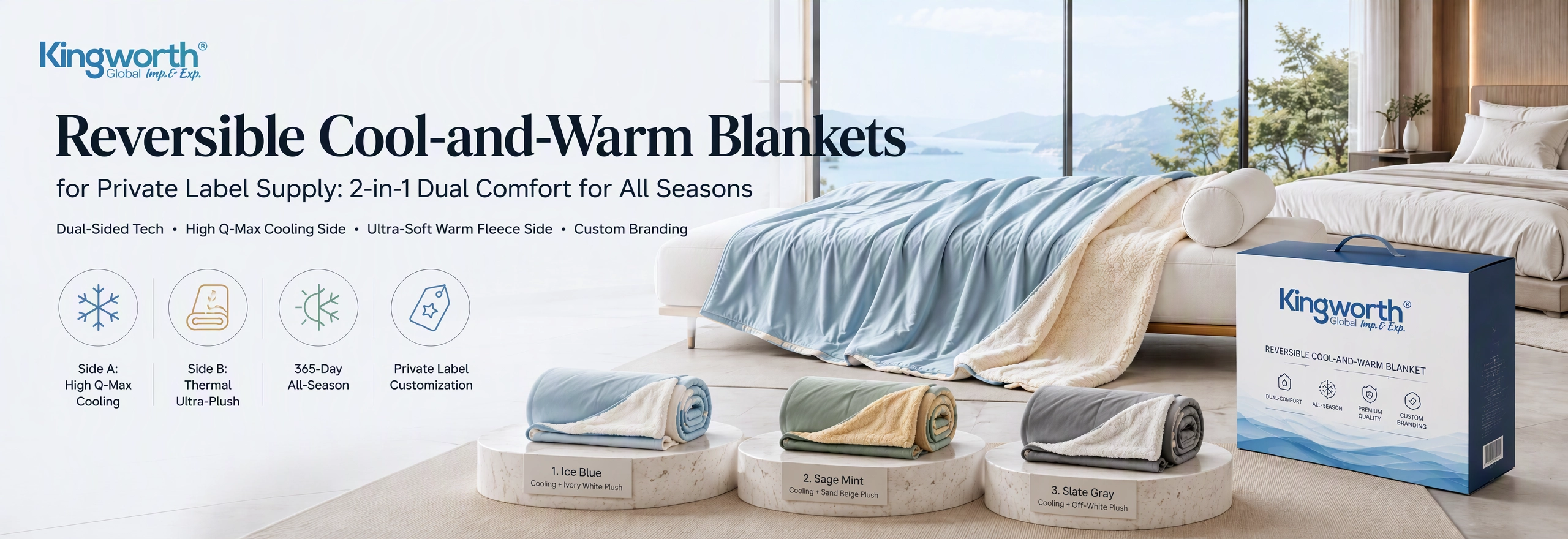
Reversible Cool-and-Warm Blanket for Private Label Supply
A reversible cooling blanket gives home textile brands, homeware retailers, gift wholesalers, and import distributors an opportunity to offer two different fabric experiences in one product. One side is designed around a cooling-touch fabric concept, while the reverse side uses a different textile surface for everyday comfort. For private label buyers, the value lies not only in the reversible design but also in verified fiber composition, consistent fabric joining, reliable finishing, clear care instructions, and packaging that supports seasonal retail campaigns.
Kingworth, a Ningbo-based comfort product manufacturer and export supplier, supports B2B product development through OEM and ODM discussions, sample review, specification coordination, branded packaging, quality inspection, and shipment coordination. Our P050 reference product is a double-sided cooling blanket and pillowcase set featuring a cooling side made from 80% mica nylon and 20% PE Arc-Chill Pro cooling fabric, paired with a reverse side made from 100% cotton. The blanket measures 51 x 67 inches.
For buyers evaluating a reversible cooling blanket or cooling summer throw, this guide explains how to assess the two fabric sides, define the intended use, confirm size and fabric-weight requirements, inspect seams and binding, validate touch performance after washing, and plan private label packaging for different sales seasons.
1. What Is a Reversible Cooling Blanket?
A reversible cooling blanket is designed with two different fabric surfaces so that users can choose which side feels more suitable for their immediate comfort preference. In a double-sided product, the two surfaces may differ in fiber composition, texture, hand feel, and intended use. This creates a practical merchandising opportunity for retailers who want to present one blanket as a versatile home comfort product.
However, reversible does not automatically mean that the product actively regulates temperature, heats or cools on demand, or maintains a fixed temperature in every environment. The experience depends on the fabric construction, room conditions, skin contact, bedding layers, and the individual user. Product descriptions should explain the verified material characteristics without promising automatic temperature control.
How the Two-Sided Design Works
In Kingworth’s P050 reference, the cooling side uses a fabric composition identified as 80% mica nylon and 20% PE Arc-Chill Pro cooling fabric. The reverse side is identified as natural 100% cotton. The combination gives the product two distinct textile surfaces that can be presented for different comfort preferences and merchandising messages.
For buyers, the most important distinction is that each side should be documented separately. A general statement such as double-sided cooling fabric would not adequately explain the construction of a product in which the two sides use different compositions.
- Cooling side: Confirm the exact composition, surface finish, touch characteristics, and any substantiated cooling-performance information.
- Reverse side: Confirm the cotton composition, fabric construction, texture, and care requirements.
- Joining construction: Inspect how the two sides are connected, including seams, edges, corners, and binding where used.
- Finished blanket: Verify the overall dimensions, appearance, labels, and approved packaging.
Why Reversible Blankets Appeal to Private Label Buyers
A reversible cooling blanket can help a retailer build a product story around material choice and everyday versatility. Rather than requiring a shopper to choose between two separate blanket designs, the reversible format offers two fabric experiences within one finished item.
For homeware retailers, the design can be displayed with either surface facing up. For gift wholesalers, the two-sided concept can be explained through a product card or packaging insert. For e-commerce brands, close-up photographs of both surfaces and the connecting edge can help customers understand the actual product before ordering.
2. P050 Product Specifications and What Buyers Should Confirm
Before placing a private label order, buyers should distinguish the information already documented for the reference product from specifications that still require confirmation. This is particularly important when a brand wants to create multiple sizes, fabric weights, colors, or packaging formats under one product family.
| Product attribute | Current P050 reference information | Confirmation needed for a private label order |
|---|---|---|
| Product type | Double-sided cooling blanket and pillowcase set | Final set configuration and individual component quantities |
| Blanket dimensions | 51 x 67 inches | Final tolerance and measurement method |
| Cooling-side composition | 80% mica nylon and 20% PE Arc-Chill Pro cooling fabric | Final approved material declaration and supporting documentation |
| Reverse-side composition | 100% cotton | Approved fabric specification and labeling wording |
| Cooling-related information | Product description mentions Japanese Q-Max greater than 0.4 | Applicable test report, test method, tested fabric, and conditions before making a performance claim |
| Care instructions | Machine wash with a laundry net bag; do not tumble dry, dry in direct sunlight, bleach, or iron | Final care-label wording and confirmation for the approved production version |
| Packaging | Color box packaging | Artwork, box dimensions, labeling, barcode, and final pack configuration |
| Sample timing | Reference profile lists 5–7 days | Current schedule based on sample requirements and material availability |
The available product profile does not confirm additional blanket dimensions, alternative fabric-weight versions, the exact pillowcase dimensions, or the pillowcase fiber composition. These details should be verified before they are advertised as standard options.
3. Document the Fiber Composition of Each Side Separately
Accurate material disclosure is a central requirement for private label sourcing. When a blanket uses two different fabrics, the technical specification should identify each side independently rather than describing the complete product with a vague material label.
Cooling Side: Composition and Performance Information
For P050, the documented cooling-side composition is 80% mica nylon and 20% PE Arc-Chill Pro cooling fabric. Buyers should preserve this information in the product-development record and confirm the final wording that will appear on packaging, care labels, and online listings.
The product profile also mentions a Japanese Q-Max value greater than 0.4. A numerical performance claim should be used in marketing only when the supplier can provide applicable supporting documentation. Buyers should verify which fabric was tested, the test method, the test conditions, and whether the reported result applies to the material alone or the finished product.
Q-Max is associated with the maximum heat flux measured during initial contact between a material and a measuring surface under a defined test method. It can help describe an initial cool-touch sensation, but it does not by itself establish that a blanket actively cools a room, maintains a particular body temperature, or delivers the same result under all conditions.
Reverse Side: Cotton Composition
The P050 reference identifies the reverse side as 100% cotton. This can support a product story centered on a natural cotton surface, provided the final production specification and labeling documentation confirm the composition.
Buyers should also avoid assuming that cotton automatically means warmer, cooler, softer, or more durable in every situation. The perceived experience depends on the fabric construction, yarn, finish, thickness, ambient conditions, and how the blanket is used.
Request a Side-by-Side Material Specification
A useful specification sheet should include the following information for each fabric side:
- Fiber composition and approved material wording.
- Fabric identification and construction details where available.
- Color reference and surface appearance.
- Applicable fabric weight or thickness, if measured and specified.
- Care requirements and any relevant test results.
- Performance claims that have supporting documentation.
This information helps purchasing teams compare quotations accurately and gives designers and marketing teams a reliable basis for product-page content.
4. Warm-Side and Cool-Side Uses Without Overstated Claims
A reversible cooling blanket can be positioned around different fabric preferences rather than guaranteed temperature outcomes. Buyers should describe the cooling side as a surface designed for a cool-touch experience when that description is supported by the material specification. The cotton reverse can be positioned as an alternative fabric surface for users who prefer its texture and feel.
Using the Cooling Side
The cooling side may be presented for warm-weather use, summer lounging, sofa relaxation, or other settings where customers prefer a cooler-feeling textile surface. Actual comfort will vary with room temperature, humidity, contact conditions, clothing, bedding, and individual sensitivity.
For e-commerce listings, use clear close-up images and explain which side contains the cooling fabric. Avoid suggesting that the blanket uses powered cooling, automatically adjusts its temperature, or guarantees a specific reduction in body temperature unless those features have been independently established.
Using the Cotton Reverse
The cotton side offers an alternative surface for customers who prefer the feel of cotton. It may be suitable for everyday relaxation at home, sofa use, or layering according to the customer’s comfort preference. Whether it feels warmer or cooler than the other side will depend on the product construction and use conditions.
Instead of describing the cotton side as an automatic warming system, brands can use more accurate language such as an alternative cotton surface for everyday comfort. This wording communicates the product’s versatility without creating an unsupported performance expectation.
How to Explain the Reversible Benefit to Shoppers
- Identify the cooling side and cotton side in product photographs.
- Use close-up images to show the surface texture of both fabrics.
- Explain the composition of each side using verified material information.
- Describe the product as offering two fabric experiences rather than automatic temperature control.
- Provide the actual blanket dimensions and care instructions.
5. Size and Fabric-Weight Variants for Wholesale Programs
Retailers may want a reversible cooling blanket in multiple dimensions or fabric weights to address different price points and display needs. These can be explored during OEM or ODM development, but they should not be treated as existing standard variants until the manufacturer confirms feasibility and the relevant samples are approved.
Blanket Size Planning
The documented P050 blanket measures 51 x 67 inches. Buyers should use this as the current reference dimension and specify whether they intend to retain it or investigate another size for a new project.
When developing additional dimensions, consider how the finished size affects the product’s visual proportions, drape, packing volume, and retail positioning. Any change should be documented with an agreed measurement method and acceptable tolerance.
Fabric Weight and Thickness
Fabric weight can affect perceived substance, drape, package volume, and the overall hand feel of a textile product. However, the available P050 information does not specify a confirmed range of alternative fabric weights or thicknesses.
For a new development, buyers should clarify whether they mean the weight of each fabric separately, the combined fabric construction, or the finished blanket weight. These are different measurements and should not be used interchangeably.
| Development parameter | Buyer requirement | Supplier confirmation |
|---|---|---|
| Blanket size | Target length and width | Feasibility, finished dimensions, and tolerance |
| Cooling-side fabric weight | Preferred target if applicable | Available construction and measurement basis |
| Cotton-side fabric weight | Preferred target if applicable | Available construction and measurement basis |
| Finished product weight | Target or acceptable range | Sample result and agreed tolerance |
| Packaging size | Retail display and shipping requirements | Pack dimensions and carton configuration |
A Customizable product program should be based on agreed specifications rather than assumptions about what can be changed without affecting performance or cost. The final configuration should be recorded in the approved sample and production documents.
6. Fabric Joins, Seams, and Binding Inspection
The connection between two fabric sides is a key part of a reversible blanket’s construction. Even when both surfaces look attractive, poor joining or inconsistent edge finishing can affect the appearance and handling of the finished product.
Inspect the Joining Construction
Buyers should request clear photographs of the product edges, corners, and joining areas. A physical sample is useful for checking whether the two sides are aligned, whether the edge finish looks consistent, and whether the finished blanket matches the approved reference.
The exact seam and binding method should be confirmed for the product under development. Buyers should not assume that every reversible blanket uses the same construction or that a particular binding treatment is available on every material combination.
Key Inspection Points
- Side alignment: Check that the two fabric layers are joined consistently and do not show obvious unintended displacement.
- Seam consistency: Look for skipped stitches, uneven stitching, loose threads, or other visible defects.
- Edge finishing: Confirm that binding or other edge treatments match the approved sample.
- Corner appearance: Review the corners for neatness, bulk, and consistent finishing.
- Surface condition: Inspect both sides for pulls, stains, fabric damage, and visible irregularities.
- Reversible presentation: Confirm that both sides can be displayed as intended without exposing unintended construction details.
For private label supply, these checks should be translated into clear acceptance criteria. Words such as premium finishing or high quality are less useful than a reference sample, documented inspection points, and an agreed process for handling defects.
7. Touch Testing and Performance After Washing
Initial touch is an important part of a cooling blanket’s retail appeal, but a single touch assessment cannot establish all aspects of product performance. Buyers should evaluate the fabric before and after the approved care procedure and document any changes in hand feel, surface appearance, dimensions, or construction.
Assess the Two Sides Before Washing
During sample review, examine each side separately under comparable conditions. Record the initial surface feel, visible texture, fabric alignment, and overall appearance. If a cooling-touch claim is planned, ensure that the claim is supported by relevant test evidence rather than relying exclusively on subjective impressions.
Touch evaluation can still be useful for comparing samples. For a more consistent review, use the same sample-conditioning approach, handling method, and assessment criteria when comparing different versions or suppliers.
Follow the Documented Care Instructions
The current P050 reference instructions specify machine washing with a laundry net bag. They also state not to tumble dry, dry in direct sunlight, bleach, or iron. These instructions should be reviewed against the approved production version before final labels and packaging are released.
Buyers should not assume that a different washing temperature, drying method, or cleaning product is suitable without confirmation. A change in material or construction may affect whether existing care guidance remains appropriate.
Record Changes After Washing
| Evaluation area | What to inspect |
|---|---|
| Dimensions | Compare the finished length and width before and after the agreed care procedure. |
| Surface feel | Record any noticeable change in the touch characteristics of each side. |
| Appearance | Check for visible surface changes, discoloration, pilling, or other defects. |
| Joining and binding | Inspect seams, edges, and corners for loosening, distortion, or damage. |
| Fabric alignment | Check whether the two sides remain aligned and the product retains its intended shape. |
| Performance claims | Use the appropriate test method if the brand intends to make a measurable cooling-performance claim after washing. |
Any wash-performance statement should be based on the actual test procedure and results. If a brand wants to claim that the cooling effect remains unchanged after a specified number of wash cycles, the claim should be supported by a suitable test plan and documented results for the relevant product version.
8. Seasonal Display Ideas for One Reversible Model
A reversible cooling blanket can support different merchandising presentations without necessarily requiring a separate product for every seasonal campaign. Retailers can change which side faces outward, adjust the surrounding display, and adapt product messaging to the intended shopping occasion.
Summer Homeware Display
For a summer display, present the cooling side prominently and use close-up photography to communicate its texture. Product cards can identify the cooling-side composition and explain the intended cool-touch experience in measured language. A neutral or light visual environment may help shoppers focus on the material surface without suggesting a performance claim that has not been substantiated.
Everyday Comfort and Gift Displays
For a general home comfort or gift-oriented display, show both sides in the same visual presentation. One image can feature the cooling side, while a second reveals the cotton reverse. This approach makes the reversible construction easy to understand and helps buyers explain the product’s value at the point of sale.
Online Product Page Presentation
- Use a main image that clearly identifies the product as reversible.
- Add separate close-up images of the cooling side and cotton reverse.
- Include an image of the edge or binding to demonstrate the finished construction.
- Display the actual blanket dimensions and verified fabric composition.
- Present care instructions in a readable format.
- Use lifestyle images to illustrate suitable home settings without implying unverified temperature-control performance.
These merchandising methods can help retailers communicate the product’s two-sided design while keeping product information consistent across wholesale catalogs, e-commerce listings, and physical retail displays.
9. Private Label Packaging for the Same Reversible Model
Packaging should help the customer identify the product, understand its two-sided construction, and follow the correct care instructions. For Kingworth’s P050 reference, the available profile lists color box packaging. Alternative package designs should be reviewed as project-specific options rather than assumed standard configurations.
What Packaging Should Communicate
For a reversible cooling blanket, the retail package can identify the cooling side and cotton reverse, list the verified material composition, state the blanket dimensions, and provide approved care instructions. If the product is sold as a set, the package should clearly identify the included components and their confirmed specifications.
The P050 reference is described as a blanket and pillowcase set, but the available profile does not establish the exact pillowcase dimensions, composition, or complete set configuration. Those details should be confirmed before they appear on the package or product page.
Packaging Development Checklist
- Confirm the final retail package format and dimensions.
- Approve artwork, logos, color references, and product photography.
- Verify all material and performance claims against available documentation.
- Confirm the blanket and pillowcase details for the final set configuration.
- Check care instructions, barcode placement, and product identification.
- Review the actual packed sample before bulk packaging begins.
- Confirm carton configuration and shipping requirements for the intended channel.
A gift-oriented package may prioritize presentation, while an e-commerce package may need to balance visual appeal with shipping protection. The appropriate solution depends on the buyer’s channel, product positioning, and agreed packing requirements.
10. Limits on Label, Color, and Pattern Development
Private label buyers often want to customize more than the logo. They may also want a new color palette, a branded package, an exclusive pattern, or a different fabric combination. These requests should be evaluated individually because the feasibility of each change depends on the materials, production process, design requirements, and order conditions.
Brand Labels and Artwork
Branding discussions can include label placement, care-label information, hangtags, packaging artwork, and other approved identification elements. Before production, the buyer should confirm the final artwork, wording, dimensions, and placement. Any fiber or care statements must match the approved product specification.
Color and Pattern Limits
Additional colors or patterns may require material sourcing, sample development, and approval. Buyers should not assume that every color reference can be reproduced identically across different materials or that a proposed pattern can be applied without affecting the appearance of the finished product.
For the reversible construction, it is particularly important to confirm whether a requested pattern or color change applies to the cooling side, the cotton reverse, or both. Each side should have its own approved reference where necessary.
What to Confirm Before Approving Customization
- Which elements are standard and which require development.
- Whether the requested label, pattern, or color is feasible for the selected construction.
- Whether the material composition or care instructions will change.
- Whether a revised sample is needed before bulk production.
- Whether packaging artwork and product photography must be updated.
- Whether the change affects cost, order quantity, or production schedule.
These questions should be resolved during the development stage. A written approval record helps prevent differences between the intended design and the final goods.
11. OEM and ODM Supply Process with Kingworth
Kingworth supports B2B buyers looking to develop comfort products for wholesale, private label, and export channels. For a reversible cooling blanket project, the most efficient process begins with a defined product brief and continues through sample evaluation, specification approval, packaging confirmation, and agreed quality checks.
Step 1: Share Your Product Brief
Provide the intended sales market, target customer, preferred dimensions, material preferences, branding direction, packaging requirements, and expected order quantity. If you have a reference product or an existing technical sheet, share it to clarify the target construction.
Step 2: Review Materials and Construction
Confirm the cooling-side composition, cotton-side specification, joining construction, finished dimensions, and relevant performance information. For the P050 reference, the documented blanket dimensions and side compositions provide a starting point for this discussion.
Step 3: Evaluate the Sample
Review the sample for fabric feel, visual consistency, side alignment, seams, binding, dimensions, and overall appearance. Identify any required revisions and ensure that the final sample represents the product intended for bulk production.
Step 4: Confirm the Technical and Packaging Documents
Finalize the BOM, material wording, dimensions, tolerances, care instructions, labels, artwork, packaging, and inspection requirements. Where performance claims are planned, identify the evidence needed to support them.
Step 5: Agree on Production and Inspection Requirements
Confirm the commercial terms, order quantity, production schedule, approved specification, and applicable inspection criteria. During final inspection, compare the goods and packaging against the agreed requirements before shipment coordination.
This approach helps create a clear record for the purchasing team and supports more consistent communication between product development, quality control, and logistics.
12. How Wholesale Buyers Can Evaluate a Supplier
Choosing a supplier for a reversible cooling blanket requires more than comparing the quoted unit price. Buyers should evaluate whether the manufacturer can explain the two-sided construction, document the material composition, coordinate sample revisions, and provide clear inspection and packaging requirements.
Supplier Evaluation Checklist
- Can the supplier provide the composition of each fabric side separately?
- Are the blanket dimensions and material specifications documented?
- Can the supplier explain the joining and edge-finishing construction?
- Is the cooling-related information supported by applicable test documentation?
- Are the care instructions appropriate for the approved product version?
- Can the supplier coordinate sample review and record the final approval?
- Are label, color, pattern, and packaging requirements confirmed before production?
- Are the commercial terms, schedule, inspection requirements, and shipment responsibilities agreed in writing?
For private label programs, the best supplier is one that can support a transparent development process and help buyers distinguish confirmed product characteristics from options that still need testing or approval.
13. Related Product Categories and Accurate Keyword Positioning
Buyers researching a cooling summer throw may also explore other comfort blanket categories, including weighted blankets and knitted blankets. However, these categories should not be treated as interchangeable. A reversible cooling blanket is defined by its two-sided fabric concept, while a weighted blanket is defined by its weighting construction and a knitted blanket by its textile structure.
Reversible Cooling Blankets
This category is relevant to shoppers and buyers seeking two different fabric surfaces within one product. The product description should identify the two sides, their confirmed compositions, the dimensions, and the approved care instructions.
Bead-Free Weighted Blankets
The term bead free weighted blankets refers to a different product characteristic. It concerns whether separate beads or similar loose weighting components are used and how the blanket achieves its weight. It should not be used to describe the P050 reversible cooling blanket unless its actual construction supports that classification.
Cotton Knit Weighted Blankets
The term cotton knit weighted blankets combines material, construction, and weighting concepts. It is relevant to buyers researching knitted weighted products but is not a synonym for a reversible cooling blanket. A brand should only use it when the actual product has a knitted construction, the verified cotton composition, and the corresponding weighted design.
Keeping these categories distinct improves product accuracy and helps wholesale buyers find the product that matches their requirements. It also prevents a private label listing from combining unrelated keywords in a way that could confuse customers.
14. Request a Reversible Cooling Blanket Sample
If you are planning a new cooling summer throw collection or evaluating a reversible blanket for private label supply, start by confirming the intended construction, material specifications, dimensions, and packaging requirements. A physical sample can then be reviewed against the written specification before a bulk order is approved.
Kingworth’s P050 reference offers a starting point for discussion: a 51 x 67 inch double-sided cooling blanket and pillowcase set with an 80% mica nylon and 20% PE Arc-Chill Pro cooling-fabric side and a 100% cotton reverse. Additional sizes, fabric-weight variants, pillowcase specifications, and branding options should be confirmed during project development.
To discuss your sourcing requirements, contact Kingworth:
- Email: info@king-worth.com
- Phone: +86 133 3687 4040
- Location: Ningbo, Zhejiang, China
Share your target market, preferred product configuration, branding needs, and packaging concept. Our team can discuss the relevant OEM/ODM development requirements, sample review, specification confirmation, and export coordination for your project.
Frequently Asked Questions
What is a reversible cooling blanket?
A reversible cooling blanket has two fabric surfaces that provide different textile experiences. For Kingworth’s P050 reference, one side uses a cooling-fabric composition and the reverse side is 100% cotton. The exact composition, dimensions, care instructions, and applicable performance information should be confirmed for the approved version.
Does a reversible cooling blanket automatically regulate temperature?
No. Reversible construction does not by itself establish automatic temperature regulation. The product can offer different fabric surfaces, but comfort depends on the material, environment, and user. Any measurable cooling claim should be supported by appropriate documentation.
What is the size of Kingworth’s P050 cooling blanket?
The current reference profile lists the blanket at 51 x 67 inches. Alternative sizes have not been confirmed in the available product information and should be discussed as potential development requirements.
What is the fiber composition of each side?
The documented cooling side is 80% mica nylon and 20% PE Arc-Chill Pro cooling fabric. The reverse side is identified as 100% cotton. Buyers should confirm the final production specification and labeling wording before publishing material claims.
Can I order different fabric weights or dimensions?
Additional dimensions or fabric-weight variants can be discussed during OEM/ODM development, but they are not confirmed as standard P050 options. The supplier should assess feasibility, document the specification, and provide a sample for approval where required.
Can the cooling blanket be machine washed?
The current P050 reference instructions specify machine washing with a laundry net bag and advise against tumble drying, direct sunlight drying, bleaching, and ironing. Buyers should verify the final care instructions for the approved production version before printing labels or publishing product information.
Can the product be customized with a private label?
Kingworth supports OEM/ODM development discussions that may include branding and packaging. The feasibility of specific labels, patterns, colors, and packaging formats should be confirmed for the project. Final artwork and product specifications should be approved before bulk production.
What should I inspect on a reversible blanket sample?
Review both fabric surfaces, material identification, dimensions, side alignment, seams, binding, corners, visible defects, and packaging. If the product will carry cooling-performance or wash-durability claims, verify the applicable supporting test information as well.
What is the difference between a cooling blanket and a weighted blanket?
A cooling blanket is generally positioned around fabric feel and cooling-related characteristics, while a weighted blanket is designed around a specified weighting construction. Some products may combine multiple characteristics, but buyers should verify the actual BOM and construction before classifying or marketing a product.
How do I begin a wholesale or private label order?
Share your target market, intended dimensions, material preferences, packaging requirements, branding needs, and expected order quantity. The next steps are to confirm feasibility, review a sample, approve the technical specification, and agree on commercial terms and inspection requirements.